
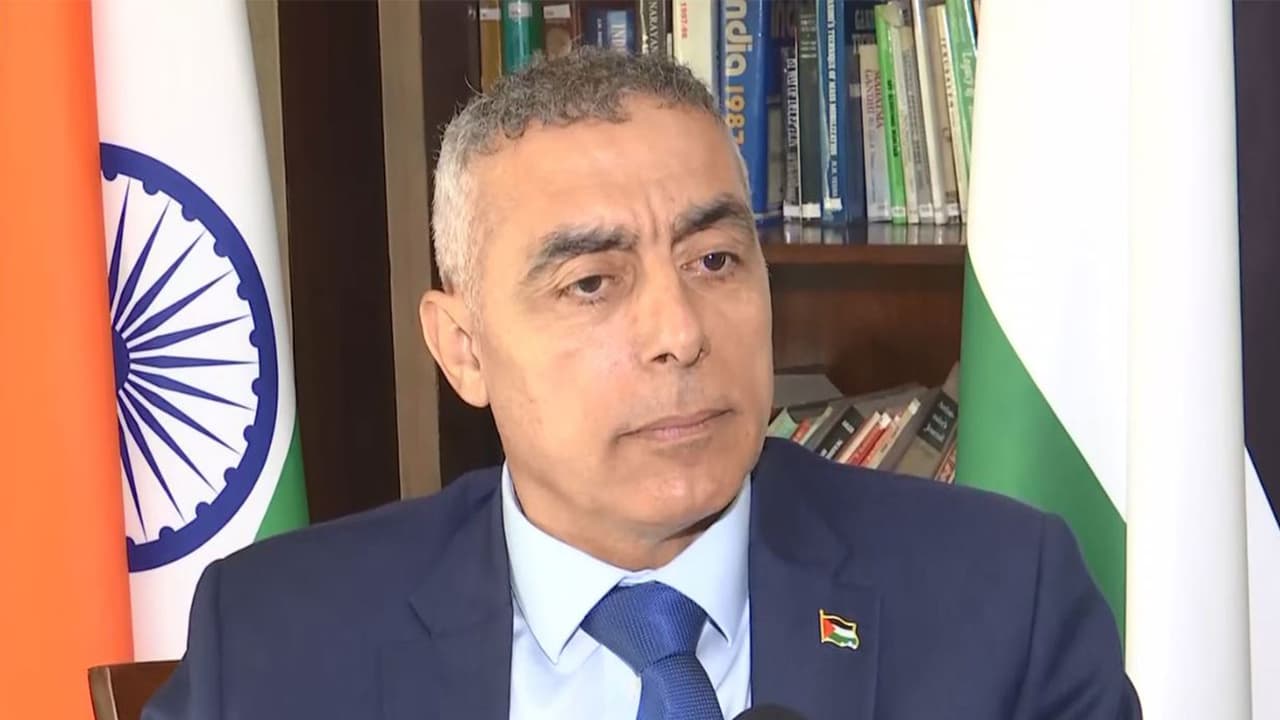
Palestine's Ambassador to India, Abdullah Abu Shawesh, urged an end to the 'devastating war' in the Middle East, stressing its global consequences and calling for a two-state solution as the only path to lasting peace in the region.
Call for End to Hostilities
Abdullah Abu Shawesh, Palestine's Ambassador to India, underscored the importance of ending hostilities in the Middle East and called for a two-state solution as the foundation for lasting peace in the region. Speaking to ANI, the diplomat highlighted the devastating impact of the ongoing conflict, stressing that its consequences extend far beyond the immediate parties involved.
"Indeed, it's not only for the Palestinian. When we talk about ending this devastating war, ending approximately 40 days of relentless bombardment from the Israeli and the American side to the Iranian country and of course from Iran to Israel and closing the strain and all of this stuff which is a devastating consequence not only for the people who is engaging in the war itself but also for the international community so that our perspective as a Palestinian this is something good for the whole international community for every single one peace lover," he said.
The diplomat emphasised that while some in Israel and the United States continue to advocate for further military action, the global community benefits from any steps toward peace. "I'm not revealing a secret when they declared themselves loud and declared this war should be continued. And many of them is talking also advocating in Israel and in America also advocating for bombing a new Iran itself. But for any single person worldwide whose belief of peace and love and belief of safe future for everyone, this is a good thing," he added.
Strategic Concerns and Hormuz Strait
Addressing strategic concerns, he spoke about the importance of the Hormuz Strait for energy security, noting that the conflict had placed the region and the international community on a delicate balance. "Indeed, when it came to this particular port, the Strait of Hormuz itself, it was open. But unfortunately, with the war that was launched by America and Israel against Iran, we found ourselves as international community, as all the human around the world was hanged... Iran is used this leverage, might be the only one of the most significant leverage at its hand to close or to not allow them the crossing of this strait as it was before the war."
Impact on Palestinian Territories
He also condemned the continued violence in Palestinian territories, citing recent casualties and ongoing restrictions at religious sites. "The war affected every single one, in particular, of course, our region. In particular, we in Palestine, had been harshly and negatively affected because Israel utilized that all the cameras is turning to West Asia, to Iran, and the war in Iran, and utilised this unfortunate war to expand its settlement... Still, just yesterday, 10 Palestinians have been killed... Al-Aqsa Mosque is closed while the Jewish prayers going to Western Wall, Al-Buraq Wall, practicing their religion. But when it came to the Muslim and the Christian, it was closed."
Path to Lasting Peace
On achieving lasting peace, the diplomat insisted, "The Golden Age in the Middle East will happen when the Palestinians will enjoy justice... if there is a two-state solution. And the two-state solution needs Israel to abide by the international law. And the two-state solution, just and solution, and peace in the Middle East, needs the international community to stop treating Israel as a spoilt, jealous, stupid teenager."
He concluded by urging all parties, especially the United States, to honour commitments toward ending the conflict. "If there is a will, there is a way. And if the Americans realise that they will, they should put an end to this war... If he abides by this and there is a will, I'm pretty sure there is a way." (ANI)
(Except for the headline, this story has not been edited by Asianet Newsable English staff and is published from a syndicated feed.)