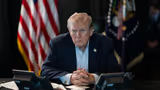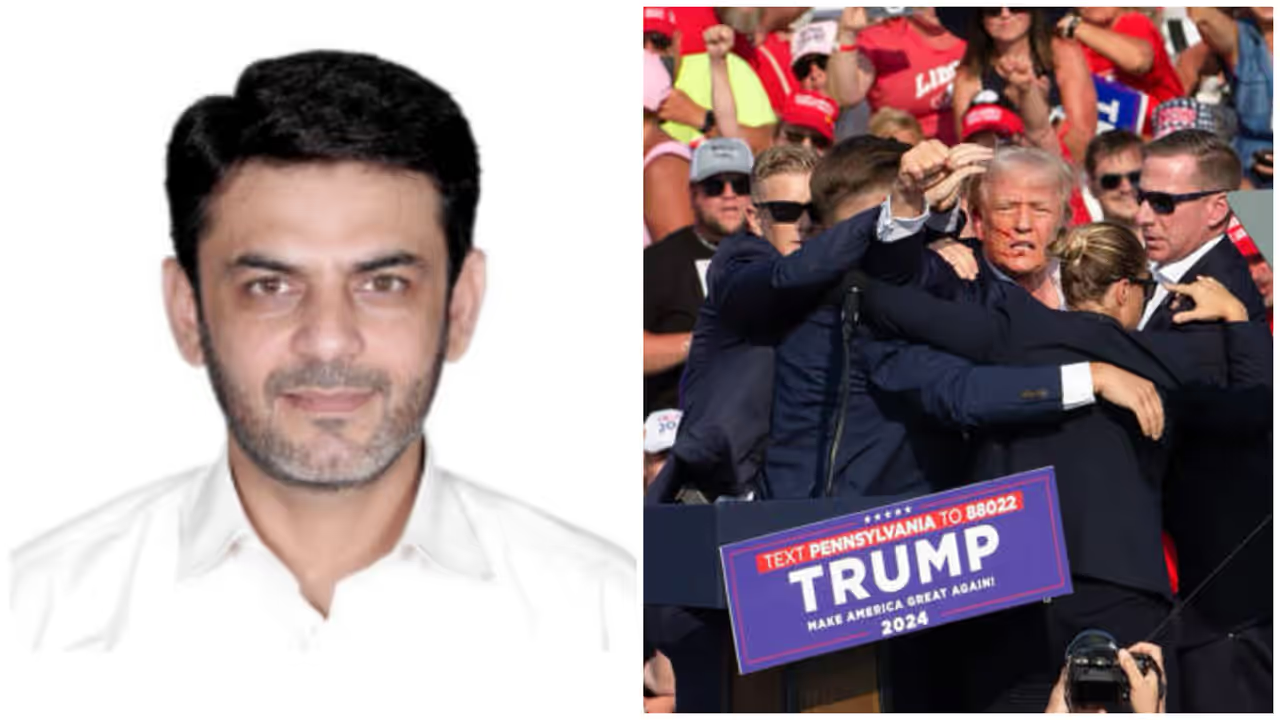
A Pakistani national accused of plotting to assassinate senior US political figures has claimed that Iranian intelligence operatives recruited him to kill President Donald Trump, his predecessor Joe Biden and former UN ambassador Nikki Haley.
A Pakistani national accused of plotting to assassinate senior US political figures testified on Wednesday that Iranian intelligence operatives recruited him to kill President Donald Trump, his predecessor Joe Biden and former UN ambassador Nikki Haley, according to The New York Times.
Asif Merchant, who faces terrorism and murder-for-hire charges in Federal District Court in Brooklyn, testified in his own defense. He told the court that he never intended to carry out the plan and believed from the beginning that the operation was doomed to fail.
“I was not wanting to do this so willingly,” Merchant, wearing a gray sweater over a light-blue shirt, said in clear, enunciated Urdu, with a translator by his side.
Related Articles

The alleged plot, according to prosecutors, involved recruiting hitmen, stealing sensitive documents, staging protests and potentially assassinating political figures in the United States. But the supposed contract killers Merchant ultimately contacted were actually undercover FBI agents, bringing the alleged conspiracy to an abrupt halt.
Merchant told the jury he was never given direct instructions to kill a specific person. However, he said that during multiple discussions in Tehran, his Iranian handler mentioned three high-profile political figures: Trump, former President Joseph R. Biden Jr. and Nikki Haley, the former governor of South Carolina.
US-Israel vs Iran
The trial unfolds at a volatile geopolitical moment, with tensions between Iran, the United States and Israel escalating dramatically. The United States and Israel have recently launched a sweeping bombing campaign against Iran.
On Wednesday, Defense Secretary Pete Hegseth said an American strike had killed the leader of the Iranian covert unit that schemed to assassinate Trump in 2024. The Trump administration has said that Iran’s efforts to kill Trump were one reason behind the bombing campaign.
Prosecutors allege that Merchant was operating under the direction of Iran’s Revolutionary Guards Corps, which they say has long sought revenge for the killing of Maj. Gen. Qassim Suleimani. The powerful Iranian commander, widely considered the architect of Iran’s regional security network, was killed in a US drone strike on January 3, 2020.
During the trial, prosecutors presented jurors with images allegedly retrieved from Merchant’s Facebook account depicting Trump’s decapitated head and another image showing the former president next to a pig.
Who is Asif Merchant?
Merchant described himself as an experienced businessman who had worked in banking before venturing into several businesses including banana exports, car sales and importing glass fiber insulation. He eventually joined his uncle’s garment business.
Merchant has five children with two wives - one in Pakistan and another in Iran. He said he met his Iranian wife during a religious pilgrimage to Karbala in Iraq, one of the holiest cities for Shiite Muslims.
According to his testimony, his involvement with Iranian officials began in late 2022 through a cousin who introduced him to a man named Mehrdad Yousef, whom he described as a member of the Revolutionary Guards Corps.
“He asked me if I was interested in doing some work with the Iranian government, and I said yes,” Merchant said.
Initially, the work involved transferring money to Iran through the hawala system, an informal and often illegal financial network commonly used to bypass international sanctions.
But when Merchant expressed interest in launching a garment business in the United States, Yousef allegedly suggested he travel there to recruit individuals sympathetic to Iran’s cause. He was even trained in basic counter-surveillance tactics, including methods to detect hidden cameras in airports.
By March 2024, Merchant said, the mission had evolved into something far more sinister. During a meeting in Iran, his handler instructed him to search for criminals particularly those linked to the “Mafia” to carry out a multi-layered operation.
The plan, according to his testimony, included four elements: organising protests, stealing documents, laundering money and possibly arranging a killing.
Merchant clarified that when he referred to the “Mafia,” he meant small-time criminals as understood in Pakistan, not members of Italian organised crime.
Despite his fears, he claimed he agreed to continue because he was worried about the safety of his wife and adopted daughter living in Iran.
In April 2024, he travelled to the United States and arrived in Houston, where his uncle lives. His entry raised suspicions among immigration officials, who detained him for hours, searched his belongings and examined his electronic devices.
They questioned him about his recent trip to Iran.
That moment, Merchant said, convinced him that the plan was already compromised.
He believed he was being monitored by American authorities but continued the operation out of fear that Iranian security forces were watching him as well.
To maintain appearances, he said he searched online for locations of Trump rallies and even sent reports back to his handler in Iran, all while expecting his arrest to come sooner or later.
“I did not think I was going to be successful,” he testified.
The alleged plot ultimately unraveled due to a man Merchant believed was a friend, Nadeem Ali, who turned out to be an FBI informant.
Federal prosecutors, however, strongly reject Merchant’s explanation. In a court filing, they argued there was no evidence that he acted out of fear for his family or under duress.
During cross-examination, prosecutor Nina Gupta pressed Merchant on whether he knew he was working with a designated terrorist organization.
He acknowledged that he did.
She also asked whether he knew he was being recorded when he allegedly sketched details of the assassination plot on a napkin in a hotel room in Queens.
He said he had not.
Merchant was eventually arrested in Richmond, Texas, on July 12, 2024, before being transported to New York to face trial.
After his arrest, he claimed he attempted to cooperate with US authorities and hoped to apply for a green card. He also wanted to explore the possibility of bringing his family from Iran to the United States.
But those discussions collapsed.
“It appeared they thought I was some kind of super spy,” he said.
Also read: Cracks Within Hezbollah? Reports Suggest Elite Radwan Unit Acting Independently