
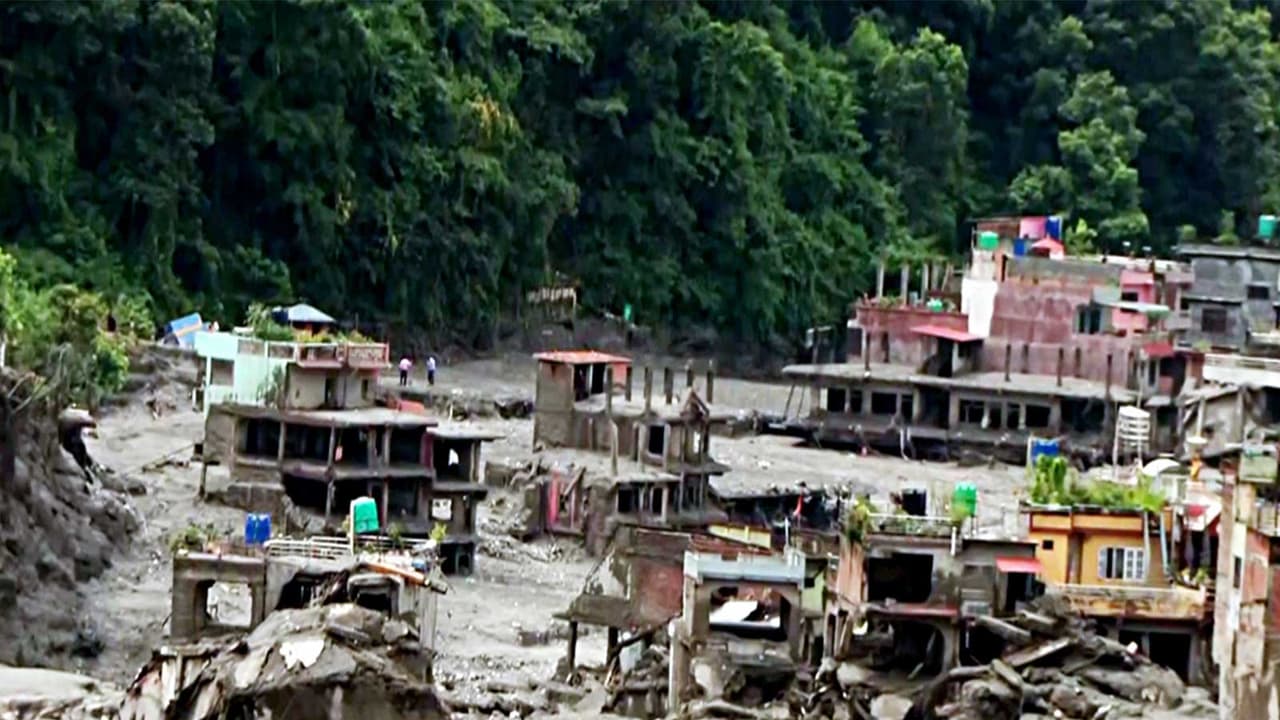
Nepal has formed a seven-member expert committee to investigate the origin and cause of the Tibet-Nepal floods. The panel has two months to submit its report, which will include recommendations for protecting hydropower infrastructure from future disasters.
Nepal has formed a seven-member expert committee to determine the origin, cause and sequence of events behind the Tibet-Nepal floods, which has a deadline of two months to submit its report.
Nepal’s Ministry of Energy, Water Resources, and Irrigation on Wednesday formed the committee under the coordination of Devesh Belbase, an expert on water policy and governance, to investigate the issue. The committee comprises hydrologist Narendra Man Shakya, glaciologist Rijan Bhakta Kayastha, remote-sensing expert Uttam Babu Shrestha, geologist Meghraj Dhital, hydropower infrastructure expert Hari Pandit, and disaster-risk reduction expert Anil Pokharel.
Investigation Mandate and Methodology
“The committee will conduct field studies from the potential origin of the flood through the Bhotekoshi/Lhende river system to the downstream areas,” ministry spokesperson Mohan Kumar Shakya told ANI.
“The investigation will cover not only the flood’s scientific origin and sequence of events but also how hydropower and other energy infrastructure can be protected from similar disasters in the future.”
As per the official, drones, satellite imagery, and other technologies will be used as necessary during the study.
“The committee will study the event not simply as a case of extreme rainfall or flooding, but as a ‘cascading disaster’ in which Himalayan, geological, and hydrological hazards may have been activated sequentially,” Shakya added.
Preliminary Study and Recommendations
Days after the disaster hit the Himalayan Nation, a preliminary study by the Center for Hydrology and Water Resources Research pointed out insufficient scientific evidence to establish where the flood originated, what physical processes triggered it, and how those processes spread downstream through the Bhotekoshi-Lhende river system. The centre recommended a comprehensive scientific investigation of the entire sequence of events before attributing the disaster conclusively to climate change.
Protecting Critical Infrastructure
Drawing lessons from the damage to energy infrastructure, the committee will recommend measures for risk preparedness and ways to maintain electricity generation and system operations even during natural disasters.
Three-Phase Investigation Plan
The Ministry has planned to conduct the study in three phases, as per the officials.
Phase One: Damage and Chronology
The committee at first will be examining the chronology of events and physical damage in areas from the high Himalayan region through the Bhotekoshi/Lhende river system and downstream areas. Along with this, the committee will also examine the interrelationship between glaciers, rock and soil-slope instability, landslides, debris, river flow, and flooding.
Phase Two: Causal Analysis
In the second phase, the committee will identify the immediate and underlying physical causes of the flood. In potential source areas, the team of experts will study rock conditions, cracks, weak geological formations, slope stability, the possibility of landslides, and the amount and characteristics of sediment that entered the river.
Phase Three: Climate Change Impact
In the third phase, the committee will scientifically assess the extent to which human-induced climate change contributed to the likelihood or intensity of these hazards or helped create the conditions preceding the event. This will involve analysing rainfall, temperature, snowfall, melting of snow, river flow, and long-term weather and climate trends before the event.
Data and International Cooperation
For the study, the Energy Ministry also has planned to incorporate scientific and hydrological information available from the Chinese side into the investigation. “Where necessary, mechanisms for scientific cooperation and data sharing will be developed,” Shakya said.
Distinction from Past Disasters
A World Weather Attribution study of the extreme rainfall, floods, and landslides that occurred in Nepal from September 26-28, 2024, had previously pointed to effects associated with human-induced climate change. However, the current event may have been different in nature, so it will not be directly compared with the 2024 disaster, the ministry said. Instead, the investigation will be based on evidence specific to the new event. (ANI)
(Except for the headline, this story has not been edited by Asianetnews Editorial staff and is published from a syndicated feed.)