
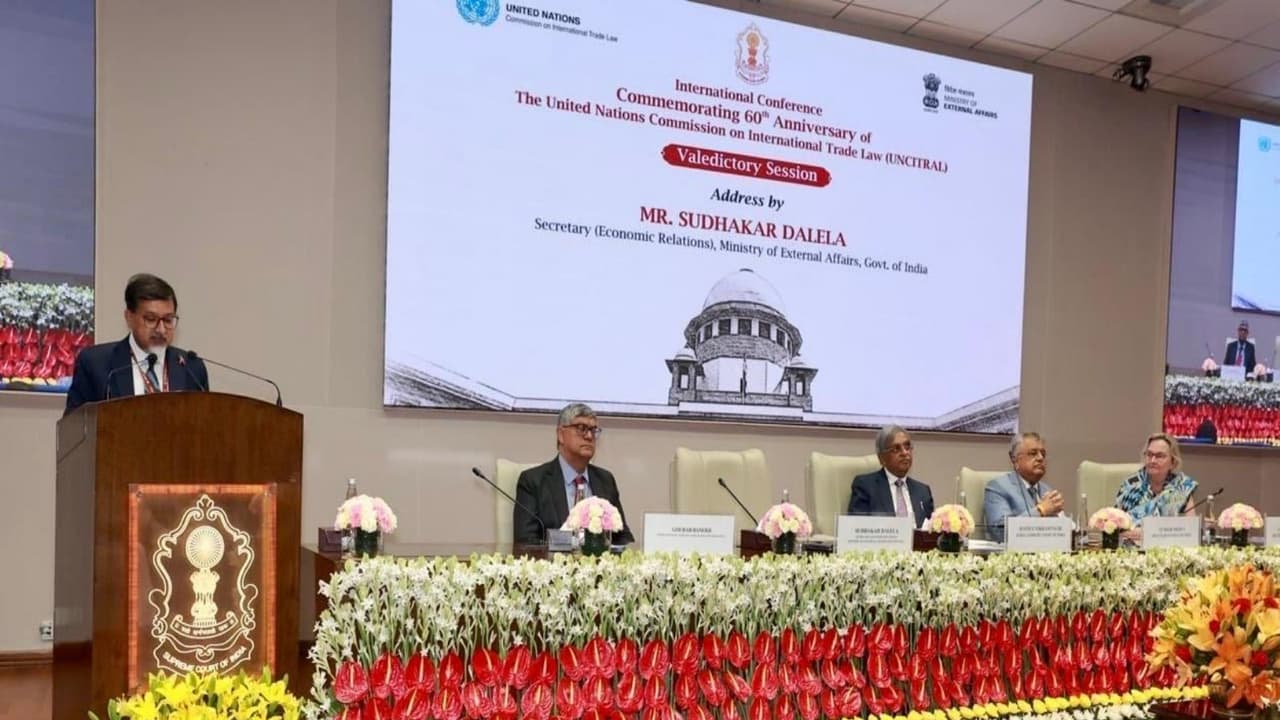
The MEA highlighted India's contribution to international trade law at the 60th anniversary of UNCITRAL. EAM S Jaishankar called for a harmonised, rules-based legal architecture to ensure predictability and resilience in global commerce.
The Ministry of External Affairs (MEA) on Sunday said the international conference marking the 60th anniversary of the United Nations Commission on International Trade Law (UNCITRAL) was "a fitting occasion to reflect on India's contribution" to the development of international trade law.
In a post on X, MEA spokesperson Randhir Jaiswal said Secretary (Economic Relations) Sudhakar Dalela participated in the valedictory session of the conference, which was co-hosted by the Ministry of External Affairs, the Supreme Court of India, and UNCITRAL. Secretary (Economic Relations) @SudhakarDalela participated in the valedictory session of the international conference, co-hosted by MEA with the Supreme Court of India and United Nations Commission on International Trade Law (UNCITRAL), to mark the 60th Anniversary of UNCITRAL.… pic.twitter.com/KZNUIsEi3j — Randhir Jaiswal (@MEAIndia) July 26, 2026
"It was a fitting occasion to reflect on India's contribution and collaboration with UNCITRAL in the development of international trade law," the MEA said in the post.
Jaishankar Calls for Rules-Based Legal Architecture
Earlier on Friday, External Affairs Minister S Jaishankar called for a harmonised, rules-based legal architecture to safeguard global trade against growing geopolitical volatility, supply chain disruptions, and rapid technological shifts.
Delivering the inaugural address at an international conference commemorating the 60th anniversary of the United Nations Commission on International Trade Law (UNCITRAL), Jaishankar emphasised that in today's transforming global landscape, nations are seeking legal predictability above all else.
"Today's world is witnessing unprecedented geopolitical volatility, supply chain disruptions, rapid technological shifts," Jaishankar told the gathering of international delegates, jurists, and legal experts.
"And these developments are affecting how goods, services, capital, and data move across borders, exposing businesses and governments to risks for which no country can be resilient in isolation."
Addressing the evolving dynamics of international trade, the minister stressed that legal development cannot remain insulated from changing global realities. He noted that standardised legal frameworks are critical to keeping cross-border flows moving reliably amidst systemic uncertainty.
"What nations are seeking is not just infrastructure and connectivity, but most of all legal predictability," Jaishankar asserted.
"They are looking for harmonized, rules-based architecture that ensures the trades, data flows and contracts enforcement are seamless across borders and continents. With harmonized legal frameworks, efficient dispute-resolution mechanisms, and greater certainty in cross-border transactions, that UNCITRAL in particular is advancing, trade and cross-border commerce can remain resilient even amidst all these disruptions."
A More Inclusive Future
Looking toward the future, Jaishankar pointed to the shifting global economic centre of gravity, insisting that tomorrow's legal architecture must become more democratic, inclusive, and attuned to the needs of developing nations.
UNCITRAL, established by the United Nations, plays a central role in promoting the harmonisation and modernisation of international trade law by developing legislative and non-legislative instruments to facilitate cross-border trade and investment. (ANI)
(Except for the headline, this story has not been edited by Asianetnews Editorial staff and is published from a syndicated feed.)