
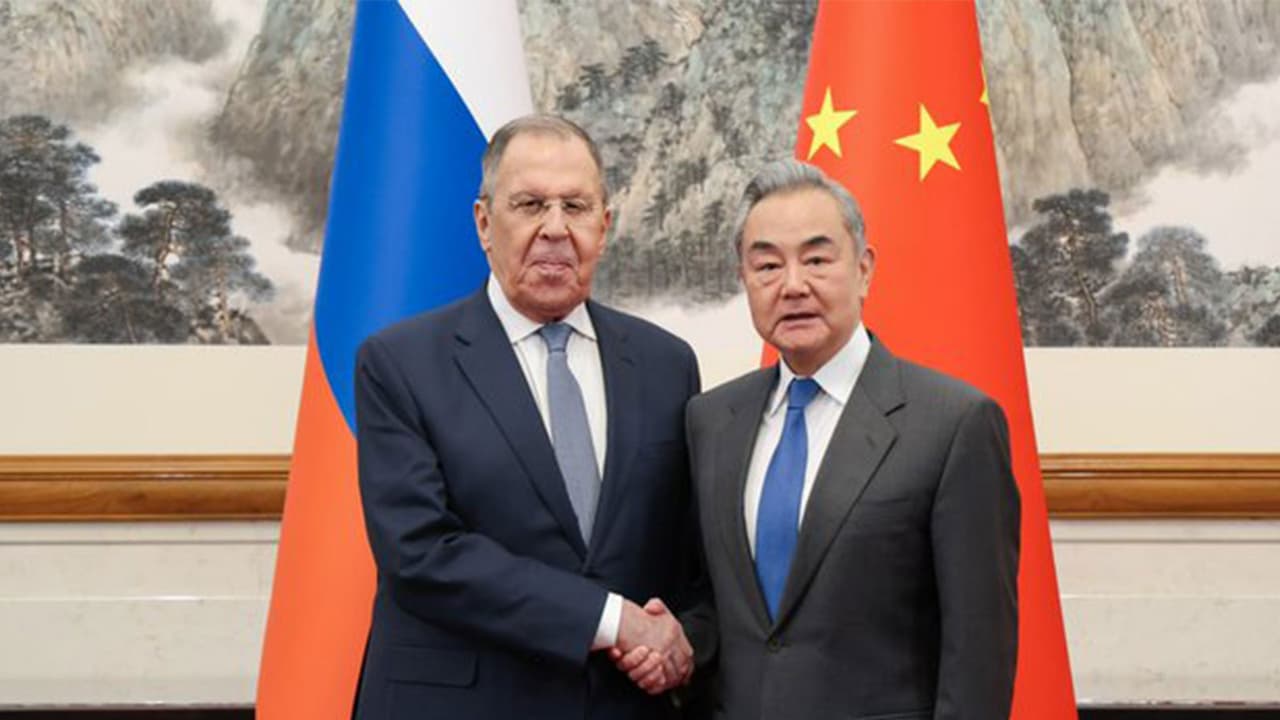
Amid escalating global tensions, Russian Foreign Minister Sergey Lavrov and Chinese counterpart Wang Yi met in Beijing, reaffirming their 'no-limits' partnership and coordinating responses to Western policies on Ukraine, West Asia, and Taiwan.
Amid the West Asia crisis and a tightening US naval blockade in the Strait of Hormuz, Russian Foreign Minister Sergey Lavrov and Chinese Foreign Minister Wang Yi on Tuesday met in Beijing, marking their first in-person meeting this year. The discussions come amid escalating geopolitical tensions across multiple regions, including Ukraine, West Asia, Taiwan Strait, and the Korean Peninsula.
Opening the talks, Lavrov underscored the continuity of dialogue between the two sides, noting that while this was their first face-to-face meeting of the year, they had already maintained "several telephone conversations" that were "always substantive and detailed." "This is our first in-person meeting this year, although we have already had several telephone conversations. They are always substantive and detailed."
He added confidence that both sides would continue high-level exchanges throughout the year to prepare for further decisions ahead of upcoming leadership engagements between Russian President Vladimir Putin and Chinese President Xi Jinping. "I do not doubt that we will have many more opportunities to speak again this year and thus prepare additional decisions ahead of new contacts between our Leaders. These contacts are already scheduled."
Lavrov Slams West, Cites Global Crises
The meeting underscored the growing strategic "no-limits" partnership between the two superpowers as they navigate a volatile global landscape and coordinate their responses to Western interventionism in the Middle East. During his opening remarks, Lavrov said the global order was facing "the most serious trials," pointing to crises in Latin America, Venezuela, and Middle East.
On the Ukraine Crisis
He further claimed that the Ukraine conflict had been "manufactured" by Western nations and was now being used to justify the creation of a new "aggressive bloc" in Eurasia aimed against Russia. "The Ukrainian crisis, which the West sought to manufacture artificially in order, as it claimed, to inflict a 'strategic defeat' on Russia, is now being used, above all by the Europeans, to begin hatching plans for the creation of a new aggressive bloc in the west of the Eurasian continent."
On Destabilising Developments in Asia
Lavrov also raised concerns over what he described as destabilising developments in Asia, including tensions over Taiwan, the South China Sea, and the Korean Peninsula. He warned that longstanding cooperative frameworks in the ASEAN-centred space were being undermined by bloc politics. "Attempts are being made to dismantle it by creating small-group and bloc-based structures to contain both China and Russia."
Moscow, Beijing to Deepen Security Cooperation
Reaffirming alignment between Moscow and Beijing on regional and global security frameworks, Lavrov said both sides would focus on practical cooperation linked to Chinese President Xi Jinping's Global Security Initiative and Russian proposals for a broader Eurasian security architecture led by President Vladimir Putin. "Our vast continent as a whole requires constant attention. I am confident that today we will be able to discuss in practical terms our concrete steps."
Wide-Ranging Agenda
Lavrov concluded by describing the meeting as timely and expressing readiness for "concrete and productive work." The talks between Lavrov and Wang Yi are expected to cover bilateral cooperation, coordination in multilateral forums such as the United Nations, BRICS, SCO, G20, and APEC, and ongoing consultations on major international conflicts, including Ukraine and the Middle East.
(Except for the headline, this story has not been edited by Asianet Newsable English staff and is published from a syndicated feed.)