
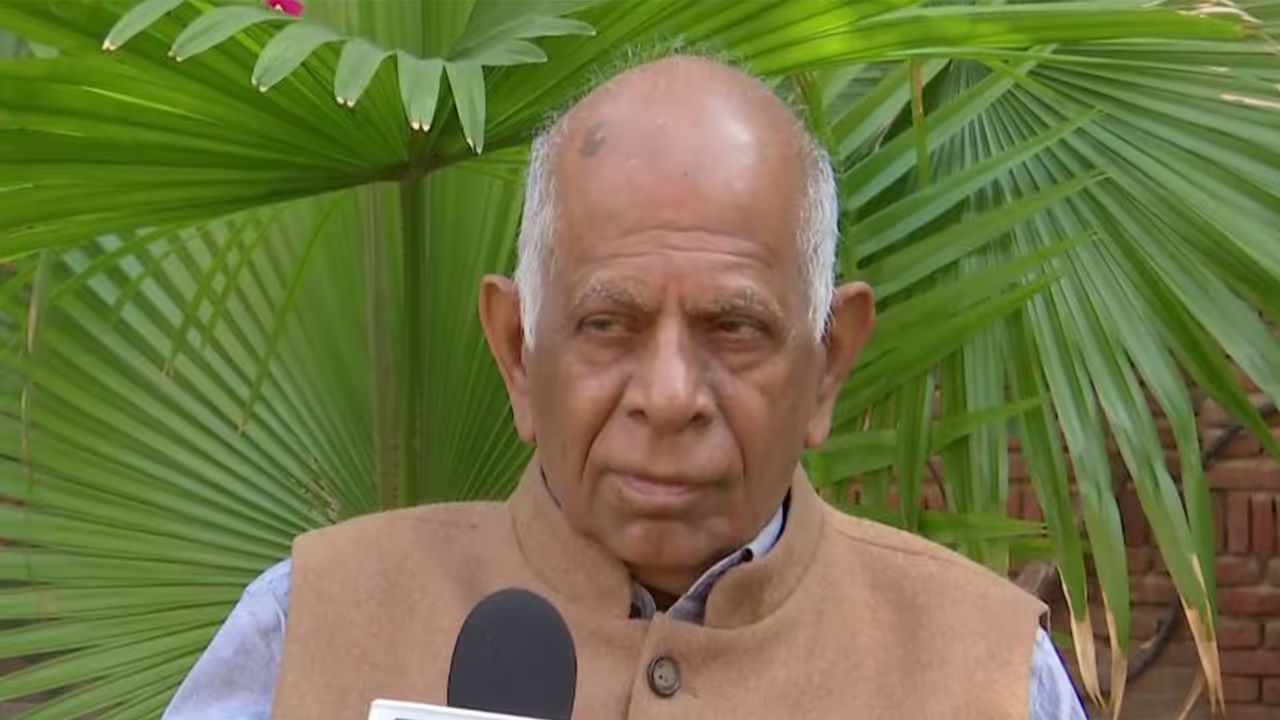
Amid rising West Asia tensions, former diplomat K P Fabian says Iran is playing a strategic 'chess game'. He notes Tehran's careful diplomacy, blames the US and Israel for initiating conflict, and highlights the impact on regional energy.
Amid rising tensions in West Asia, recent developments have once again placed Iran, Israel, and the United States at the centre of global attention. Former Diplomat K P Fabian says that Tehran's strategic moves are being closely watched internationally, particularly following attacks on nuclear and energy facilities.
Iran's Diplomatic Chess Game
"First Iran said that Strait of Hormuz is open for everyone, ships belonging to America and Israel are open. And I think Iran will repeat this. Because you know that Japanese Prime Minister was in the White House," Fabian noted, highlighting Iran's careful diplomatic maneuvering. Japan's PM Sanae Takaichi was on an official visit to the US recently, in which she met with US President Donald Trump at the White House and later told reporters she had briefed Trump on what support Japan could provide under its laws.Trump had earlier called on Japan and other countries to help reopen the Strait of Hormuz that Iran has closed in retaliation for the US-Israeli attacks.
Meanwhile Fabian noted that discussions between Iran and Japan reportedly paved the way for the release of two Japanese nationals previously detained in Iran. "One was released by Iran and the other will also be released. This means that Iran plays such a chess game that there be another announcement. Look, they are open. Only America and Israel," the diplomat added, emphasising the calculated nature of Tehran's actions.
No Immediate Nuclear Threat Detected
International monitoring agencies have also weighed in on the situation. "Secretary of National Automic Energy Agency, IAEA has tweeted that the missile attack news reported and the nuclear research centre has any sign. Also, according to no unknown radiation level has been found," the former diplomat said, noting that there were no immediate nuclear threats detected despite the attacks.
Historical Context and First Strike
Reflecting on regional history, the diplomat recalled the Suez Canal crisis of 1956, underscoring the long-standing complexities in the region: "Britain, Israel, or France conspired. When Israel attacks Egypt, France and Britain will withdraw. But Egypt is the Egyptian territory. At that time, France, Israel and America had information. When the American president got the Israel said, stop it. But Israel did stop. The American president said, let's this is now radiation, but before that, Israel attacked Natan's nuclear facility. It means that Israel started first. Iran only retaliated. This is very important."
Humanitarian Concerns
Highlighting the humanitarian aspect, Fabian stressed the irony of the attacks occurring during Eid. "Eid is of peace Now, on that day to do such a thing shows how much hatred is there in people's minds, which is very, very sad. People are going mad," he said.
Impact on Regional Energy
The regional energy situation has also been affected. "Our condition is not good. You know there is a shortage LPG. Qatar, from which we have a big contract because of Iran's attack, the production capacity has been brought down by 17 percent and Qatar has made it clear it is going to lose about 20 billion dollars yearly and it will take a couple of years for it to restore the full production capacity," he noted.
Geopolitical Picture: US and Israel 'Started This'
Addressing the broader geopolitical picture, he underscored that Israel and the US initiated the recent tensions: "The big picture is that there was a conversation between Prime Minister Modi and Iranian President Pesach Kyan. And the Iranian President has made it very clear that Iran is urging India to speak out at the BRICS chair. It is Israel and America who started this."
Iran's Nuclear Commitments and US Influence
Regarding Iran's nuclear commitments, Fabian said, "Iran agreed to zero enrichment, zero stockpiling of nuclear material, down blend the uranium, and never ever to seek a nuclear weapon." He criticized the US response, noting, "Now why didn't he do it? Because he was under the influence of Netanyahu. Now, that is most unfortunate. The tail is wagging the dog." (ANI)
(Except for the headline, this story has not been edited by Asianet Newsable English staff and is published from a syndicated feed.)