
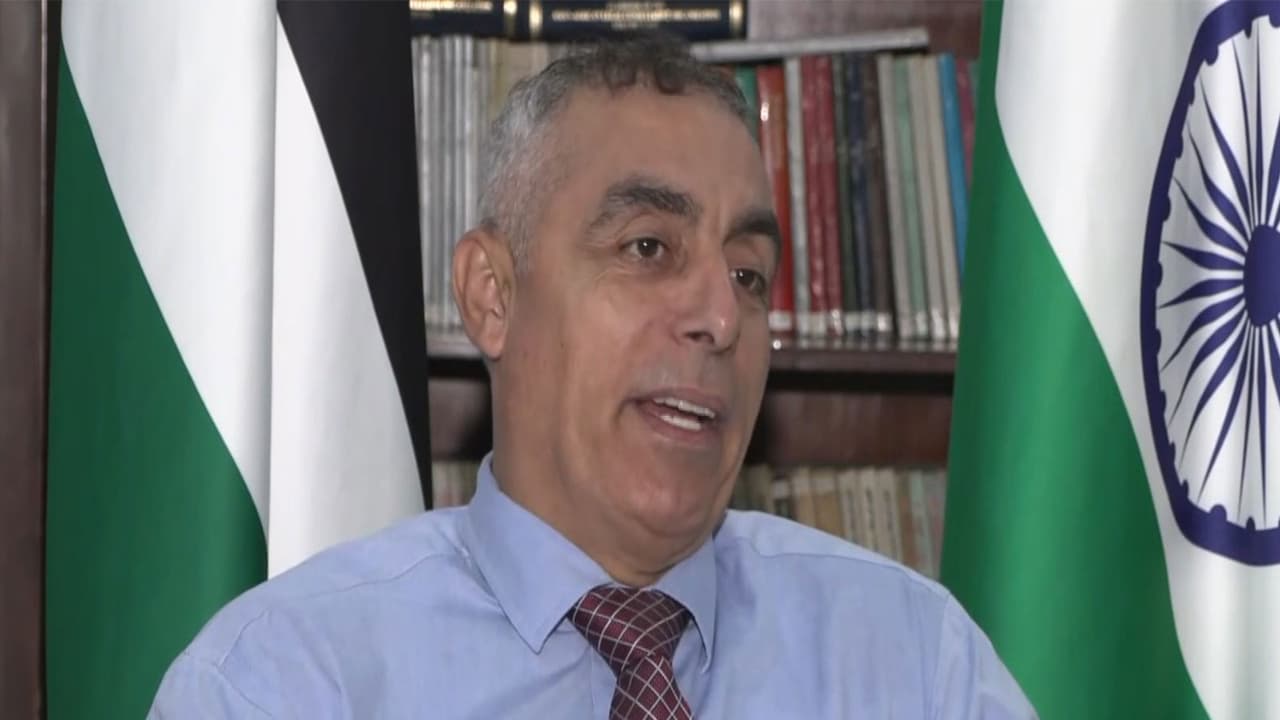
Palestinian Ambassador Abdullah Abu Shawesh expressed confidence that India is uniquely positioned to play a major role in promoting global peace, specifically in mediating the escalating regional conflict involving Israel and Iran and restoring stability.
Palestinian Ambassador to India Abdullah Abu Shawesh on Friday expressed firm confidence that India is uniquely positioned to play a major role in promoting global peace, specifically in mediating the escalating regional conflict involving Israel and Iran. Speaking to ANI, Abu Shawesh highlighted India's geopolitical standing and stated that New Delhi could make a meaningful contribution toward restoring stability to West Asia.
India's Pivotal Role in Global Peace
"India stands first and foremost. I believe India can play a pivotal role, certainly regarding the situation with Israel and in fostering global peace. Therefore, I hope India will stand firm and play a significant part. I am fully confident that India is capable of this and can make a meaningful contribution in this regard; at the very least, regarding our specific situation, India can once again play a crucial role," the Envoy stated.
Skepticism Over Ceasefire Durability
While commenting on the prospects of a potential peace agreement between the United States and Iran, the Palestinian diplomat expressed deep reservations regarding the durability of any ceasefire or diplomatic breakthrough involving Israel. "All of us hope that stability will be maintained in the Middle East and will prevail across the globe as well. I am certain that Israel will leave no stone unturned to ensure that this war resumes very soon," Abu Shawesh cautioned.
His remarks coincided with his attendance at events relating to the ongoing state funeral ceremonies of Iran's late Supreme Leader Ayatollah Ali Khamenei. Abu Shawesh extended his condolences for the massive loss of life across the region, adding: "Unfortunately, thousands of Iranians have lost their lives, and this is a tragic situation. We must also recall the incident in October 2023, when Israel killed over 500 Palestinians. We must remember these events, and certainly, we must remember everyone who has lost their life--whether Israeli, Palestinian, Iranian, or anyone else."
Conflict's Historical Lens and Gaza Crisis
Reflecting on the humanitarian disaster in Gaza, Abu Shawesh urged observers to look past recent months and examine the conflict through a broader historical lens. The diplomat referenced his newly circulated article, 'October 7: One Thousand Days Later', which uses the core "W" journalistic queries--why, what, who, where, and when--to deconstruct the crisis. He sharply critiqued narratives that analyse the region solely through the lens of recent events. Abu Shawesh described this as a flawed framework that acts "as if everything began on October 7 itself, as if nothing existed before it--no occupation, no bans, no annexation, and nothing after it should be considered." He stressed that the current phase of the war is an intensification of a crisis dating back to 1917 and 1948.
"In Gaza, a large majority of people are descendants of refugees, with many born in refugee camps, including myself... The situation has steadily deteriorated over decades, becoming worse and worse with time," he said, citing widespread starvation used as a weapon of war and the near-total collapse of daily living conditions. (ANI)
(Except for the headline, this story has not been edited by Asianet Newsable English staff and is published from a syndicated feed.)