
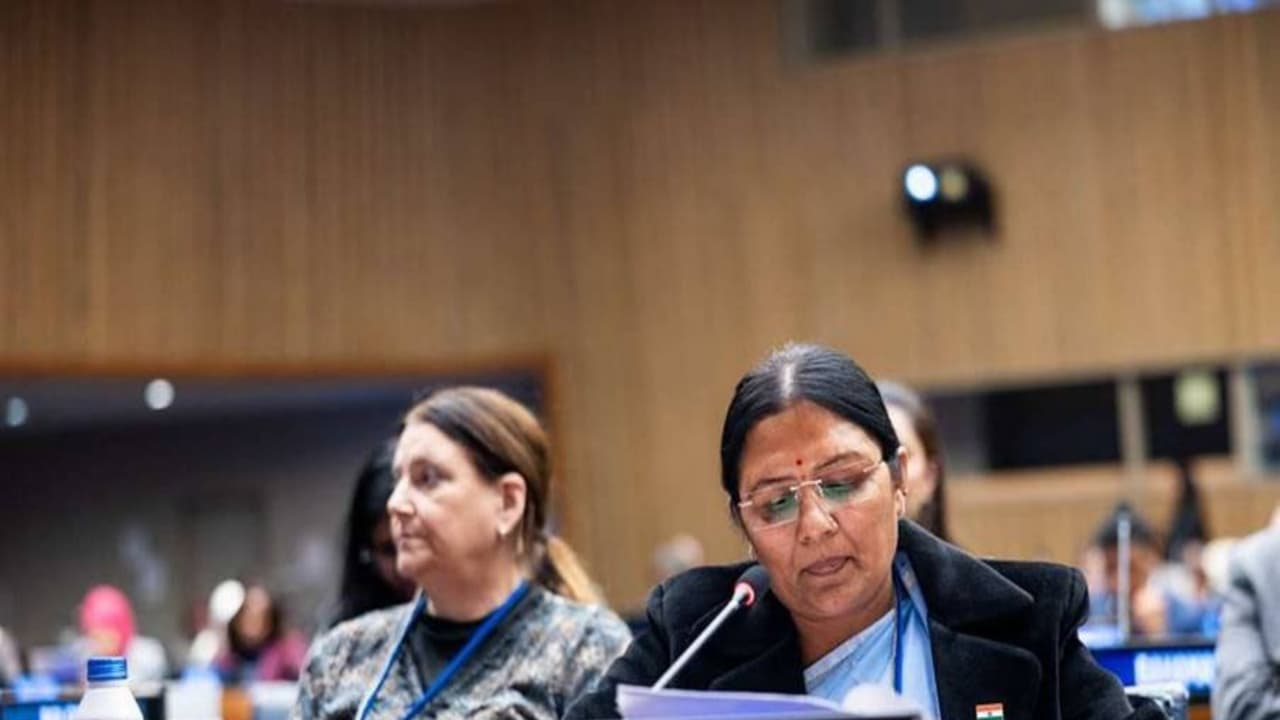
An Indian delegation at the 64th UN CSocD session, led by MoS Savitri Thakur, reiterated its commitment to social justice. Thakur highlighted the 'Sabka Saath, Sabka Vikas' principle and the Viksit Bharat 2047 vision for social development.
An Indian delegation led by Union Minister of State for Women and Child Development Savitri Thakur, reaffirmed its commitment to inclusive and rights-based social development at the 64th Session of the Commission for Social Development (CSocD).
India's Vision for Social Justice
Delivering India's national statement, Thakur emphasised that social justice and social protection in India are rooted in constitutional guarantees and aligned with the country's long-term vision of Viksit Bharat 2047. She highlighted the guiding principle of 'Sabka Saath, Sabka Vikas', reflecting a whole-of-government and whole-of-society approach to ensure that no one is left behind.
Key National Initiatives
The Union Minister of State outlined key national initiatives demonstrating scale, inclusion and last-mile delivery. These include parity in girls' and boys' participation in education, supported by improved school infrastructure and residential schooling in remote areas. There has also been large-scale expansion of basic services, including piped drinking water, clean cooking energy and sanitation facilities, with significant benefits for women and vulnerable communities, she said.
She pointed to transformative financial inclusion through hundreds of millions of bank accounts, with women emerging as leading beneficiaries of entrepreneurship and credit schemes.
Nationwide protection and support mechanisms for women and children have been established through dedicated helplines and integrated service centres.
Comprehensive maternal, child health and nutrition programmes are reaching over 100 million beneficiaries.
Expanded social security and targeted schemes cover the elderly, persons with disabilities, unorganised workers and transgender persons.
Leveraging Digital Infrastructure
India also highlighted the role of digital public infrastructure and Direct Benefit Transfers (DBT) in enhancing transparency, efficiency and accountability in public service delivery.
Call for Global Cooperation
Emphasising that global challenges require collective responses, India expressed support for strengthened multilateral cooperation, capacity building and South-South collaboration to accelerate progress on social development models.
UN Session Overview
The 64th session was presided over by the chair of the commission, Ambassador Khrystyna Hayovyshyn, Permanent Representative of Ukraine to the UN. Deputy Secretary-General of the UN Amina J Mohammed, President of the General Assembly Annalena Baerbock, President of ECOSOC and Permanent Representative of Nepal Ambassador Lokbahadur Thapa, ASG (Policy Coordination) DESA Bjorg Sandkjaer, and Chair of the NGO Committee on Social Development Gillian D'Souza-Nazareth addressed the session.
The session witnessed participation from over 100 UN member states.
(Except for the headline, this story has not been edited by Asianet Newsable English staff and is published from a syndicated feed.)