
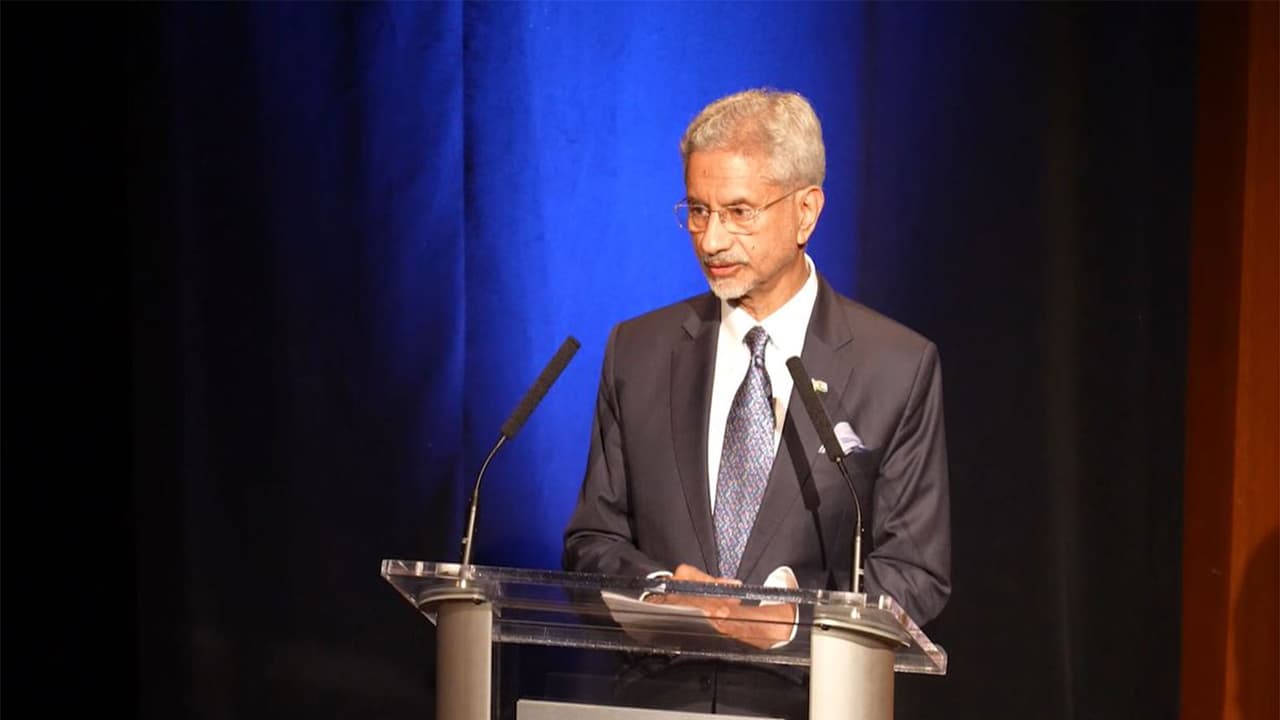
EAM S Jaishankar has observed that India-China bilateral ties are 'better' and returning to normalcy as border issues are resolved. He stated this follows a period where ties went 'off-track' after the 2020 military impasse on the border.
India-China Relations Returning to Normalcy
External Affairs Minister S Jaishankar has observed that bilateral ties between India and China are "better" today compared to preceding years, noting that the relationship is returning to a state of normalcy as outstanding border issues are progressively resolved. Speaking on Monday during a conversation hosted by the Asia Society in New York, EAM Jaishankar addressed the recent trajectory of India-China relations, which have seen improvements following Chinese President Xi Jinping's recent visit to India for the BRICS Leaders' Summit in New Delhi.
Reflecting on the timeline of diplomatic recovery, EAM Jaishankar stated, "If you asked me, compared to where you were in 2025, is the relationship better today? I would say yes. Compared to 2024, even more so." He clarified that this positive shift did not represent a fundamental "structural change", but rather followed a period where diplomatic ties had gone "so much off-track" in the wake of the 2020 border standoff.
Highlighting the disruption caused by the prolonged military impasse, he noted, "The moment you stabilised it, it was going to improve, because after what happened in 2020 and the long standoff that we had on the border, the relationship had really been impacted." Detailing the extent of the previous diplomatic freeze, EAM Jaishankar pointed out that all "normal contacts" between New Delhi and Beijing had previously ceased, affecting official exchanges, visa issuances, and direct flights, while trade continued. Confirming the return of administrative channels, he stated, "So once the border standoff was resolved, it was natural that this would start to improve."
Diplomatic Strategy and Core Principles
Elaborating on India's diplomatic strategy, EAM Jaishankar explained that New Delhi had consistently communicated to Beijing that ongoing border friction served no mutual purpose and merely advantaged external parties. Reaffirming New Delhi's foundational foreign policy approach, he stated, "We also maintained consistently a very elementary principle of statecraft - don't get locked into a problem which benefits others." Although it required time for the Chinese administration to acknowledge this perspective, he affirmed that resolving the prolonged standoff serves the interests of both nations, noting, "To the extent there is an improvement in our relations, I think it certainly helps our position."
Furthermore, he emphasised that easing tensions with Beijing strengthened India's broader diplomatic standing globally, remarking, "Because I don't want to get totally focused to my disadvantage on one particular relationship and issue. If I can find a solution which works for me, I would rather do that."
Reiterating New Delhi's core premise guiding bilateral engagement, EAM Jaishankar stated that both nations have aligned around a fundamental maxim: "the state of the border determines the state of the relationship." Explaining the linkage between territorial stability and diplomatic health, he stated, "You can't have tension...on the border and say the relationship should be normal. So what we've had is, as the border comes back more towards normalcy, the relationship comes back more towards normalcy, and if the relationship comes back more towards normalcy, it helps both of us."
Jaishankar on Shifting Global Order
Shifting focus to broader geopolitical developments before an audience that included prominent members of the Indian-American community, EAM Jaishankar observed that the global order is transitioning "quite visibly" towards greater multipolarity. He noted that the primary global power historically serving as "the ballast" or "the shaper of the system as we know it currently" is experiencing "an erosion in alliances" and "a tendency to do it alone", influencing strategic calculations worldwide.
Commenting on the recent 'G2' summit between US President Donald Trump and Chinese President Xi Jinping in Washington, EAM Jaishankar remarked that when the world's primary and secondary economic heavyweights engage, "while they may have their points of convergence, overall they are in a competitive mode." He added, "There are limits to what the two of them can agree upon vis-a-vis the rest of the world. And that then leaves the rest of us and the rest of us are coming to terms today with a very different America, with the fact that there is also today a certain conversation taking place between America and China."
Describing how international actors are adapting to these structural shifts, EAM Jaishankar noted that governments are forging independent arrangements and pursuing "optimal solutions." Highlighting contemporary diplomatic adjustments, he asked, "How do we de-risk? How do we diversify? Which are the new partners? Where do we get more value out of an existing partnership?" Characterising the current international landscape as challenging, EAM Jaishankar observed that nations are continuously calculating, adjusting, and securing new accommodations, trends that featured prominently across discussions during the recently concluded high-level UN General Assembly week. (ANI)
(Except for the headline, this story has not been edited by Asianet Newsable English staff and is published from a syndicated feed.)