
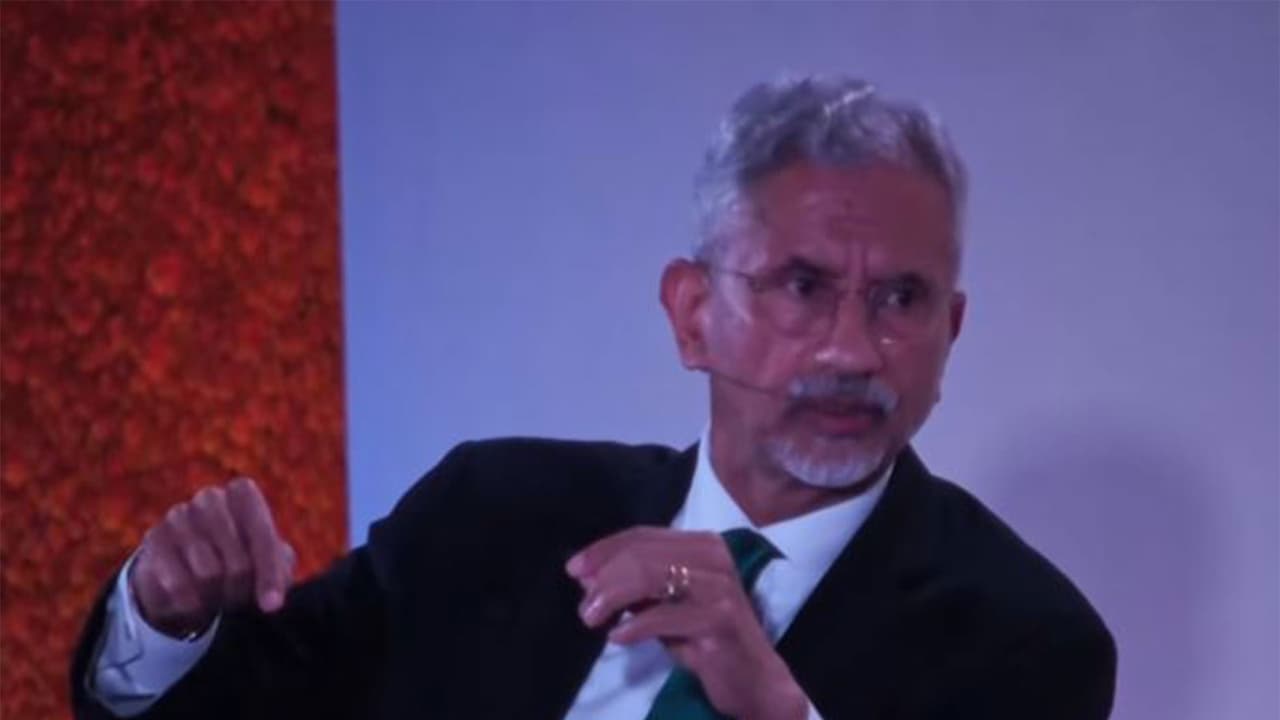
EAM S Jaishankar said India is a 'natural option' for Russia as it turns to Asia amid strained Europe ties. He stated that India's steady relations with Russia, built over decades, contribute to the balance of power and status quo in Asia.
India a 'Natural Option' for Russia
External Affairs Minister S Jaishankar on Tuesday said that India is a “natural option” for Russia as Moscow increasingly turns towards Asia amid strained relations with Europe, asserting that New Delhi's longstanding ties with Moscow have remained steady over the past eight decades and contribute to the balance of power in the region.
Speaking in conversation with John Micklethwait, Editor-in-Chief of the Bloomberg New Economy Forum, Jaishankar said that Russia's relationship with Europe had become embittered following the Russia-Ukraine war, pushing Moscow to turn increasingly towards Asia, particularly China. “I'm not disputing that... what we see clearly is today pretty much a broken, embittered relationship between Russia and Europe. Historically, Russia has always seen itself as a European country. It has always priced its relationship with Europe and also with the US... The result of what has happened because of the Ukraine war is that Russia, perforce, has turned much more to Asia. In Asia, much of that is towards China. But I do believe it's in our interest, and in the world's interest, that Russia has multiple choices and that it has other relationships in Asia of great weight and consequence,” he said.
Highlighting India's longstanding relationship with Russia, Jaishankar said New Delhi remained a natural partner for Moscow and that maintaining these ties was in the interests of both countries. “We are a natural option in that regard because we've had very decent relations with Russia from pretty much the early start... those relationships have stayed steady. What we are doing right now is we are maintaining our relationship with Russia,” he said.
The External Affairs Minister said India was reassuring Russia that despite changes in the international order and Moscow's strategic calculations, its longstanding relationship with New Delhi continued to remain steady. “In my own words, we are reassuring Russia that while we understand today the world has changed, Russia has changed, the entire strategic calculation between Russia and Europe and Russia and the West has changed... We're not even passing a value judgment on it. All we are saying is that we, by maintaining our relationship, are reassuring Russia that something which has been built up over the last 75-80 years remains steady,” he added.
Jaishankar further underlined the strategic significance of the relationship, saying it had contributed to the balance of power and the overall status quo in Asia. “It's an option that has worked for both of us. It has had a steady impact on the balance of power and overall status quo in Asia, and we think that's a good thing,” he said.
EU Intensifies Sanctions on Russia
His remarks come amid continued efforts by the European Union to increase economic pressure on Russia over the war against Ukraine. EU foreign policy chief Kaja Kallas on Monday announced nearly 1,600 sanctions listings targeting Russia's military-industrial complex and individuals linked to elections in Russian-occupied Ukrainian territories. “The main topic is war in Ukraine. We have now 1,600 listings that we are putting forward regarding the Russian military-industrial complex, but also the sham elections in Russia regarding the occupied territories of Ukraine,” Kallas said.
According to a European Council press release, the bloc adopted restrictive measures against 1,569 individuals and entities, including 826 Russian companies and 743 individuals serving as chief executive officers of those companies. The latest package brings the total number of individuals and entities listed under the EU sanctions regime supporting Ukraine's territorial integrity to nearly 4,600.
The measures target companies supplying components used in advanced Russian weapons systems, including missiles, unmanned aerial vehicles and aircraft. These components include semiconductors, microcircuits, computers, communication equipment, radar systems, aviation and missile technology, explosives, ammunition, optics and navigation systems.
The European Council said the measures were adopted in response to Russia's continued aggression against Ukraine, particularly military operations targeting civilian infrastructure and causing suffering among the civilian population. The sanctions announcement also came as Ukrainian President Volodymyr Zelenskyy had questioned Russia's intentions amid US President Donald Trump's push for an energy ceasefire. (ANI)
(Except for the headline, this story has not been edited by Asianetnews Editorial staff and is published from a syndicated feed.)