
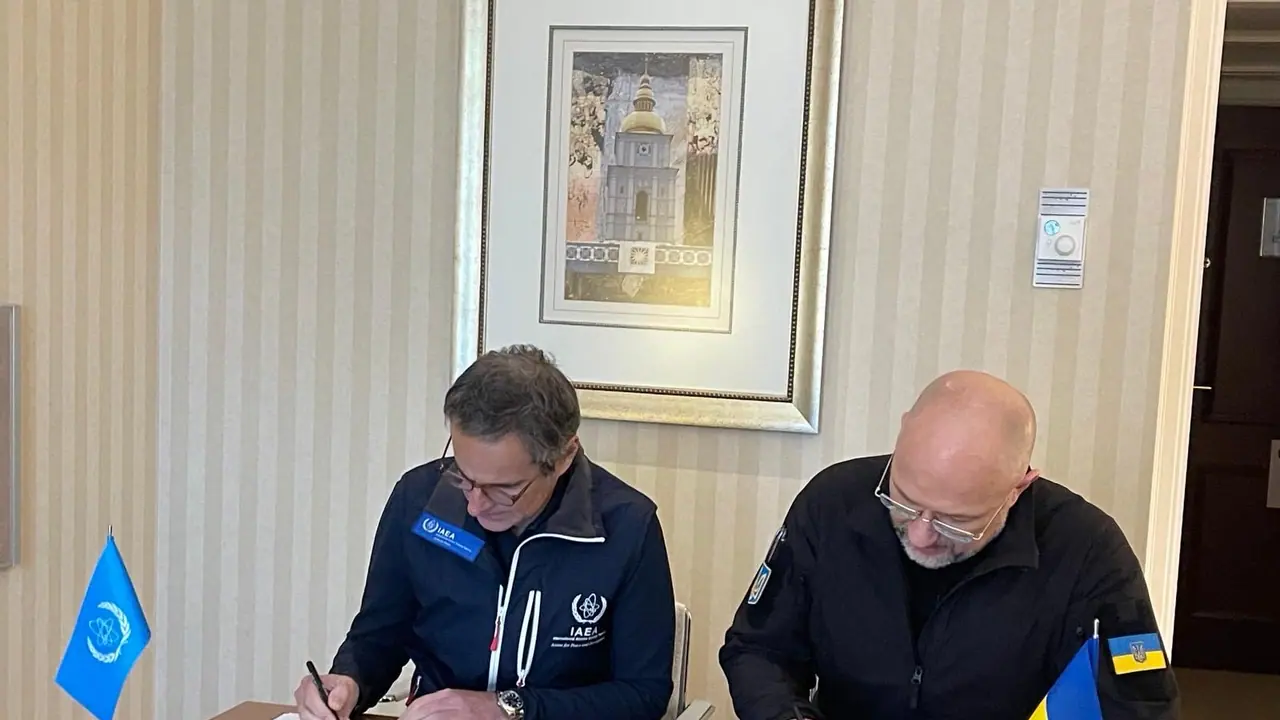
The IAEA signed an agreement with Ukraine's Energy Ministry to aid the reconstruction of its energy sector, damaged by Russia's invasion. The deal, announced on the 40th anniversary of the Chornobyl disaster, focuses on nuclear energy and safety.
IAEA and Ukraine Sign Energy Reconstruction Agreement
The International Atomic Energy Agency (IAEA) on Sunday signed an agreement with Ukraine's Ministry of Energy to support the country's energy sector reconstruction, which has sustained heavy damage due to Russia's aggression following its invasion of the country in 2022, marking 40 years since the Chornobyl nuclear disaster.
According to the Director General of the IAEA, Rafael Mariano Grossi, in a post on X, Ukraine's energy sector remains "central to the country's recovery and future", adding that the agreement was signed in Kyiv with Ukraine's Energy Minister Denys Shmyhal to bolster reconstruction efforts. "Ukraine's energy sector is central to the country's recovery and future. Marking 40 years since the Chornobyl accident, signed an agreement with Ministry of Energy of Ukraine's Denys Shmyhal in Kyiv to support Ukraine's reconstruction. It focuses on the energy sector, particularly nuclear energy, from expansion with SMRs to reconstruction of the grid and substations critical for nuclear safety, as well as support for research and applications. The IAEA will continue this work," Grossi stated in his post.
Details of Ongoing IAEA Support
He further highlighted ongoing humanitarian and technical assistance provided to Ukraine's nuclear infrastructure, including the delivery of medical support. The Director of the UN nuclear watchdog stated that the IAEA handed over four ambulances.
Till now, EUR 25 million in equipment and EUR 3 million in medical supplies have been delivered to all nuclear facilities in Ukraine since the start of the conflict. "Handed over a fourth ambulance to Ukraine today under the IAEA's Programme for Medical Assistance for Operating Personnel at NPPs in Ukraine, alongside Ministry of Energy of Ukraine's Denys Shmyhal. Since the start of the conflict, over EUR25 million in equipment has been delivered to support safe and secure operations, with nearly EUR3 million in medical supplies to all nuclear facilities, including Chornobyl NPP," Grossi stated in a separate post.
Grossi also participated in the Ukraine Energy Coordination Group event titled "40 years after Chornobyl", held in Kyiv and attended by Ukrainian Prime Minister Yulia Svyrydenko. The agreement comes as Ukraine continues efforts to rebuild and secure its energy infrastructure amid ongoing conflict, with international agencies maintaining on-ground support for nuclear safety and operational stability.
Historical Context: The Chornobyl Disaster and IAEA's Role
On 26 April 1986, the No. 4 reactor at the Chornobyl Nuclear Power Plant, then part of the Soviet Union, experienced a catastrophic failure during a low-power safety test. The test was improperly conducted, leading to a sudden loss of control that triggered an explosion and fire, which destroyed the reactor building. This resulted in the release of significant amounts of radioactive material into the atmosphere.
As safety systems were neglected, the uranium fuel inside the reactor overheated, ultimately melting through its protective barriers. In the aftermath of the disaster, the IAEA provided immediate assistance to the Soviet Union, focusing on environmental cleanup, decommissioning efforts, and radioactive waste management, while also helping to improve safety conditions at the site.
The agency collaborated with other UN bodies under the "International Chernobyl Project", which assessed the radiological impact of the accident and reviewed protective measures. Following the accident, the IAEA also helped develop two key international conventions, later adopted by member states: the Convention on Early Notification of a Nuclear Accident and the Convention on Assistance in the Case of a Nuclear Accident or Radiological Emergency. These agreements created a global framework for rapid notification, information sharing, and coordinated assistance during nuclear or radiological emergencies, with the IAEA serving as the central coordinating body. (ANI)
(Except for the headline, this story has not been edited by Asianet Newsable English staff and is published from a syndicated feed.)