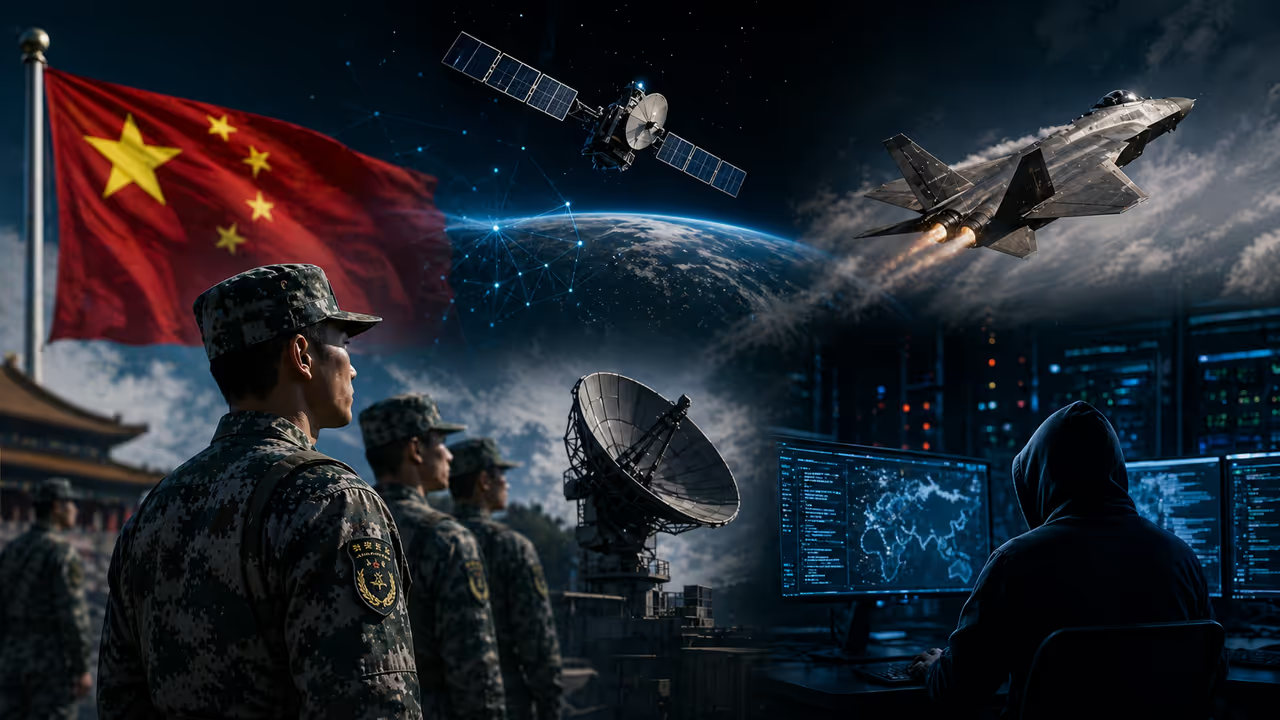
China's military created the Information Support Force in 2024 after dissolving the Strategic Support Force. Experts say the new structure makes it harder for other countries to track China's military capabilities. The force handles communications, AI systems and network operations, while the separate Cyberspace Force manages cyber attacks.
New Delhi: When China dissolved the Strategic Support Force and created the Information Support Force in April 2024, it simultaneously restructured the PLA's entire service architecture around categories that existing arms control frameworks were never designed to cover.
The PLA now formally lists the Army, Navy, Air Force, and Rocket Force as its four theater-grade services, with the Aerospace Force, Cyberspace Force, ISF, and Joint Logistics Support Force sitting below them as deputy-theater-grade arms directly subordinate to the Central Military Commission. The structural categories that most existing international treaties are built around do not map cleanly onto this new architecture.
'Brand-new strategic arm'
The official language used to describe the ISF reinforces the problem. A PLA spokesman characterised it as "a brand-new strategic arm of the PLA and a key underpinning of coordinated development and application of the network information system" - a phrase that sounds administrative rather than military. It describes an infrastructure function, which is substantially harder to classify as an offensive capability under international law than a new missile regiment or carrier strike group. The phrasing may be technically accurate and simultaneously misleading, which is precisely its utility.
Related Articles

Arms control verification depends on transparency: declared force sizes, identified capabilities, inspectable assets. The ISF's mandate spans satellite communications, AI-enabled command platforms, and network integration across services, while the separately constituted Cyberspace Force carries primary responsibility for offensive cyber operations and computer network attack. Both sit under a broader organisational umbrella that covers civilian technology transfer through military-civil fusion. No existing treaty framework was built to cover that combination simultaneously, and Beijing has not volunteered any clarification.
Xi Jinping's December 4, 2024 inspection of the ISF, reported by Xinhua, confirmed its domestic political importance without addressing its external military role. The visit generated significant coverage inside China, framing the force as a modernisation achievement, with Xi calling for leapfrog development of the PLA's network information system. Its actual capabilities, operational chain of command, and relationship to the Cyberspace Force's offensive operations were not disclosed to international observers and have not been since.
What research bodies say?
SIPRI and comparable research bodies have identified this as a structurally difficult monitoring problem. Cyber capabilities are not visible the way armoured divisions or carrier groups are. AI systems do not carry serial numbers that can be counted.
Quantum cryptography programmes exist inside national laboratory systems with civilian as well as military applications.
Monitoring any one of these in isolation is already difficult; monitoring all of them in a country that treats military-civil fusion as a stated national strategy borders on impossible under current verification frameworks.
The ISF's creation drew considerable international attention in 2024, but the ambiguity surrounding its purpose has made it difficult to characterise conclusively in policy discussions. That ambiguity is its own form of strategic utility. The harder verification challenge may lie not with the ISF's labelling but with the structural decision to constitute offensive cyber as its own independent arm - the Cyberspace Force - equally opaque and equally outside existing treaty definitions.
Together, the two forces conduct functions that Beijing has no obligation to declare, in domains that no current verification regime can monitor, under organisational labels that provide no foothold for negotiated constraint.