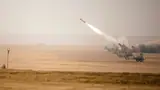
Counter-Rocket, Artillery, and Mortar system, or C-RAM on early Tuesday sprang to life with lethal precision as a fresh drone and rocket attack targeted the US embassy in Baghdad.
The skies over Iraq's Baghdad erupted into chaos in the early hours of Tuesday as a fresh wave of drone and rocket attacks targeted the heavily fortified US Embassy. In a dramatic display of rapid-response warfare, the Counter-Rocket, Artillery and Mortar system, better known as C-RAM, roared into action, unleashing a blistering barrage to neutralise incoming threats mid-air.
Designed as a land-based adaptation of the Navy’s Phalanx close-in weapon system, C-RAM swiftly locked onto hostile projectiles, whether low-flying drones or rockets and responded within seconds. Its automated 20mm M61A1 Gatling gun spun into action, firing at a staggering rate to create a lethal wall of defence.
An AFP journalist reported plumes of black smoke rising from within the embassy complex following an explosion, while air defence systems successfully intercepted another drone mid-flight.
Related Articles

A security official confirmed the scale of the assault, stating that "three drones and four rockets attacked the embassy, with at least one drone crashing inside it." Just hours before, another rocket attack had already been thwarted, underscoring the relentless nature of the assault.
Visuals circulating on X captured the sheer intensity of the interception. A piercing, high-pitched roar filled the air as the cannon ramped up to 4,500 rounds per minute, spewing streams of high-explosive incendiary tracer ammunition in controlled bursts. The night sky lit up with rapid muzzle flashes, resembling strobe lights, as glowing tracer rounds carved fiery arcs toward their targets.
Eyewitness footage froze the decisive moment, incoming threats disintegrating mid-air in bursts of sparks and debris, shredded by a dense curtain of tungsten projectiles before they could strike. The remnants either burned out or fell harmlessly, averting what could have been a catastrophic hit on one of America’s most secure diplomatic compounds in the region.
How C-RAM works
Built as a last line of defence, the Counter-Rocket, Artillery and Mortar (C-RAM) system is engineered to protect military bases, embassies and critical infrastructure from incoming aerial threats such as rockets, artillery shells and mortars.
Originally developed by the US Army during the Iraq war, the system evolved from a missile-intercept platform into a specialised defence against short-range, high-speed threats typical of insurgent attacks. It integrates advanced radar sensors, fire-control systems and a high-speed rotary cannon to detect, track and eliminate threats mid-air with precision.
Once a projectile is detected, the system rapidly calculates its trajectory and fires timed bursts to destroy it before impact. Its network includes components like the AN/TPQ-36 Firefinder radar and Lightweight Counter Mortar Radar, which identify threats almost immediately after launch.
A command-and-control system then predicts the likely impact zone and issues warnings to personnel, buying crucial seconds in high-risk scenarios.
Unlike its naval counterpart, the land-based C-RAM uses self-destructing ammunition to reduce the risk of civilian casualties from falling debris. Widely deployed across US bases and diplomatic facilities in Iraq and Afghanistan, it remains a critical shield against sudden aerial attacks.