
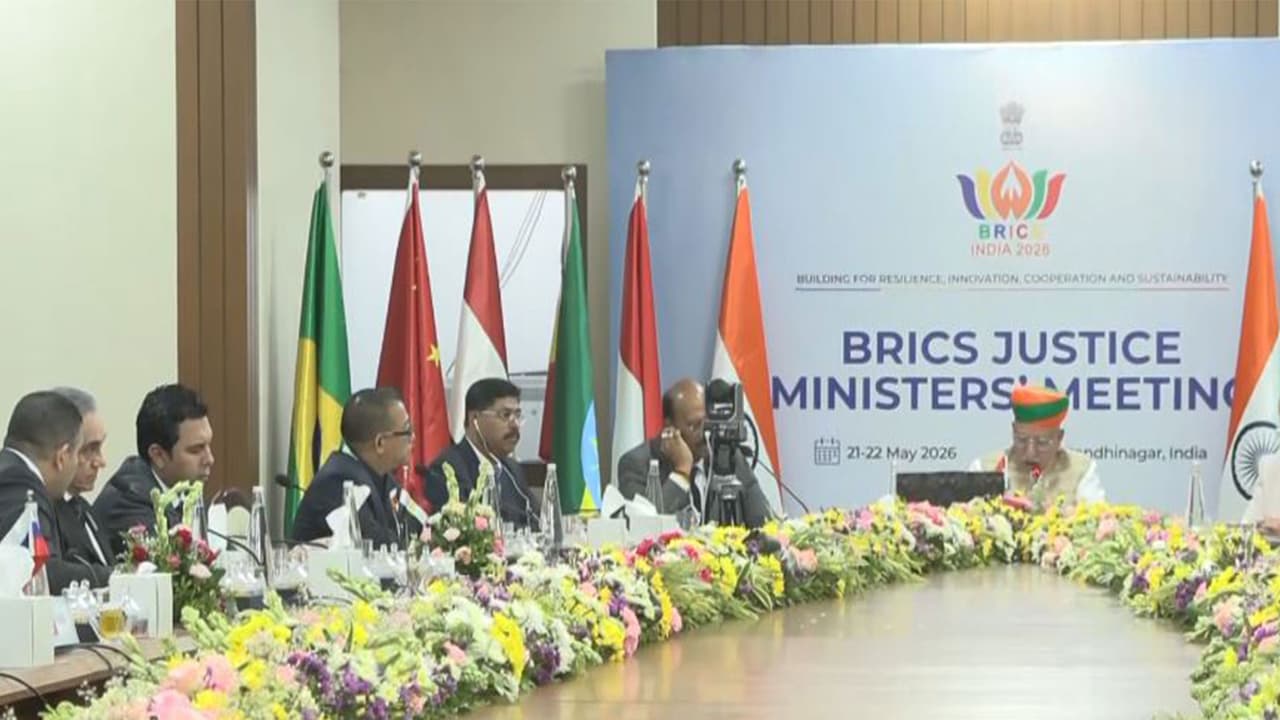
Under India's 2026 BRICS Chairship, the Justice Ministers' Meeting in Gandhinagar formally adopted a joint declaration to strengthen Alternative Dispute Resolution mechanisms, focusing on capacity building in mediation and arbitration.
The BRICS Justice Ministers' Meeting (JMM) under India's BRICS 2026 Chairship commenced in Gandhinagar, Gujarat, with Heads of Delegation and representatives from member nations arriving for ministerial deliberations and engagements. The meeting follows the Senior Officials' Meeting held on Wednesday in Gandhinagar, where participating officials finalized the text of the Joint Declaration titled, "Declaration of the Ministers of Justice of the BRICS Countries on Strengthening Alternative Dispute Resolution through Capacity Building in Mediation and Arbitration." The Senior Officials' Meeting was conducted in hybrid mode and witnessed participation from Brazil, China, India, Egypt, Ethiopia, Iran, Indonesia, Russia, South Africa and the United Arab Emirates. Following extensive and constructive consultations among member nations, the Declaration was placed before the Ministers of Justice for formal adoption and was adopted today.
Focus on Strengthening ADR Mechanisms
All participating members expressed consensus on the importance of strengthening ADR mechanisms, particularly through enhanced cooperation and capacity building in mediation and arbitration. Earlier, the Ministry of Law and Justice said in a press statement highlighted how the meetings underscore India's leadership in promoting ADR as a core component of modern legal-system reform and as a vital tool for delivering accessible, speedy and affordable justice to citizens. The choice of Gandhinagar, Gujarat, as the venue reflects the city's emergence as a hub for major international legal and multilateral events under India's 2026 BRICS Chairship.
It further noted how the BRICS Justice Ministers will promote dialogue and cooperation on Alternative Dispute Resolution (ADR), particularly mediation and arbitration, by facilitating exchange of best practices, policy approaches, and institutional experiences; strengthening professional capacity and institutional ecosystems through training, professional exchanges, joint workshops, and knowledge sharing platforms for mediators, arbitrators, judges, government legal officers, and legal professionals; enhancing court referred and pre litigation mediation; fostering institutional cooperation among arbitration centres, mediation institutions, and legal training bodies; leveraging digital technologies to improve accessibility, efficiency, supporting cooperation on cross border commercial disputes; advancing legal research and comparative study of BRICS jurisprudence to harmonise laws on trade, and environment; and promoting training for government legal officers. (ANI)
(Except for the headline, this story has not been edited by Asianet Newsable English staff and is published from a syndicated feed.)