
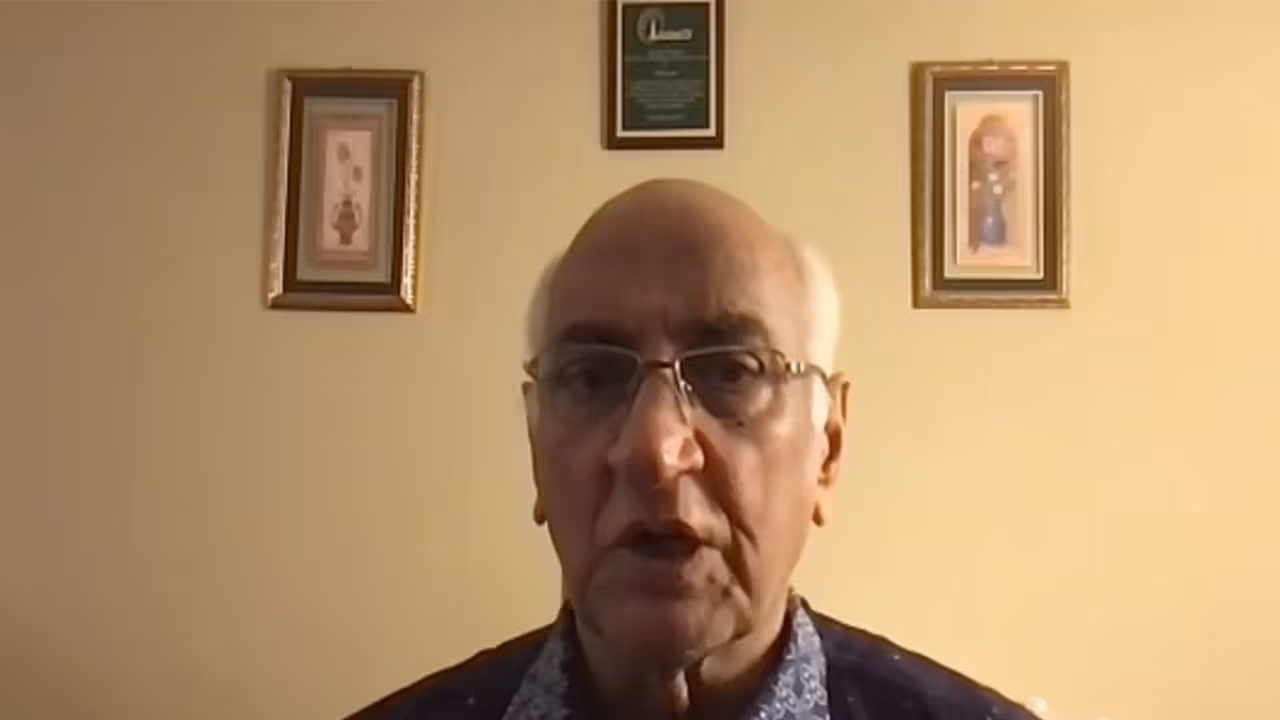
Former diplomat Vidya Bhushan Soni warns that constant anti-India tirades from Bangladesh could harm bilateral ties. He comments on Tarique Rahman's return to politics after his mother Khaleda Zia's death and the ongoing political turmoil.
Reflecting on Khaleda Zia's Legacy
Soni recounted how Begum Khaleda was a reluctant politician, who went on to work and implement policies for women empowerment in the country. He also said that she was not overtly friendly with India. "What a sad occasion today at the passing away of Begum Khaleda Zia. She was a reluctant politician, catapulted into politics by the untimely passing of her husband... She was not against India, but she was also not overtly friendly or warm towards India. She had a 'correct' relationship. She did a lot for the women of her country. She was able to reserve certain seats for the women parliamentarians in the Bangladesh parliament. She also did a lot to promote free education for the girl child. She worked for women's empowerment... She was more directed towards China on one side and perhaps to the ASEAN countries," she said.
Political Turmoil in Bangladesh
Soni added that the youth in Bangladesh is also exceedingly dissatisfied with Chief Adviser of the Interim government, Muhammad Yunus. "In Bangladesh today, it's a very tumultuous time. The current caretaker is unable to control the situation as expected... Even the younger generation who were in favour of his assuming power are not terribly enthused by some of his decisions... The timing of her son's coming back after 17 years to Bangladesh is perfect. He arrived when things were hotting up in Bangladesh. Now that his mother has passed away, the baton or the responsibility has to pass on to somebody," he said.
Tarique Rahman as Likely Successor
Soni said that Tarique Rahman will likely be Zia's successor and might capitalize the public sympathy upon her death. "He is likely to be the party's nominated successor and, as such, of the political process... He will have an obvious advantage because there is no credible opposition leader to challenge him. They may be political leaders from the younger generation, but they would enter the scene without much support base, whereas Begum Zia's party is well established... Secondly, a sympathy wave will hit the Bangladesh political scene because most politicians will think that, since she is no more, her son should at least be given a chance... The son has to be very careful about how he dons the mantle not only of his father but also of his mother. He has to start on the right note because if he does something dangerous, then it will be a stillborn attempt for him to capitalise on the sympathy wave," he said.
A 'Positive' Development in Bilateral Ties?
When asked how he saw the relationship between the two countries going forward especially after reports in media that Bangladesh High Commissioner to India, Riaz Hamidullah, arrived in Dhaka after an urgent call from the foreign ministry, he said that it was a positive development. "It's seen in a positive angle, because after having been here for some time, he must have been overseeing the situation, and of course he has had interaction with the Ministry of External Affairs... The fact that he was summoned back home suggests that there may be a rethink: that India should not be unnecessarily antagonised, and that no action should be taken that will make us unsupportive... My reading of the situation is positive, that there will be some reassessment at the Dhaka end to see if they can do something even at this late stage, so as not to allow the drift which has ensued in our bilateral relationship," he said.
Concerns Over Upcoming Elections
Soni expressed his worries that this will not be real representative election as the Awami League is banned from participating. "A dangerous game is going on in Bangladesh politics... All the parties should have been given the opportunity to participate. But the Awami League has not been allowed to participate. So how can it be a real representative election?" he said.
Khaleda Zia Passes Away at 80
Begum Khaleda Zia died in the early morning today at the age of 80, while she was undergoing treatment at Evercare Hospital in Dhaka. According to a BNP statement on Facebook, Zia died at around 6 am (local time), shortly after the Fajr prayer. "Khaleda Zia passed away at around 6:00 am, just after Fajr prayer," the BNP statement read. "We pray for the eternal peace of her soul and ask everyone to pray for her departed soul," it added.
Zia was admitted to the capital Dhaka's Evercare Hospital on November 23 with a lung infection. The former Prime Minister has been suffering from various physical ailments, including heart disease, diabetes, arthritis, liver cirrhosis, and kidney complications, for a long time, and earlier this month, she was sent to London for advanced medical treatment for her ailments. (ANI)
(Except for the headline, this story has not been edited by Asianet Newsable English staff and is published from a syndicated feed.)