
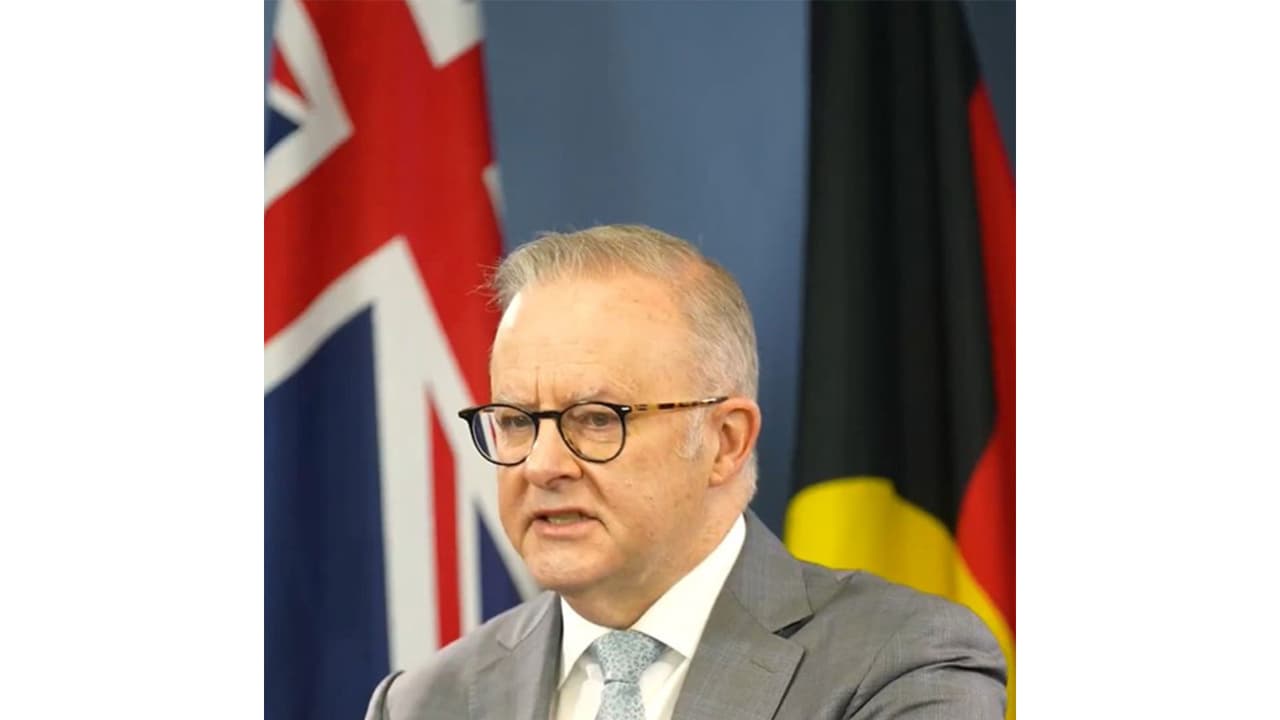
Australian PM Anthony Albanese called for de-escalation in West Asia and reopening the Strait of Hormuz after a 49-nation summit. Australia is also taking emergency steps to manage its domestic fuel supply amid the crisis.
Albanese Calls for De-escalation in West Asia
Australian Prime Minister Anthony Albanese on Saturday called for de-escalation in West Asia and the reopening of the critical Strait of Hormuz, stressing the need to keep the route free from tolls and privatisation amid the ongoing conflict. In a post on X, following his participation in a virtual Leaders' Summit on the Strait of Hormuz co-hosted by French President Emmanuel Macron and UK Prime Minister Keir Starmer, Albanese said 49 countries had come together with a "consistent approach" focused on ensuring freedom of navigation.
We want to see an end to this conflict and the Strait of Hormuz open. pic.twitter.com/Z0J2orxb9g — Anthony Albanese (@AlboMP) April 18, 2026 He said, "Last night, I joined the Strait of Hormuz freedom of navigation summit. There were 49 countries participated. There was a consistent approach. We want to see de-escalation."
He added that the aim was to see the Strait of Hormuz "opened" and to see "no privatisation and no tolls." He said, "We want to see the Strait of Hormuz opened and we want to see no privatisation and no tolls."
Earlier, Australian Prime Minister Anthony Albanese on Friday (local time) welcomed the reopening of the Strait of Hormuz and cautioned that prolonged conflict in the region could have serious consequences for the global economy and energy markets. He said, "Overnight, I joined a virtual Leaders' Summit on the Strait of Hormuz co-hosted by President Macron and Prime Minister Starmer. Australia has consistently called for an end to this conflict. The longer the war goes on, the more significant the impact on the global economy will be, and the greater the human cost."
Australia's Response to Crisis Impacts
Protecting National Interests
Shifting his focus towards the Australians, he said, "Our focus, of course, has also been on doing what we can to shield Australians from the worst of the impacts that are occurring right around the globe. We're not immune. What we are doing, though, is making every effort that we can, leaving no stone unturned, to make sure that we defend Australia's national interests. That's what my government will continue to do."
Emergency Fuel Measures
Meanwhile, Australia is taking emergency steps to manage its domestic fuel situation. According to Al Jazeera, the Australian Energy Minister Chris Bowen announced an extension of the relaxed fuel-quality standard until September, following the impact of the Iran conflict on Australia's fuel supply.
"I've decided to extend the period of higher sulphur for petrol in Australia," Bowen said on Friday. The measure allows fuel to contain up to 50 parts per million (ppm) of sulphur, five times higher than the usual 10 ppm limit, aimed at easing supply constraints caused by the crisis. The decision, initially introduced in March, is to be implemented as Australia faces localised fuel shortages triggered by disruptions in West Asian supply routes. As reported by Al Jazeera, Prime Minister Anthony Albanese has visited three Asian countries this week in a bid to secure additional fuel for his country.
(Except for the headline, this story has not been edited by Asianet Newsable English staff and is published from a syndicated feed.)