
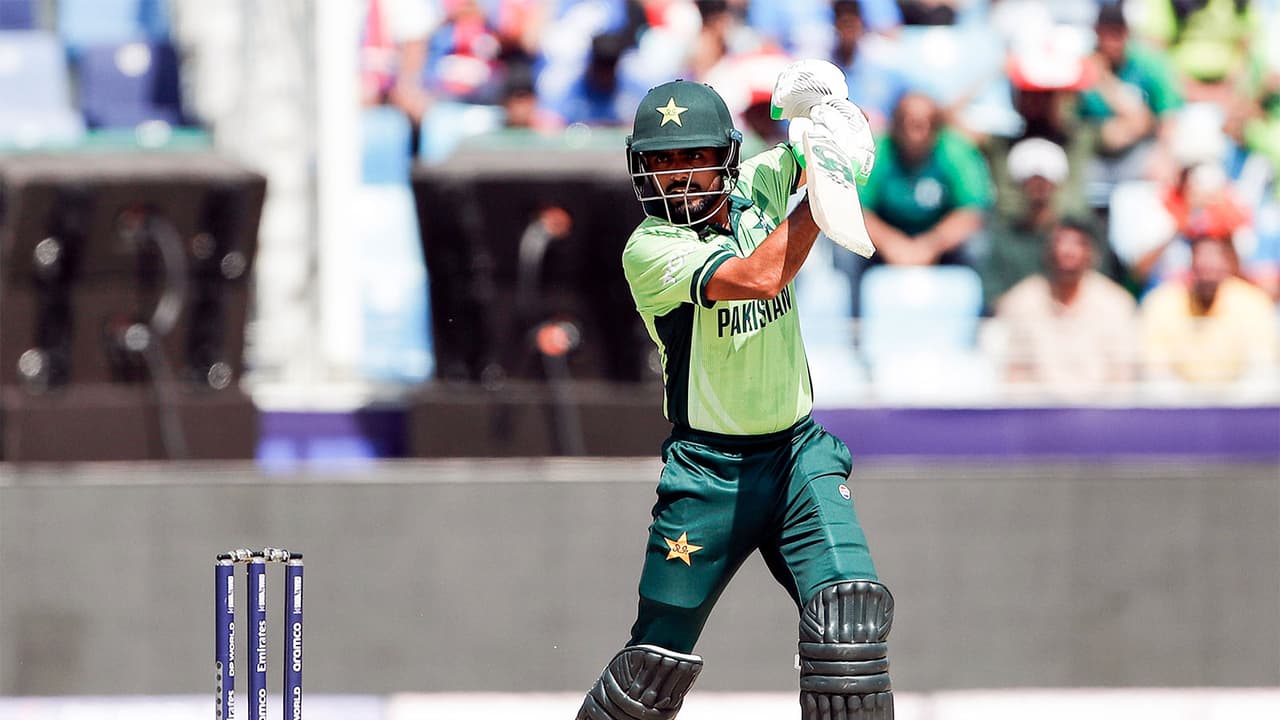
Pakistan head coach Mike Hesson defends Babar Azam's No. 4 batting position, citing strategic needs despite his poor form. Hesson also cleared the air on a tense exchange with Salman Agha and downplayed historical stats against New Zealand.
Pakistan head coach Mike Hesson has addressed questions about Babar Azam batting at number four in T20 matches, despite the star batter's history of opening the innings in various leagues and formats. During the pre-match press conference ahead of the Super Eight clash against New Zealand, Hesson explained that the team's strategy and current needs have dictated Babar's role in the middle order. Babar Azam is having a poor campaign in the ongoing T20 World Cup. The right-handed batter has made 66 runs in four matches at a dismal average of 22 and a strike rate of 115.78.
Hesson on Babar Azam's Batting Position
"Babar is well aware of that. I think he's well aware strike rate in the power play in World Cups is less than 100 in T20s. So clearly, that's not a role that we think here we need," Hesson said. He emphasised that Babar's strengths lie in stabilising the innings and accelerating once set, rather than opening aggressively in the power play.
"We think he's a fine player through the middle, if required, in terms of if we're in a little bit of trouble, or as we saw against the USA, once he gets himself set, he can increase his strike rate at that point," Hesson added.
Hesson said, "So, we brought Babar back in for a specific role post the Asia Cup. We wanted some batsmanship through the middle, and he certainly brings that for us. And he did in many games throughout the last 10."
The coach also highlighted that Babar's position allows other players better suited for late-innings hitting to come in during the final overs. "At the 12th over mark, Babar Azam is not the best person to come in. We've got plenty of other options who can perform that role towards the end. And Babar is actually the first to acknowledge that," said Hesson.
The Pakistan head coach added, "He knows that he's got a certain set of skills that the team require, and there are certain times where other players can perform that role more efficiently."
Coach Clears Air on Salman Agha Incident
Following Pakistan's recent match against Namibia, footage of a tense moment between captain Salman Agha and the coach sparked speculation, but Hesson has now cleared the air. "I've actually got sent that video, and you guys have really got that wrong," he said, explaining the context behind the exchange.
The Pakistan coach revealed, "So I was going over to talk to Salman about getting Nawaz to put the pads on as a left-hander, and Agha was upset that he just got out, so he threw the bottle into the ground. Nothing to do with the conversation we were having. And then, obviously, as I said, once the left arm spinner finished, we talked about shut up, go and getting his pads on to come in after - So it was a really simple conversation that often he wasn't even part of. He was just standing there, being pretty disappointed that he was out, and it just happened to be in the crossfire. So, amazing what people can interpret sometimes."
Psychological Edge vs. Skill
In the T20 World Cups, Pakistan have secured five victories as compared to two, which were won by New Zealand. Overall, in the shortest format, the Men in Green have won 24 games, whereas the Black Caps have clinched 23 wins. Addressing questions about Pakistan's edge, having won five of seven T20 World Cup encounters against New Zealand, with the last defeat dating back to 2016, Hesson emphasised that matches are won through skill, not history or mindset.
"I don't think games are won or lost psychologically. I think they lost; they won through skill. New Zealand have played a huge amount on the subcontinent in recent times. Sri Lanka tends to spin a little bit sharper than it does in India as a general rule. And, we saw that a little bit at SSC. We saw that also during the first innings in particular, here the other night. So I don't believe anyone's got a psychological edge. Obviously, I remember the 2016 game. I was there at the time. I remember that, and I remember us preparing pretty well against Pakistan. We had a lot of different threats. So, yeah, what's happened in the past is in the past. We're looking forward to starting the Super 8s well tomorrow," Hesson explained.
Addressing Key Player Matchups
New Zealand's Mark Chapman has a great record against Pakistan in T20Is. The Kiwi batter has amassed 663 runs in 25 matches and 22 innings at an average of 41.43. Chapman has slammed one century and four half-centuries. Addressing questions related to Chapman, Pakistan head coach acknowledged the challenge posed by New Zealand batter, while also praising the versatility of off-spinner Usman Tariq.
"I mean, Mark Chapman has an incredible record against Pakistan, both in Pakistan and at home for him. So he's faced a lot of our bowlers, and he's had some success. But this pitch will bring some different challenges, and we'll have some different thoughts around how we might find a way of trying to subdue him a little bit," he said.
Hesson added, "But he's certainly not the only threat; there are plenty of them. So we won't be focused just on one, but your question was about Usman Tariq. I think he's one of those bowlers around the world who does both. He's able to attack and defend at the same time. And that's an incredible skill to have, so we're very fortunate that he's on our side."
Pakistan's Path to Super Eight
The Salman Agha-led Pakistan, who are playing their matches in Sri Lanka, finished second in the Group A standings. The Men in Green secured victories against the USA, Netherlands and Namibia in Group A matches. But they suffered a thrashing 61-run loss against the defending champions, India. (ANI)
(Except for the headline, this story has not been edited by Asianet Newsable English staff and is published from a syndicated feed.)