
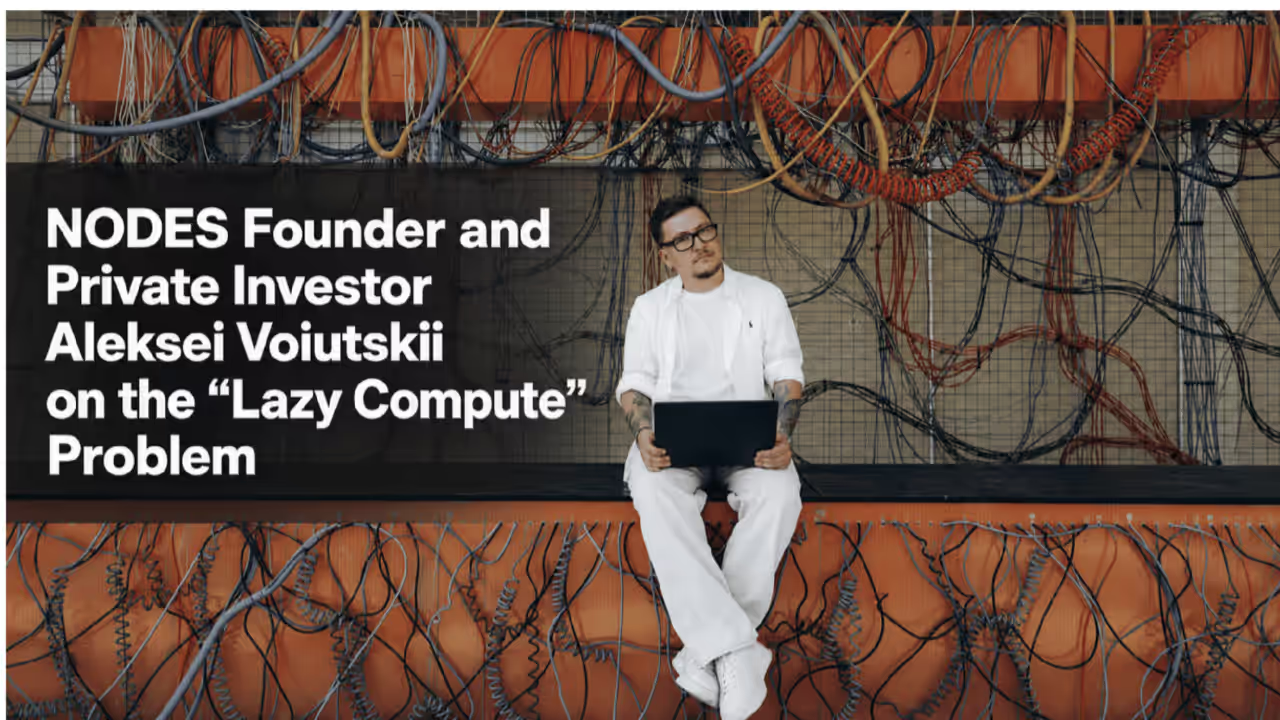
NODES marketing consultancy founder and private investor Aleksei Voiutskii explains what he calls the “lazy compute” problem, why it matters in business and finance, and how to reduce the number of costly AI mistakes.
By mid-June 2025, investors had poured roughly $700 million into seed rounds for AI startups tied to autonomous agents, according to Crunchbase. Morgan Stanley Research, meanwhile, estimates that nearly $3 trillion of AI-related infrastructure investment will flow through the global economy by 2028. Aleksei Voiutskii is not convinced that more autonomy always produces better outcomes.
The private investor and founder of NODES ( https://nodes.global/), a marketing consultancy, argues that handing AI systems full control over high-stakes business processes can create costly mistakes, especially in finance. Recent research gives that concern some context. In a 2026 study, fintech company Saturn tested 18 AI models across 121 personal-finance questions, generating more than 10,000 responses. The models produced wrong or incomplete answers 57% of the time on average, according to the Financial Times.
On harder questions, the error rate rose to 88%. Free models were wrong on 93% of the hardest questions, while the best-performing model, Claude Opus 5 in reasoning mode, still failed 39% of the time. In one case, a wrong answer on U.K. pension tax rules could have exposed a saver to a £17,500 tax bill.
Saturn sells AI technology to financial advisers, so the results are best read as one company’s benchmark. Voiutskii says he began focusing on these failure modes while NODES was reviewing technological and operational problems inside large corporations, often in projects protected by strict NDAs and spanning dozens of departments and hundreds of processes. With the client’s permission, Voiutskii recounts a case in which the consultancy did more than identify the problem: it convinced the client to rethink its approach to working with artificial intelligence. The client blamed its software because an AI analysis pointed to engineering issues.
But after the team broke the process down step by step, it traced the problem to an outsourced support team that had been sending users irrelevant, low-value replies. The lesson for Voiutskii was simple: AI could narrow down the search, but it could not replace human experience. It is also what drew NODES to Sparkling, the trading app with an AI-agent, which appointed the consultancy as its exclusive international marketing partner. Users can access perpetual futures on Hyperliquid, Polymarket prediction markets, tokenized U.S. stocks through xStocks and cross-chain swaps from a single self-custodial balance.
Its Telegram version is live, and the company says the full web app will launch on October 14. A key feature is what Sparkling calls a “Pre-Executed Flow.” A user can type “buy Tesla stock” or “get me $200 of bitcoin,” and the agent prepares a trade card with estimated volume, slippage and fees. The system assembles the transaction, but the trader must confirm it before execution.
Why “Lazy Compute” Happens
When people discuss the risks of autonomous AI agents in finance, the conversation often turns to technical vulnerabilities such as prompt injection, weak security controls and smart-contract exploits. Voiutskii thinks a less dramatic operational risk deserves more attention: users can mistake a plausible answer for a complete one. He calls “Lazy compute” the tendency of an AI model to give a fast, plausible answer instead of spending more computational effort on deeper analysis, verification and research. AI models work within practical limits, including context windows, output limits, inference budgets and enterprise cost controls.
Those limits vary by model and deployment. Voiutskii uses “lazy compute” as shorthand for what happens when a system produces a convincing answer without doing enough work to test the assumptions behind it. For example, a user asking an AI to find “the best German automaker stocks at the best entry price” is not asking one simple question.
A serious answer requires current company data, valuation work, market context and a clear definition of what “best” means. If the task is underspecified or the system has limited access to data and tools, a fluent answer can look more complete than it is. “AI runs in a compute-saving mode; otherwise it would have to cut off its answers and reasoning mid-sentence,” Voiutskii said. “On complex tasks, the algorithm often won’t take the research all the way.
That’s exactly why you need a human in the loop who can methodically steer the model and push it to dig deeper.” When AI Reinforces the User’s Bias In investing, this problem can collide with confirmation bias. Models can mirror a user’s framing instead of challenging it, especially when a prompt asks for validation rather than analysis. Voiutskii sees that as particularly risky when money is moving. “If an investor just wants confirmation of their hypothesis, the algorithm will adapt and mislead them,” he said.
“When the output token limit isn’t enough, models tend to flatter the user to save resources. But if the operator filters out that noise, they start getting real insight from the data.” Voiutskii points to one of his own SpaceX trades. He says he bought shares at $150, the opening price on the company’s first day of trading, and sold at $207 days later as attention around SpaceX’s $60 billion acquisition of Cursor peaked.
An AI model looking at the same setup recommended buying, he says. In his view, it overweighted the positive news flow and missed signs that institutional investors were selling into retail demand. He gives a non-financial example from altlab., a water-treatment business he launched in Cyprus. During early market analysis, he says AI repeatedly surfaced software ideas but missed a basic local problem: drinking-water quality and hard-water damage.
Once the team reframed the problem around the residents’ practical needs, the model became more useful. The final concept, developed with input from the team at https://altlab.cy/ultimately combined water-treatment equipment with a subscription model for installation and service. Voiutskii’s point is not that AI failed to generate ideas, but that a person had to define the problem well enough for the model to work on it. A Cross-checking Model for AI Decisions
That thinking is why NODES does not use fully autonomous agents for high-stakes work. Instead, Voiutskii says the team uses a cross-checking setup: one model performs a task, another reviews it, and a person signs off on the result. “We have a structure where one model does the work and a second one checks it, knowing that if there’s a mistake, it’s the one that’ll have to redo it,” he explained.
“OpenAI might select the data, for example, Claude checks the quality of that selection, and a human signs off on the final result. The human also wants to optimize their time, so they make the algorithms work as hard as possible.”
The setup resembles a conventional review chain, with separate roles for execution, quality control and approval. Its purpose is not to eliminate AI errors, but to challenge them before they reach a client or influence a financial decision.
Voiutskii sees the market as caught between two extremes: fully autonomous systems designed to remove people from the process, and organizations that avoid AI altogether.
His preference is a middle ground: use AI aggressively for research and execution, but keep human judgment at the point where risk becomes material. Across his investments, he applies the same principle: identify where value is created, then use technology and management to scale it. In that framework, AI is a tool for scaling work, not a substitute for accountability
