
The better signals are more grounded: original products, defensible intellectual property, export traction, repeat customers, manufacturing know-how, and management teams that have lived through different market cycles.
Australian manufacturing has a perception problem. Mention manufacturing to many Australian investorsand the reaction is often polite, but cautious. The assumption is that the sector is too hard, too capital intensive, too exposed to labour costs, too vulnerable to offshore competition, and too slow compared with software, property, artificial intelligence or whatever investment theme is running hot that quarter. I understand the scepticism. Manufacturing in Australia is not easy. It never has been. You have to deal with materials, tooling, safety, compliance, freight, global distribution, warranty, quality control and the hard reality that a product either works in a customer’s hands or it does not. There is no hiding behind a pitch deck once steel meets timber, masonry or soil. But that is also the point.

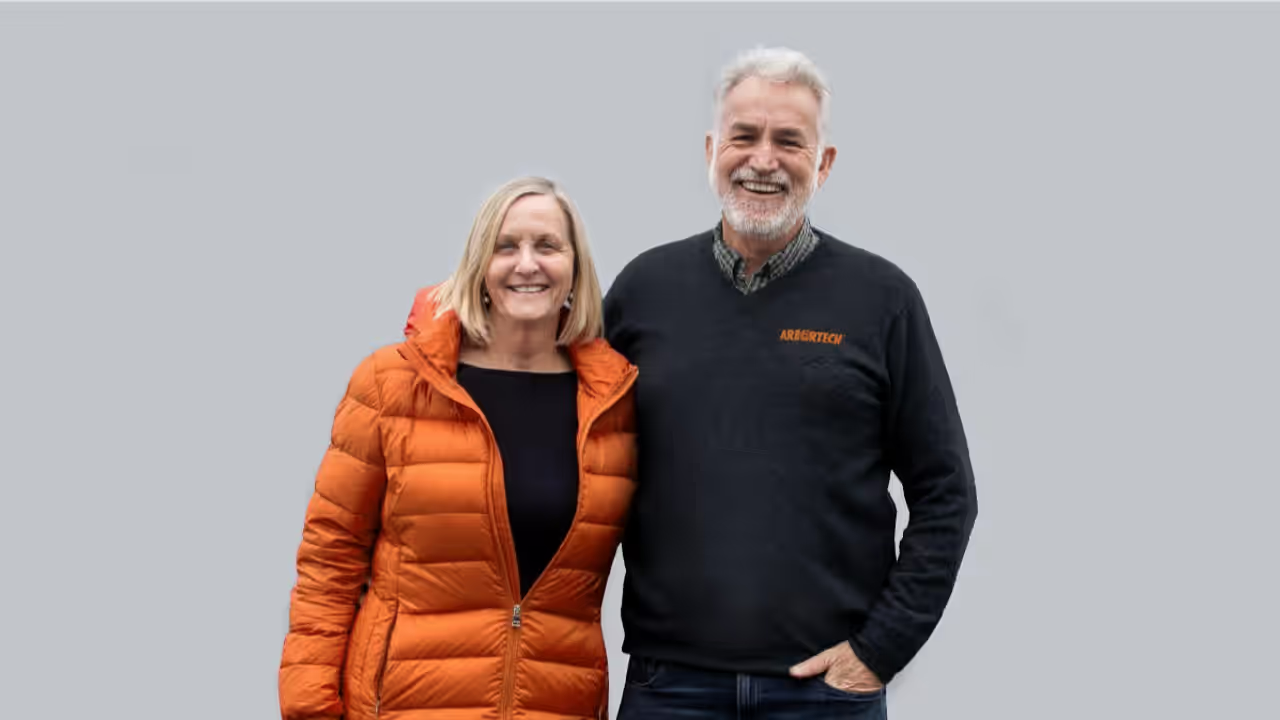
The same things that make manufacturing difficult can make a good manufacturing business valuable. Difficulty can be a moat. Longevity can be a signal. Product knowledge can compound. Engineering decisions can become intellectual property. A reputation for quality can travel further than the factory floor. That is the part of Australian manufacturing I think investors sometimes miss. Arbortech is not a new company chasing a fashionable category. We are an Australian-owned and run power tools company based in Perth, Western Australia.
Our roots go back to 1983, when Kevin Inkster started experimenting with a way to sculpt timber more safely and efficiently than using a chainsaw. That idea eventually led to a disc attachment for an angle grinder, then to power carving products, and then to a company that has spent decades developing tools for makers, trades, woodworkers, landscapers and specialist users around the world. Today, Arbortech products are sold into more than 100 countries. We have more than 50 employees across four continents. We develop tools across power carving, masonry, construction restoration and outdoor applications. We are still here after more than 30 years because the business was built on making things that work. That may sound simple. It is not. In manufacturing, survival itself tells a story. Over the years, plenty of Australian product companies have come and gone. Many started with good ideas. Some had strong brands. Some raised money. Some had early export promise.
But the hard middle of manufacturing often catches people out. It is one thing to invent a product. It is another to make it repeatedly, improve it, support it, distribute it, repair it, protect the intellectual property around it, and keep customers coming back after the novelty has worn off. That is why I believe Arbortech sits in a category Australian investors should look at more closely - resilient, IP-heavy sovereign manufacturing. We are likely one of the very few remaining Australian power tool manufacturers, and possibly the only one operating at this level in our category.
Many brands sell here. Some design here. Some distribute here. Some assemble or adapt products here. But very few Australian-owned businesses have built a decades-long power tool company with a genuine product development heritage and global customer base. That matters because power tools are not abstract technology. A good tool must be safe, durable, balanced, efficient and practical. It has to solve a problem that the user recognises immediately. It has to justify its place in a workshop, ute, jobsite or shed. It has to perform for professionals and enthusiasts who know very quickly whether a manufacturer understands the work or only the marketing. That kind of trust cannot be rushed. In recent years, investors have become used to fast cycles. A sector becomes hot. Money moves in. Valuations rise. A few companies succeed. Many disappear. Then the market moves to the next theme. There is nothing wrong with backing new technology. Australia needs more of it. But investors should also ask whether they are underpricing businesses that have already done something rare: survive, adapt and export from Australia over decades. Arbortech’s heritage is not just a nice story. It is part of the business model. When a company has spent decades refining products, it builds a knowledge base that is difficult to replicate. It understands customer pain points because it has heard them directly. It knows where tools fail. It knows which features matter and which are only cosmetic.
It knows how products behave in real conditions, not just in a controlled demonstration. That learning becomes a product development discipline. For Arbortech, being Australian has not limited the business to Australia. It has pushed us to build tools good enough to leave Australia. If a product can be developed in Perth, tested by demanding users, improved through real feedback and sold internationally, then Australian manufacturing is not a handicap. It is proof of capability.
This is where the conversation about sovereign manufacturing capability in Australia needs to mature. Too often, sovereign capability is discussed only through defence, critical minerals, batteries, clean energy or large-scale industrial policy. But sovereign manufacturing capability is also built through smaller and mid-sized companies that know how to design, make, sell and improve physical products over long periods. These companies may not always look like the kind of growth stories investors are used to these days.
They may not have the same language as software companies. Their assets may sit in product designs, patents, tooling knowledge, supplier relationships, customer loyalty, distribution channels and decades of practical experience. The Australian industrial tech sector has a chance to become much more than a policy slogan. It can be a serious investment category again if investors look for the right signals. Not hype. Not subsidy dependence. Not vague promises about reshoring everything. The better signals are more grounded: original products, defensible intellectual property, export traction, repeat customers, manufacturing know-how, and management teams that have lived through different market cycles.
That is where long-term investment value in Australian manufacturing can sit. The irony is that the traits often seen as unfashionable in manufacturing are exactly the traits many investors say they want when markets become uncertain. Stability. Discipline. Real customers. Tangible products. Pricing power based on quality. A reason to exist beyond momentum. Arbortech has stood the test of time because it has had to. There was no shortcut from a shed experiment to a global tools business.
There was no easy path from a rough disc attachment to a product range used by people around the world. There was only the work: inventing, testing, making, selling, improving and doing it again. The opportunity for investors is to recognise these businesses before everyone else remembers why they matter.
