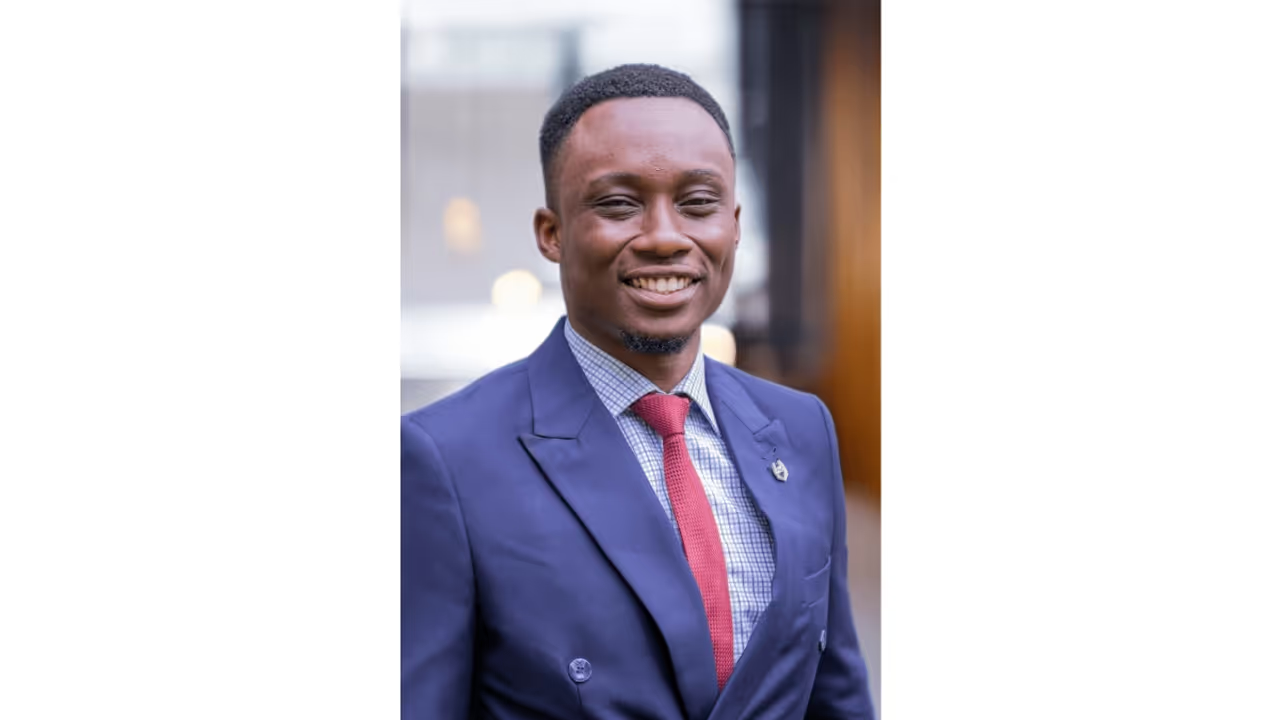
Ashiedu’s consulting foundation was built at PricewaterhouseCoopers (PwC) Nigeria, where he led complex projects that blended financial rigor with public-impact significance.
In a consulting landscape defined by complexity, speed, and high-stakes decision-making, BAT Business Transformation Leadership Award winner Benedict Ashiedu stands out as one of the most compelling young African professionals shaping how organizations invest, operate, and scale across emerging markets. His recognition in August 2025 with the BAT Business Transformation Leadership Award marked a significant milestone in a career defined by analytical rigor, operational innovation, and a sustained commitment to strengthening institutions across Africa and beyond. The award honors professionals driving measurable business transformation across the continent, and Ashiedu was recognized for his ability to translate data-driven strategy into real-world execution in complex market environments.

Following this recognition, Ashiedu’s work and perspective continued to gain global visibility. He was featured by Bain & Company in its September 2025 career spotlight, “Five Recruiting Tips from a Consultant at Bain,” where he articulated a philosophy that has come to define his professional approach. That feature highlighted Ashiedu’s disciplined approach to strategy, one grounded in clarity, execution, and real-world applicability. Rather than treating strategy as a theoretical exercise, his work emphasizes practical insight that can withstand operational realities and guide decision-making at the highest levels. This perspective has shaped a career that continues to influence investors, governments, and private-sector leaders across multiple regions.
Ashiedu’s consulting foundation was built at PricewaterhouseCoopers (PwC) Nigeria, where he led complex projects that blended financial rigor with public-impact significance. His leadership on the African Union’s Common African Agro-Parks Programme (CAAPs) project established investment pathways for transboundary agricultural infrastructure, shaping a continental initiative aimed at reducing Africa’s substantial annual food import dependence. His due diligence for a multilateral institution’s proposed healthcare Center of Excellence produced insights that accelerated project approval, mobilized donor financing, and projected improved access to specialized care for tens of thousands of patients annually. “Development outcomes matter deeply to me. A good deal should strengthen communities,” he noted in an interview reflecting on his early work. His findings influenced major infrastructure and investment decisions across agriculture, healthcare, telecoms, logistics, and manufacturing.
Related Articles

During his tenure at PwC, Ashiedu distinguished himself further by redesigning elements of the firm’s due diligence execution model. Drawing from his engineering background, he developed data-driven Alteryx playbooks that automated extraction, transformation, and analysis for financial reviews. These tools reduced project delivery timelines, improved modeling accuracy, and became internal reference points for cross-border transactions, an uncommon achievement at his career stage. He also pioneered a resource-allocation automation tool that improved staffing efficiency by 90 percent and eliminated project double-booking, strengthening workforce sustainability during the firm’s post-pandemic recovery. This innovation earned him the PwC Spotlight Award and contributed to his selection for the PwC NextGen Council, where he advised senior leadership on culture, strategy, and employee policy during a critical transition period.
The broader influence of this work extended well beyond PwC. Ashiedu’s approach to operational automation and execution excellence drew interest from other professional services firms across Nigeria, several of which adopted similar resource-management models as they sought to modernize staffing and engagement delivery. His contributions to advancing consulting practice also supported his nomination and selection as a Fellow of the Institute of Management Consultants, the institute’s highest professional grade and one reserved for individuals who have materially shaped the profession.
Ashiedu’s influence further extends into thought leadership that informs how investment decisions are made across African markets. His widely circulated article, “The Anatomy of a Successful Due Diligence – Lessons from the Field,” draws from real-world cases across Ghana, Nigeria, and East Africa and has been referenced by investment professionals for its practical guidance on financial validation, commercial viability testing, and governance risk assessment. “You cannot buy what you do not understand, and you cannot understand a business unless you look beyond the numbers,” he writes. This philosophy reflects his reputation for grounding analytical insight in operational reality, an approach that has repeatedly helped investors avoid mispriced risks, restructure transactions, and negotiate from a position of strength.
At Bain & Company, Ashiedu focuses on operations and business transformation, advising multinational clients on optimizing distribution networks, strengthening vendor ecosystems, and implementing systems-based strategies that improve performance at scale. His work spans large, complex organizations where operational decisions influence extensive supply chains and long-term competitiveness. Colleagues frequently point to his ability to translate frontline operational insight into executive-level strategy, a skill he attributes to his early engineering training. His authenticity in Bain’s 2025 career feature resonated globally, with young professionals across continents citing his principles as a model for intentional career development.
Ashiedu’s contributions also reflect a sustained commitment to expanding access to opportunity for African talent. A graduate of Duke University’s Fuqua School of Business, he served as Vice President of Admissions for the Business in Africa Club and as an Admissions Fellow, mentoring nearly 300 candidates from across the African continent and diaspora. His outreach increased applicant visibility, strengthened Africa-focused programming, and helped build a pipeline of globally competitive professionals. He remains a strong advocate of what he calls “brain circulation,” emphasizing the exchange of knowledge between Africa and the global innovation ecosystem. “Africa doesn’t lack talent; it lacks access. When access expands, potential becomes performance,” he says.
Beyond consulting, Ashiedu maintains a long-standing commitment to public service. He volunteers with Junior Achievement, Teach for Nigeria, and the Sankofa Food Pantry in Chicago, reflecting his belief that leadership should be measured by community impact, not job titles. His multidisciplinary background as an engineer, strategist, and published business writer positions him as a bridge between global markets and emerging economies. As Africa’s technology, manufacturing, and infrastructure sectors continue to evolve, Ashiedu stands out as part of a new generation of professionals redefining how global business engages with high-growth regions through purpose-driven strategy and execution.