People who disagree say that payroll software isn't a cost centre; it's a way to manage risk. Every month you run payroll on a system that isn't stable or doesn't meet the rules, you are building up liability.
To be honest, payroll was never just about transferring salaries. But for far too long, businesses treated it like a backend chore, run the numbers, push the payments, file the compliance, and so on.
In 2026, that mindset is expensive. Gradually, payroll has evolved into one of the most strategic functions in any organisation. According to a 2025 Deloitte Global Payroll Benchmarking Survey, over 73% of organisations reported that payroll errors or inefficiencies had a direct impact on employee experience and retention. Meanwhile, a PwC India HR Tech survey found that companies using outdated payroll systems spend 2.5x more time on payroll processing than those using modern, integrated platforms, time that HR and finance leaders simply can't afford to lose.
With more than 600 million people working in India, GST changes, changing PF/ESIC rules, new income tax systems, and the government's push for digital-first financial infrastructure, payroll teams have never had more work to do.
Related Articles

So, whether you're a startup founder trying to keep things easy-brezzy, a CHRO in a mid-sized company managing hundreds of employees in different states, or a CFO in a large company dealing with payroll in multiple countries, you need to really think about what your payroll software can do in 2026.
Here are the top 10 payroll features which will become mandatory in 2026.
1. Automated Tax Computation and Compliance Updates
This is the non-negotiable starting point.
India's tax landscape is one of the most dynamic in the world. Between the old and new income tax regimes, TDS calculations, Form 16 generation, quarterly TDS returns, professional tax rates varying by state, and frequent amendments to PF/ESIC rules, a manual or semi-automated payroll system is essentially a compliance liability waiting to happen.
The best payroll software in India handles all of this automatically. That means real-time updates when tax slabs change, automated TDS computation per employee based on their chosen regime, and zero manual intervention for statutory filing.
As stated by NASSCOM HR Tech India Report 2025, compliance issues constitute about 34% of all payroll disputes in Indian mid-market organisations. The consequences go beyond monetary fines, notices and audits generate a lot of noise, and no organisation should have to contend with such distractions.
Consider software that:
- Automatically updates when the government changes tax bands, PF ceilings, or ESIC ceilings
- Generates Form 16, Form 24Q, and other statutory documents automatically without user intervention
- Support professional tax computations for all Indian states out-of-the-box
- Maintains a full audit trail for every computation
2. Employee Self-Service (ESS) Portal
The modern employee doesn't want to email HR to get their payslip. They want a portal or better yet, a mobile app, where they can access payslips, tax declarations, investment proofs, leave balances, and reimbursement status on their own.
This might sound like a convenience feature, but the business impact is significant. A SHRM India 2025 Workforce Report found that organisations with employee self-service capabilities in their payroll systems saved an average of 120 HR hours per month (for a 500-person company) just by reducing manual query handling.
ESS portals helps in keeping finances clear because workers are happier and less likely to get into conflicts when they know how their pay works. Mercer's Employee Financial Wellness Index (2025) found that "the clarity and accessibility of payslips" was one of the top five things that made employees happy with their pay.
An ESS portal should have the following:
- Access to payslips right away (past and present)
- Declaration of investment and proof submission
- Requests for a loan or an advance on a salary
- Keeping track of reimbursements
- Tool for choosing and comparing tax regimes
3. Seamless Integration With HRMS, Attendance, and Leave Systems
One of the most common payroll pain points for businesses, especially those that have grown organically, is data fragmentation. Attendance data lives in one system, leave records in another, expense claims in a spreadsheet, and payroll runs on a completely separate platform. Every month, someone manually reconciles all of this. And every month, something goes wrong.
Any modern payroll software should be able to connect seamlessly with your HRMS, biometric/facial/GPS attendance system, and employee leaves management software. This is not simply for convenience but also to ensure data accuracy.
The Gartner HR Tech Adoption Report 2025 found that an integrated payroll system could help to save up to 65% in payroll processing time, and errors were reduced by around 48% when compared to the use of non-integrated payroll systems.
This integration isn't a luxury for businesses that have field staff, blue-collar workers, or hybrid teams in more than one place. It's the only way to make sure payroll is correct without a lot of people working on it.
4. Multi-Location and Multi-Entity Payroll Processing
India's growth story is a multi-city, multi-state story. A company that is based in Bangalore can have its headquarters in Delhi, its factories in Pune, and its workers in Tier 2 cities. Each state has its own professional tax rates, local rules for following them, and sometimes even its own rules for taking leave.
Handling this manually or across different software instances is chaos. The best payroll software in India runs all entities from a single dashboard, with state-specific rules applied automatically.
For businesses expanding internationally, this capability extends to multi-currency payroll, country-specific tax treatment, and global compliance management. According to Deloitte's Future of Payroll 2025 report, 82% of multinational companies cited unified global payroll visibility as a top priority, yet fewer than 40% had actually achieved it.
If you run a business that spans more than one state or entity currently or plan to scale in the next 12–24 months, this feature will save you significant operational overhead.
5. Real-Time Analytics and Payroll Dashboards
Finance and HR leaders need more than just reports; they need data. There is a small but important difference between a report and a dashboard: a report tells you what happened, while a dashboard tells you what's going on right now and what will probably happen next.
Modern payroll systems come with real-time analytics dashboards that let CFOs and CHROs see the following:
- Total payroll cost as a percentage of revenue
- Department-wise salary distribution
- Overtime and bonus trends
- Predicting headcount costs
- Comparing pay from one year to the next
According to a PwC India CFO Pulse Survey from the third quarter of 2025, 67% of CFOs at mid-sized Indian companies said that being able to see payroll costs in real time was one of their top three digital transformation goals. It has a direct effect on budgeting, planning the workforce, and due diligence for mergers and acquisitions.
And this is where the transition begins from HR software into a finance tool.
6. Payroll Outsourcing Compatibility and Hybrid Models
Some businesses don't want to handle all of their payroll in-house. A hybrid model is best for many growing businesses, especially those that don't have a full-time payroll team. With this model, the business can still see and control everything through a software platform, while a managed service takes care of the actual processing, filing for compliance, and reconciliation.
This is what payroll outsourcing looks like in 2026. It's not like the old way of giving someone a spreadsheet and waiting for a report. The business and the service provider work together in real time, with the help of technology, on a single platform.
The India Staffing Federation (ISF) 2025 Annual Report said that the managed payroll services market in India is expected to grow at 14.2% CAGR by 2028. This is mostly because small and medium-sized businesses (SMEs) and startups want to make sure they are following the rules without having to hire their own payroll teams.
When evaluating payroll software, ask yourself a couple of things, such as whether it can work with a managed service model. Can a third-party partner access a controlled view to run operations on your behalf without putting your data at risk?
7. Compliance Management: Beyond Just PF and ESIC
PF and ESIC are the most important things. Still, India's compliance structure is complicated and always under scrutiny. Here is a quick look at all the rules that an Indian business owner must follow by 2026:
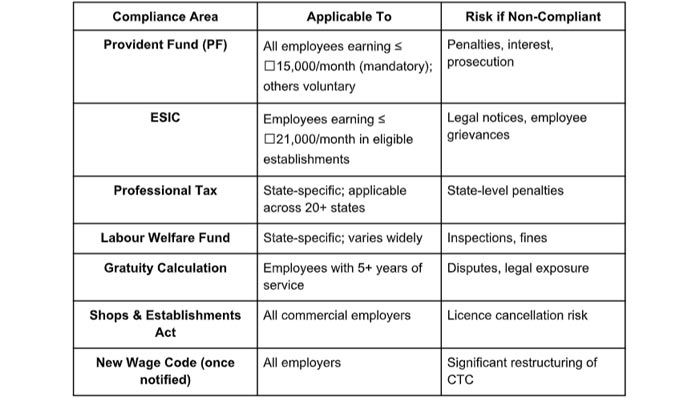
A robust payroll software system tracks all of these, sends alerts for filing deadlines, calculates liabilities automatically, and maintains digital records for audit readiness. The upcoming Wage Code implementation alone, which will change how basic wages, allowances, and PF contributions are calculated, is a reason for every Indian business to audit their payroll platform's compliance capabilities right now.
8. Salary Structure Flexibility and CTC Management
Every Indian company has its own way of paying its employees, and a good payroll platform needs to know that. It's very important to be able to set up flexible pay structures, handle HRA, LTA, special allowances, performance bonuses, ESOP vesting, and advances without having to rely on vendor customisations.
For HR and finance leaders, this goes beyond payroll processing. CTC structuring has tax implications for employees, cost implications for employers, and increasingly cultural implications. Employees today are more financially aware, and they want to understand why their take-home differs from their CTC.
According to the Aon (2025) survey of the India Compensation & Benefits Survey, flexible pay systems which give employees the option of choosing their own allowance combination have increased acceptance of offers by 22% for mid/senior-level hiring.
Ease-of-use software solutions for designing CTC packages provide an edge during the recruitment process, and not only from the standpoint of accounting.
9. Data Security, Role-Based Access, and Audit Trails
Payroll information is some of the most sensitive information a business has. All of your salary information, bank account numbers, PAN details, and Aadhaar data are stored in one place. Still, a lot of businesses use old platforms or shared Excel sheets for payroll, which have minimum access controls.
From 2026, India's Digital Personal Data Protection Act of 2023 is now fully operational. The failure to adhere to the law is not only risky for businesses but also illegal under the act. In DPDP, the employer is "the data fiduciary for personal data of employees". Failure to protect such data, particularly via insecure payroll systems, may result in severe penalties.
What to look for:
- Role-based access control (RBAC): Only the right people see the right data
- End-to-end encryption of employee financial data
- Complete audit logs of every change made to payroll records
- Cloud infrastructure is to be secured using either ISO 27001 or SOC 2 certification
- Two-factor authentication for all administrative access
The IBM Cost of a Data Breach Report India 2025 found that the average cost of a data breach for an Indian organisation was ₹19.5 crore, a figure that makes investing in secure payroll infrastructure look extremely prudent.
10. Mobile-First Access and On-Demand Pay Features
The final feature on this list is the one that perhaps best reflects how dramatically employee expectations have shifted.
Mobile-first payroll access for both HR administrators and employees is now a standard expectation, not a premium offering. Payroll runs, approvals, payslip access, and query resolution should all be possible from a smartphone. For businesses managing blue-collar or distributed workforces, this is especially critical.
It is, however, "on-demand pay", which does make a significant difference. Employees can withdraw a predefined amount of wages that have been accumulated, although the payday is not yet due. It is not a form of loan since the employee is simply accessing wages for work already completed.
The findings from a Salary Finance India survey released in 2025 indicate that 61% of the workers in India would prefer working in an organisation which allows them to receive their wages on demand. Moreover, 43% indicated that financial worries made them less productive over the previous year.
On-demand pay comes at minimal cost to organisations; however, it makes employees more fiscally healthy and reduces absenteeism, among other things.
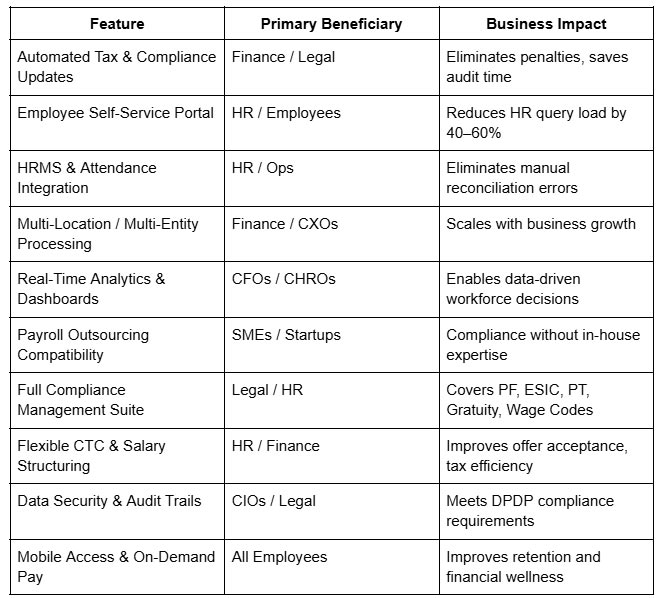
The 10 Must-Have Payroll Features in 2026
2026 Is a Turning Point for Payroll in India
India is at a unique moment. The formalisation of the workforce is accelerating, EPFO registered 7.49 lakh new subscribers in August 2025 alone, according to EPFO's official data. The gig economy is being brought into the formal fold. The new Wage Codes, once implemented, will fundamentally change how CTC is structured across industries.
At the same time, employee expectations have risen. The workforce entering the job market today, Gen Z and younger millennials, expects digital-first, transparent, mobile-accessible financial experiences at work. Payroll is a part of that experience.
Businesses that don’t upgrade their payroll systems are not only increasing their risk of non-compliance. They’re slowly but surely losing out on the war for talent.
How TankhaPay Solves Real Payroll Challenges?
For businesses navigating all of the above, TankhaPay offers a compelling answer, especially for companies that manage contract workers, blue-collar workers, gig workers, and field staff along with permanent employees.
TankhaPay integrates tracking attendance, hiring contractors, adhering to laws (PF, ESIC, and professional tax), and paying salaries into one system. TankhaPay's digital-first approach helps businesses bring employees who are still paid through informal channels into a compliant, transparent payroll system without the extra work that usually comes with it.
It's not enough to just pay people; you also have to make sure that every worker, no matter what kind of job they have, gets paid the right amount, on time, and in accordance with Indian labour laws. As businesses look for the best payroll software in India for their unique workforce structure, TankhaPay is a smart choice that was made for the Indian market.
Final Words
It makes sense to stick with what works. Why spend money to upgrade your payroll system if it "mostly" works?
People who disagree say that payroll software isn't a cost centre; it's a way to manage risk. Every month you run payroll on a system that isn't stable or doesn't meet the rules, you are building up liability. You're at risk every time a key HR person leaves and takes their knowledge of the institution's payroll with them. Every compliance deadline you rush to meet by hand takes time and energy away from growth.
The 10 features outlined in this article aren't about innovation for its own sake. They're about building a payroll function that is reliable, scalable, compliant, and increasingly a meaningful part of your employee value proposition.
In 2026, that's not a technology discussion. It's a business strategy discussion.