
AI agents are reshaping financial services, prompting regulators to examine new risks around identity, security and accountability. Find out why the Bank of England and Singapore are focusing on 'Know Your Agent'.
Over two weeks this summer, three separate efforts in two countries arrived at the same question about AI agents that can move money. Who is accountable when an agent acts?
On June 30, Bank of England Deputy Governor Sarah Breeden raised it at the European Central Bank’s annual forum in Sintra. On July 3, the Monetary Authority of Singapore, the city-state’s central bank and financial regulator, published industry guidance on checking agents before they act. On July 14, the UK Treasury, the government department that sets financial policy, published a plan calling for identity checks built specifically for AI agents.
None of them was coordinating with the others. They still ended up in the same place.
Which Regulators Are Working on AI Agent Rules for Finance?
The clearest examples right now come from HM Treasury, the Bank of England, and the Monetary Authority of Singapore, with the IMF and the FCA’s testing program adding to the picture.
Start with the UK. The Financial Services AI Adoption Plan is an independent report written by the government's AI Champions for financial services, and HM Treasury published it on July 14, 2026. Recommendation 10, on agentic payments readiness, asks for Know Your Agent protocols, meaning standardized identity and verification frameworks built for AI and autonomous software agents. It wants clear legal constructs and dispute mechanisms too, so that someone carries the accountability when agents transact.
The plan sees agentic payments as a near-term, practical stand-in for autonomous finance more generally, and it notes that firms aren't sure where liability and consent sit. The IMF got to a similar place by a different road. In its April 2026 note on agentic payments it talks about a move from click-to-pay to decide-to-pay, and about requirements shifting from Know-Your-Customer toward Know-Your-Agent.
When software can investigate, decide and move money, we need to be able to say with confidence which agent acted, on whose authority, and who remains accountable. Know Your Agent isn’t about giving software legal personality; it’s about preserving accountability as autonomy scales. Autonomy should never outrun our ability to verify, bound and, where necessary, revoke it,” says Steven McWhirter, Global Head of Policy at Binance,
Read any of these documents and the same three words keep coming back: consent, authority, liability. Breeden gave her version at the ECB's forum in Sintra. She talked about agents transacting for consumers and merchants, about who's liable for errors and fraud, and about the risk of walled gardens. Her suggestion? That more sophisticated governance and accountability frameworks may be needed.
What Is MAS SAFR and What Does It Cover?
SAFR stands for Safeguards for Agentic Finance at Runtime. It's an industry white paper the Monetary Authority of Singapore published on July 3, 2026, together with financial institutions and fintechs, under its BuildFin.ai initiative. Anyone who's had a large bank transfer held for a second signature will recognize the basic move. An agent says what it wants to do, and that gets checked and logged before anything happens.
Singapore wants agents to execute only within policy and to be validated in real time. It also wants a trail auditors can follow, and systems that can talk to each other, which is the interoperability piece. Where does that apply? The paper's examples include agent-assisted payments and treasury work, review workflows in wealth management, and client engagement.
The UK is testing too. When the FCA announced its second AI Live Testing cohort on April 21, 2026, agentic payments and Know Your Customer use cases were both on the list.
What Singapore has done is move the check from onboarding to the moment of action. With software whose behavior can shift from one instruction to the next, that's exactly where it needs to be. SAFR is guidance written with industry, not a binding rule. Still, it hands firms a concrete template they can test against.
Where the Know Your Agent Proposal Fits
Put Binance's Know Your Agent policy paper beside these documents and the overlaps jump out. The UK plan wants agent identity and verification, which is the paper's first layer, identity and provenance. Breeden wants to know about consent and liability; the paper answers with layers on the accountable principal and on the agent's mandate.
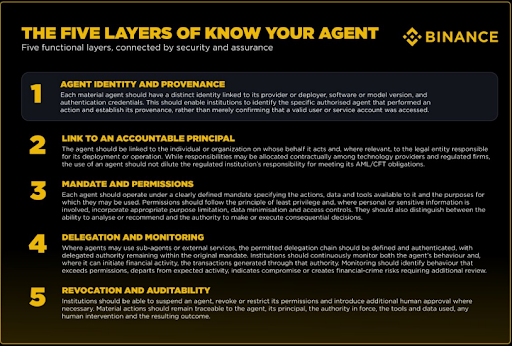
Singapore checks before execution, and the paper calls its own version point-of-action verification. As for the IMF's decide-to-pay worry, the paper's core design speaks to it directly, keeping a probabilistic decision layer apart from a deterministic control layer before anything settles.
When regulators are converging like this, an industry proposal only helps if it maps neatly onto several of them at once, and this one has clearly been built with that test in mind. It's still Binance's proposal, though. No regulator has adopted it. But call it runtime validation or call it point-of-action verification, the control point ends up in the same spot.
Best MCP servers for connecting AI agents to a crypto exchange?
Look for the ones whose permissions and data exposure match what regulators have started asking for. It matters because the MCP connection is where an agent's identity and authority meet the venue.
MCP is an open standard that Anthropic open-sourced on November 25, 2024, for building secure, two-way connections between AI applications and outside tools. Binance's MCP server is part of Agent OS and works with tools like ChatGPT, Claude Code, Codex and Cursor. Through it, agents can get market data, read-only account information and trading, but not non-trading personal data such as email addresses or KYC information.
When the UK plan calls for interoperable machine-to-machine authentication, this is the layer where that'll get built, through choices like these about what an agent can see and do.
Convergence Before Rules
Regulators agree on the question, even though none of them has written the rule yet, and the frameworks being drafted now will shape the answer. That leaves the next year unusually open.
Firms that can show how they verify and limit an agent will be helping set the standard instead of waiting for it.
By mid-2026, the regulatory and product calendars for agentic finance were moving at the same speed.