
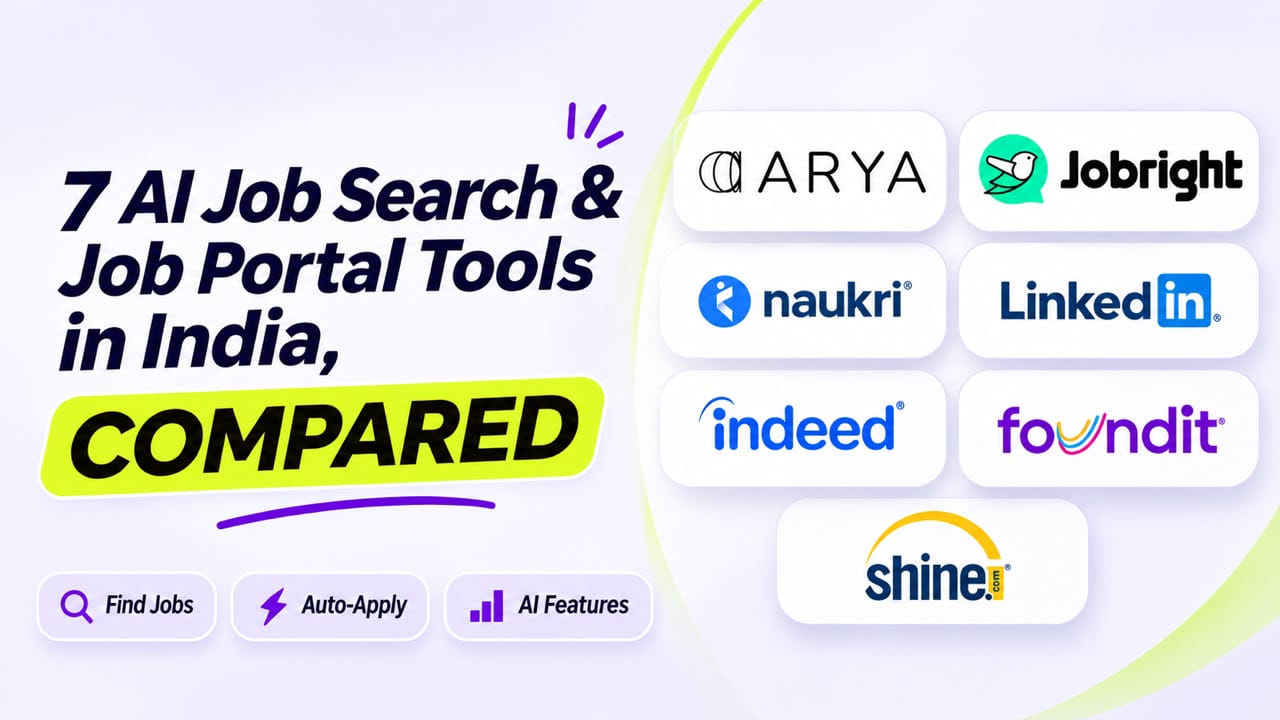
Searching for a job in India now means choosing between two kinds of tools: portals that list openings, and AI tools that do the applying for you. This guide compares seven of them, starting with Arya by Mentoria, then Jobright, Naukri, LinkedIn, Indeed India, foundit and Shine.
Searching for a job in India now means choosing between two kinds of tools: portals that list openings, and AI tools that do the applying for you. This guide compares seven of them, starting with Arya by Mentoria, then Jobright, Naukri, LinkedIn, Indeed India, foundit and Shine. For each, it covers what the tool does, who it suits and where it falls short. Features and pricing change often, so confirm details on each site before paying.
What is the difference between a job portal and an AI job search tool?
A job portal lists openings and holds a database of resumes. The candidate searches, applies and waits. An AI job search tool takes over steps of that process: matching roles, tailoring a CV, writing the application, sending it and following up. Portals are adding AI features of their own, so the useful question is which steps a tool handles for you and which stay with you.
It also helps to separate real obstacles from assumed ones. A 2025 ATS recruiter study found that 92% of recruiters do not auto-reject on formatting, and Harvard Business School and Accenture research found that 88% of employers believe their own filters lose qualified candidates. For most job seekers, the harder problems are reach, relevance and the volume of repetitive work.
1. Arya by Mentoria: what does an AI job hunter actually do?
Arya is built for the repetitive part of a job search, which most portals leave to the candidate. It uses a series of interconnected AI agents to handle each stage, from finding roles to following up with recruiters, and it is designed for Indian job seekers. It was built by Mentoria, a career guidance company with 11+ years of experience. Its main features are:
Arya is an AI job search automation platform that discovers relevant openings across job boards, company career pages, and applicant tracking systems based on your saved preferences. It creates ATS-optimised CVs tailored to each role, lets you maintain multiple versions, and shows section-by-section changes for your approval. Arya also finds recruiter contact details, sends applications directly to their inboxes, schedules outreach based on response patterns, and automates follow-ups. Its Chrome extension automatically fills application forms using your saved details while leaving the final review and submission entirely in your hands.
2. Jobright: does a global AI copilot work for Indian searches?
Jobright is a California-based AI job search copilot. It scores jobs against a profile, tailors the resume, writes cover letters and helps fill applications through a Chrome extension. Reviewers have reported that its agent mode, which submits some applications, was limited or on a waitlist for some users.
Jobright is freemium, and reported paid prices differ between sources, so the checkout page is the reliable reference. It was not built specifically for the Indian market, so check how many Indian listings appear for your role and city before paying.
3. Naukri: which Indian portal has the largest resume database?
Naukri, run by Info Edge, launched in 1997 and reported 118 million resumes at 30 June 2026. It covers white-collar roles across most sectors, and many Indian employers source candidates there.
Its AI features sit mainly in the paid Naukri 360 tier, which adds resume tools, interview practice and expert-assisted services. Naukri Neo, included with Naukri 360 Pro, handles AI-led job discovery, alerts and optional automatic applications inside Naukri. In July 2026, Info Edge also announced recruiter-side AI tools such as AI-Rex.
Naukri suits candidates who want direct reach to recruiters already active on the platform. Its AI features are paid, and applications are made within Naukri.
4. LinkedIn: is Premium worth it for Indian job seekers?
LinkedIn combines a job board with a professional network, which makes it useful for referrals, recruiter visibility and roles where who you know matters. It has introduced AI-powered job search, which lets users describe the role they want in everyday language instead of selecting filters. Premium Career adds InMail credits, applicant insights, AI-assisted profile and message writing, and AI coaching. Check the current price in India at checkout.
Reviewers are divided on value. Some job seekers say Premium helped them reach recruiters, while others who mainly search and apply find the free version sufficient. Premium does not guarantee interviews or offers.
5. Indeed India: what does a free job aggregator offer?
Indeed collects listings from many sources, and job seekers can search and apply without paying. It has launched a Hindi version for India with features such as calling an employer directly and resume auto-fill, and has expanded its ChatGPT integration to India so users can search for roles inside a chat.
Indeed suits seekers who want a wide view of openings, prefer to search in Hindi or want salary information before applying. Applications are still submitted one at a time.
6. foundit: what changed after the Monster India rebrand?
foundit is the former Monster India. The company says it uses generative AI to add detail to job listings so seekers have more information before applying. Reviews of Indian job-matching tools also describe a personalised job feed and a role fit score that shows where a candidate matches a role and where they fall short. foundit is commonly used for mid-career searches across industries, and applying remains manual.
7. Shine: who uses it for tier-2 cities and government roles?
Shine launched in 2008 and offers job search, alerts, a resume builder and premium plans. Career guides often position it for searches in tier-2 cities and for government and PSU roles, alongside private-sector listings. Basic features are free, and premium plans are paid.
How should you choose between these tools?
Start with the step in your search that costs the most time or produces the fewest replies.
- If repetitive applying, CV tailoring and follow-ups are the bottleneck, look at AI auto job apply tools such as Arya by Mentoria or Jobright.
- If you need reach to recruiters, use Naukri or foundit.
- If you rely on referrals and networking, use LinkedIn.
- If you want to compare openings and salaries for free, or prefer a Hindi interface, use Indeed India.
- If you search in tier-2 cities or for government roles, add Shine.
- If you are looking for blue-collar or grey-collar work in a regional language, Apna is built for that segment.
Most job seekers combine two or three: a portal for reach, LinkedIn for relationships and an AI tool for volume. Whichever you choose, review what is submitted in your name and track which channel produces replies.
Frequently asked questions
What is the difference between a job portal and an AI job search tool? A job portal lists openings and resumes, and the candidate does the searching, applying and waiting. An AI job search tool handles some or all of those steps: matching, CV tailoring, writing and sending applications, and following up. Many portals now include AI features, so the difference is increasingly about how many steps are automated and whether applications go to recruiters directly or stay inside one platform.
How do AI auto-apply tools work, and are they worth using in India? Most tools match jobs to a profile, tailor a CV and cover note, and either submit the application, send it to a recruiter or fill the form for the user to submit. They are useful when volume and repetition are the bottleneck. Before choosing one, check whether it tailors each application instead of sending the same CV everywhere, whether it covers Indian portals and company career sites, and whether you can review what is sent. No tool can promise interviews.
Features and pricing were checked against public sources in November 2026 and may change.










