
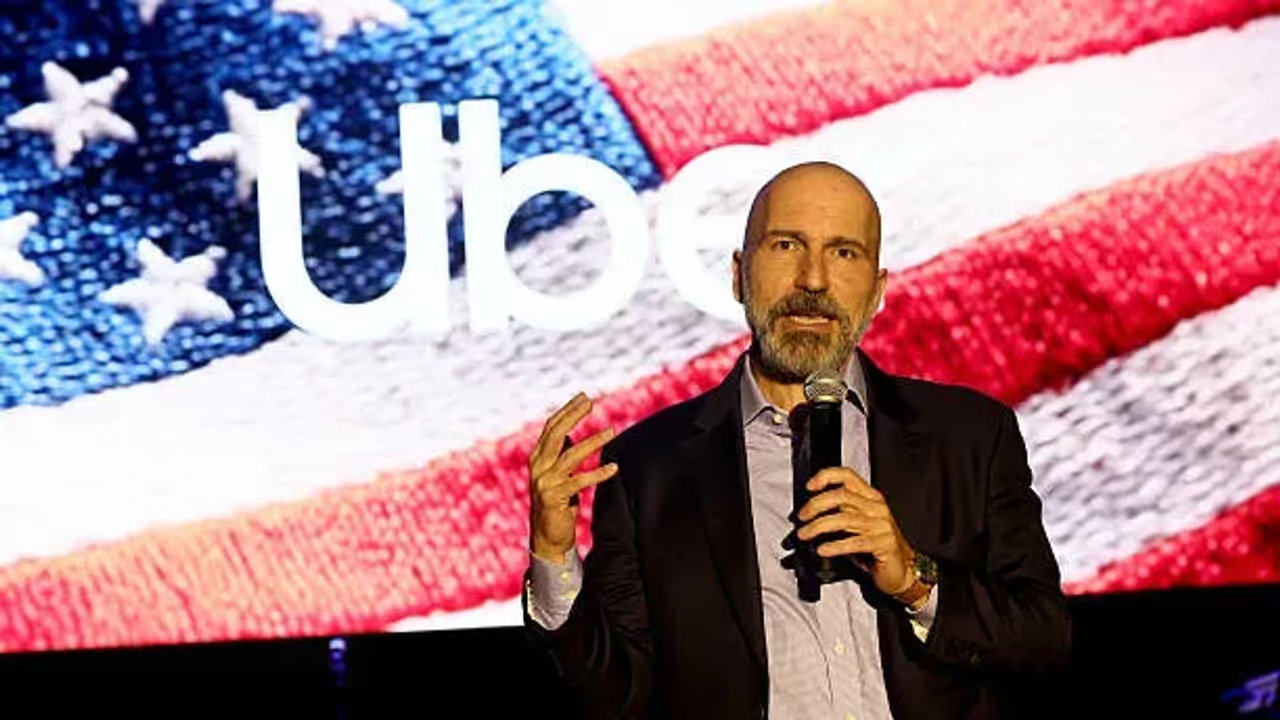
CEO Dara Khosrowshahi acquired 141,000 Uber Technologies shares on September 10 at a weighted average of $70.96, according to a filing with the Securities and Exchange Commission.
- The CEO’s purchase follows a $5.3 million buy by President and Chief Operating Officer Andrew Macdonald, who added 70,000 shares on September 4.
- Earlier this month, Uber cut about 3,300 jobs, or 10% of staff, flattening management layers as Khosrowshahi pushed for a “leaner organization.”
- According to data from Koyfin, 42 of the 51 analysts covering UBER rate it ‘Buy’ or higher.
Shares of Uber Technologies (UBER) bounced 3% on Thursday after CEO Dara Khosrowshahi disclosed a roughly $10 million open-market purchase, a rare show of personal buying as the stock trades more than 30% below last year’s peak.
Khosrowshahi acquired 141,000 Uber Technologies shares on September 10 at a weighted average of $70.96, according to a filing with the Securities and Exchange Commission. The trades ranged from $70.73 to $71.18. Khosrowshahi now holds 1,367,100 shares directly.
Executives Step In During The Slide
The CEO’s purchase follows a $5.3 million buy by President and Chief Operating Officer Andrew Macdonald, who added 70,000 shares on September 4 at prices between $75.23 and $76.85. After those trades, Macdonald owned 426,320 shares.
Earlier this year, CFO Balaji Krishnamurthy also bought about 22,450 shares near $71.25. The cluster of open-market purchases stands out after Khosrowshahi sold hundreds of thousands of shares near $95–$100 last September.
Uber Restructures As It Doubles Down On Delivery And Robotaxis
The buying coincides with a turbulent stretch. On September 2, Uber cut about 3,300 jobs, or 10% of staff, flattening management layers as Khosrowshahi pushed for a “leaner organization.” The company is also advancing a $14.8 billion takeover of Delivery Hero; the formal cash offer of €41.50 a share opened August 27 and runs through November 5. Combined, Uber has said the deal would expand its reach to 99 markets.
Autonomous driving remains the other pillar. Uber recently launched Baidu’s driverless Apollo Go in Dubai, rolled out autonomous rides in Europe, secured Spain’s first national Level 4 passenger permit with WeRide, and partnered for a Tokyo robotaxi pilot later this year. Management still targets robotaxis in as many as 15 cities by year-end. This week Uber launched its debut euro bond, a five-tranche sale sized around €4.5 billion with notes due in three to 20 years.
Valuation Gap After A Rough Quarter
Uber’s second-quarter results, released in August, showed record scale but a muted outlook. Gross bookings rose 24% to $58.0 billion, or 22% in constant currency, beating Uber’s own range and marking a fourth straight quarter of more than 20% growth. Trips climbed 18% to 3.9 billion and monthly active users rose 16% to 208 million. Revenue increased 12% to $14.2 billion after U.K. business-model changes cut reported growth by eight points. Adjusted earnings per share of $0.81 was up 35% and roughly in line with estimates. The stock still tumbled because third-quarter bookings guidance of $58.25 billion to $60.25 billion only matched forecasts near $59.3 billion, with a one-point currency headwind.
According to data from Koyfin, 42 of the 51 analysts covering UBER rate it ‘Buy’ or higher, while eight rate it ‘Hold’ and one ‘Sell.’ The 12-month average price target on the stock is $101.11, a premium of about 40% over the stock’s closing price on Wednesday.
How Did UBER Retail Traders React?
On Stocktwits, retail sentiment around UBER stock stayed ‘bullish’ over the past 24 hours, while message volume remained at ‘normal’ levels.
A Stocktwits user said the stock is “crazy hated” given how it is moving only marginally despite executive share buys.
View this Stocktwits post
Another user, however, expressed hope that the stock will climb higher.
View this Stocktwits post
UBER stock has fallen 11% year-to-date.
For updates and corrections, email newsroom[at]stocktwits[dot]com.
