
Surging oil prices, expanded bond buybacks, hawkish comments from multiple Federal Reserve officials, and persistent inflation fears drove a global bond market selloff this week.
- The 30-year U.S. Treasury yield spiked to nearly 5.5%—its highest level since 2004—while the 10-year yield rose to 5.16% and 5-year yields topped 5% for the first time since 2007.
- Michael Barr hinted that more rate hikes are needed to tame inflation.
- The Dollar Index jumped 1% this week, its second straight week of gains.
U.S. bond yields climbed for the second straight week across the curve, with yields at their highest in over a decade, as hawkish commentary from multiple Federal Reserve officials fanned inflation fears.
Market participant anxiety escalated across global markets as the Federal Reserve's recent interest-rate hike—its first since 2023—and subsequent hawkish guidance forced a rapid repricing of fixed-income assets worldwide.
The 30-year U.S. Treasury yield spiked to nearly 5.5%—its highest level since 2004—while the 10-year yield rose 10 basis points to 5.21% and 5-year yields topped 5% for the first time since 2007 during the week ending September 25.
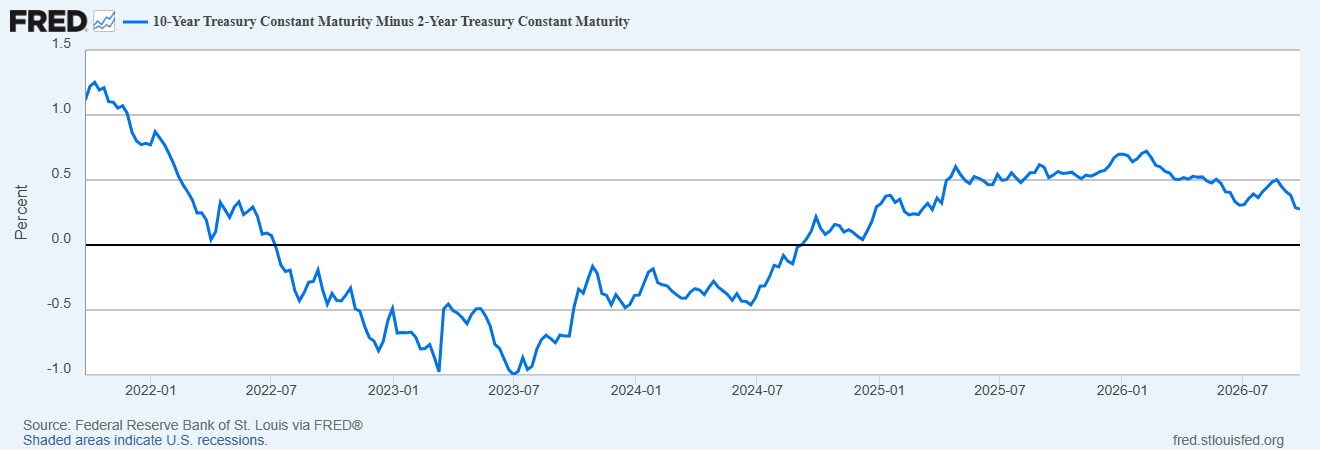
The spread between the U.S. 10-year yield and the U.S. 2-year yield dropped to about 0.28% in the week ending September 25 from a high of 0.74% hit in February earlier this year.
The iShares 20+ Year Treasury ETF (TLT) ended the week 2.4% lower, while the shorter-duration iShares 1-3 year ETF (SHY) dropped about 0.1%, its fourth straight weekly decline, signaling pressure in shorter-duration bonds as inflation concerns mount.
Retail sentiment on TLT was ‘bullish,’ with ‘high’ message volumes, while sentiment on the shorter-duration bond ETF, SHY, was ‘bearish.’
| Asset / Benchmark | Weekly Close | Weekly % Change |
| U.S. Dollar Index | 101.03 | +0.8% |
| U.S. 2-Year Treasury Yield | 4.86% | +6 bps |
| U.S. 10-Year Treasury Yield | 5.16% | +16 bps |
| U.S. 30-Year Treasury Yield | 5.49% | +17 bps |
| U.S. 10Y2Y Yield Spread | Flattening curve | - |
Yield Curve & Global Sovereign Markets
The sharp move downward shows the yield curve flattening significantly over the year, highlighting rising investor anxiety about near-term economic conditions.
Moreover, the U.S. Treasury's efforts to stabilize the market through expanded bond buybacks provided minimal relief. The U.S. Treasury announced plans to buy back up to $6 billion in long-term debt earlier this week, marking the first step in Secretary Scott Bessent’s broader initiative to curb surging yields.
“What surprised the market was that they didn’t go to the full $6 billion after how much we’ve had a selloff in the last few days,” Brij Khurana, a portfolio manager at Wellington Management, told Bloomberg. “I thought the purpose of the buybacks was to deal with drastic or illiquid price movement, and you could kind of argue that yesterday was that day.”
The bond rout expanded across international sovereign bond markets. European government bond yields rose alongside U.S. peers, while Japanese government bond yields spiked to levels last observed in 1996. Furthermore, a $44 billion auction of U.S. seven-year notes was awarded at a record-high yield of 5.085%, drawing weak investor demand.
Greenback & Economic Data Roundup
The U.S. Dollar strengthened across major currency pairs, supported by widening rate differentials—the difference between central bank rates between two countries —and persistent inflation pressures. A 5% Thursday jump in crude oil prices, fueled by threats of military expansion in the Middle East, reignited fears of commodity-driven inflation.
However, reports of possible diplomatic dialogue between Iran and the U.S. calmed oil prices towards the end of the week on Friday. Iranian Foreign Minister Abbas Araghchi said Thursday that Tehran submitted a week-long proposal to Washington to resolve hostilities, unblock the Strait of Hormuz, and launch broader negotiations on its nuclear program, The New York Times reported.
For updates and corrections, email newsroom[at]stocktwits[dot]com.<
