
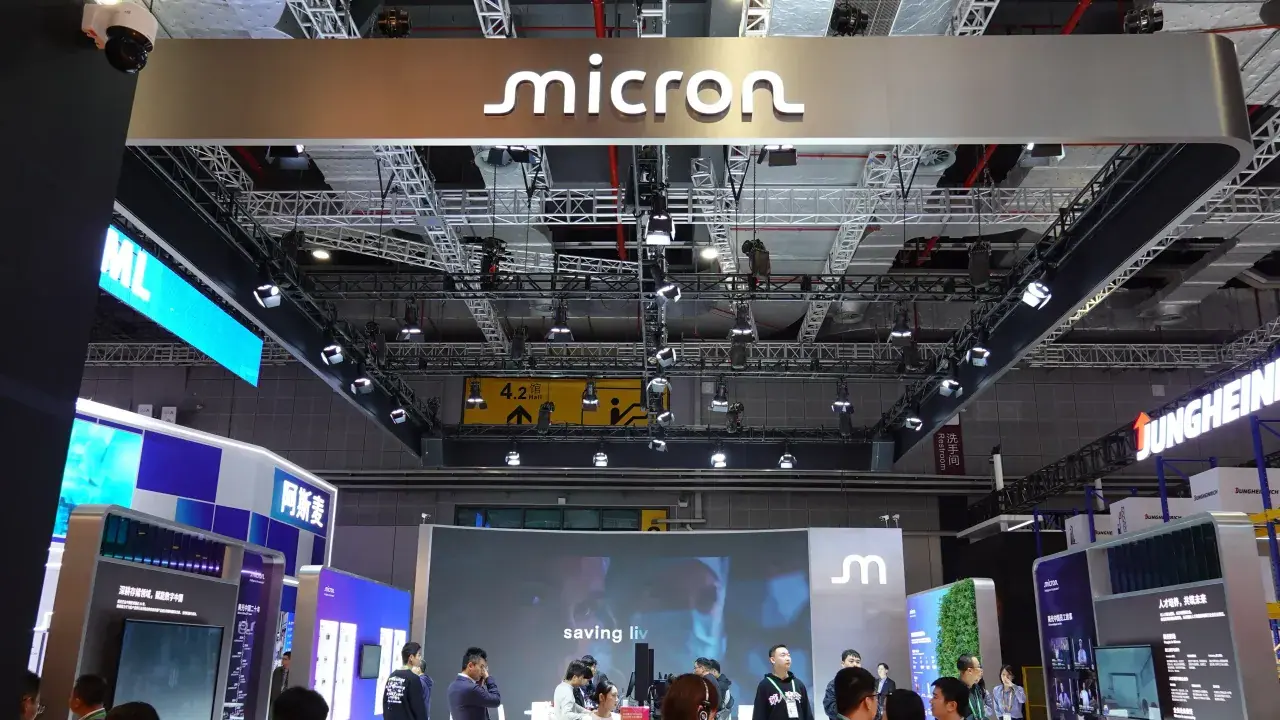
Musk’s praise offers Micron a boost as investors reassess AI-driven memory demand.
- Musk said Micron’s pricing strategy could give it an edge over rivals.
- JPMorgan expects memory supply shortages to persist through 2028.
- Stocktwits sentiment toward MU turned ‘bearish’ from ‘bullish’ on Tuesday as stock plunged over 14% in the last four sessions.
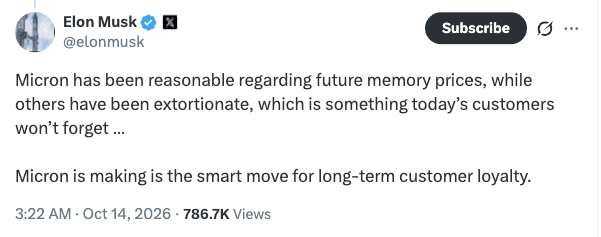
SpaceX CEO Elon Musk on Tuesday said Micron Technology (MU) has been fairer in setting future memory pricing than other vendors, calling it a “smart move for long-term customer loyalty” and a risk for competitors.
Micron shares rose 0.7% in overnight trading late Tuesday, offering a modest reprieve amid a broader semiconductor sell-off fueled by fresh concerns over returns on AI investments. Micron and peer SanDisk Corp. (SNDK) fell for four consecutive sessions through Tuesday, while the iShares Semiconductor ETF (SOXX) extended its losing streak to six sessions.
Musk Praises Micron
“Micron has been reasonable regarding future memory prices, while others have been extortionate, which is something today’s customers won’t forget,” the Tesla and SpaceX CEO wrote on X. “Micron is making is the smart move for long-term customer loyalty.”
Musk’s xAI (now part of SpaceXAI) operates the Colossus AI data-center complex near Memphis, Tennessee; its Colossus and Colossus 2 facilities collectively provide about 1 gigawatt of computing power, making it one of the world’s largest AI-computing operations.
Micron’s memory technology is embedded in Nvidia’s graphics processing units (GPUs) used in the Colossus data centers. While Micron and Musk’s companies have not announced a direct deal, the executive named Samsung, TSMC, and Micron as existing suppliers while discussing plans for his Terafab project in April.
Musk was responding to a post by Nicholas Mugalli, an institutional TMT research analyst, highlighting a bullish note from JPMorgan on the memory and storage industry.
Mugalli said Micron had secured 26 long-term supply agreements covering more than 35% of its revenue through 2030. The company also has $150 billion in contracted backlog, including $32 billion in customer cash already committed, while more than 75% of its fiscal 2027 output has been sold.
According to a note shared by Mugalli, JPMorgan expects memory supply shortages to persist through 2028, with demand for high-bandwidth memory (HBM) from AI infrastructure continuing to outstrip supply.
Why Memory Prices Have Surged
Memory prices have climbed sharply as AI data centers drive demand for advanced memory chips. Manufacturers including Micron, Samsung Electronics and SK Hynix have prioritized HBM, which delivers higher margins, tightening supplies of conventional DRAM used in servers, PCs and smartphones.
Prices for DRAM, NAND flash and HBM surged 80%-90% in the first quarter of 2026 compared with the previous quarter, according to Counterpoint Research.
Memory Stocks Face Fresh Pressure
Despite the favorable pricing environment, memory and semiconductor stocks have sold off over the past week as investors question the sustainability of AI spending and the industry’s pricing power.
Fresh competition from Chinese chipmaker ChangXin Memory Technologies (CXMT), which has reported progress on denser DRAM designs, has raised concerns that additional supply could eventually ease shortages. Meanwhile, doubts about returns on AI investments have weighed on semiconductor sentiment.
Retail View On MU
On Stocktwits, retail sentiment for MU dipped to ‘bearish’ from ‘bullish,’ although several traders remained optimistic about the memory maker, with some also viewing Musk’s hat tip as a positive endorsement.
“$MU The selloff is temporary,” a trader said. “The AI memory supercycle is just getting started. Strong earnings, booming demand, and a massive growth runway. Weak hands sell, patient investors win. Still extremely bullish on $MU.”
MU stock declined over 14% in the last four sessions, but remains 234% higher year to date.
For updates and corrections, email newsroom[at]stocktwits[dot]com.<
