

Michael Saylor argued mass adoption was the industry's real protection against a hostile administration.
- Strategy's Michael Saylor said on Saturday that crypto was "better off" with regulator rules than the CLARITY Act's rules.
- He called the bill's rejection a "positive inflection point," and warned that laws could make restrictions permanent.
- Saylor cited SEC, CFTC and Treasury moves as proof regulators can act under existing authority.
Strategy (MSTR) Executive Chairman Michael Saylor argued that the digital assets industry was "better off" pursuing supportive rules from federal regulators than accepting the restrictions written into the final Digital Asset Market Clarity Act (CLARITY Act) compromise.
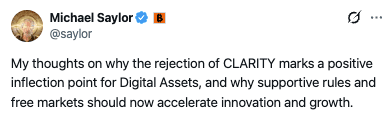
Saylor called the bill's rejection a "positive inflection point" for the sector on Saturday. "A law can make a restriction durable just as easily as it can make a right durable," he wrote in an accompanying post. "Before celebrating permanence, we should examine what we are making permanent."

He pointed to specific limits in the text. The September compromise would have barred covered providers from paying customers simply for holding payment stablecoins, according to Saylor, while its innovation sandbox would have capped participating firms at 25 employees and each commission at 20 project approvals a year.
Regulators Can Act Now
The Strategy Executive Chairman explained that the administration was already opening an alternative path. He cited the U.S. Securities and Exchange Commission’s (SEC) decision to use existing authority to grant conditional relief for onchain trading of certain tokenized stocks, and said that Chairman Paul Atkins had described letting markets develop before following temporary relief with durable rulemaking.
He also noted that Commodity Futures Trading Commission (CFTC) Chairman Michael Selig backed CLARITY but committed to using existing authority in case the bill failed to pass, directing staff to explore rules for leveraged or margined crypto trading through regulated markets. Treasury Secretary Scott Bessent, Saylor wrote, also tied stablecoin implementation to American growth and the dollar's global role.
Adoption As Best Defense
Saylor took on the main argument for the bill directly. "The strongest argument for CLARITY is familiar: 'We need a law to protect us from a future hostile administration,'" he wrote. His answer was that "no statute removes politics from regulation."
His alternative was scale. "Imagine 50 million American voters using digital financial products that improve their lives," Saylor wrote, arguing that adoption increased “the political cost of reversal." He said the industry should utilize the next 2 years to establish products at scale, convert temporary relief into durable rules and pursue focused legislation only where needed.
Saylor named beneficiaries across his own book, including Bitcoin (BTC), Strategy's STRC preferred stock, MSTR common stock, Coinbase (COIN) and Circle's (CRCL) USD Coin (USDC) stablecoin. "The best protection for digital innovation is a public that benefits from it," he wrote.
Crypto Equities Post Gains
Saylor’s comments came as crypto-linked equities closed out a strong week despite the failure of the CLARITY Act in the Senate. The Senate's cloture vote on the CLARITY Act failed 49-50 on Tuesday, falling short of the 60 votes needed to advance it.
MSTR stock closed up over 16% on Friday, while COIN stock closed up over 20%. CRCL stock also closed in the green, up over 7% on Friday.
On Stocktwits, the retail sentiment around MSTR remained in the ‘bearish’ zone, the retail sentiment around COIN stayed in the ‘neutral’ zone, whereas that around CRCL remained in the ‘bullish’ zone over the past day.
Read also: T. Rowe Price's Head Of Digital Assets Says Tokenized Stocks Must Be 'Instantly Fungible,' Agency Rules Can Move Without CLARITY Act
For updates and corrections, email newsroom[at]stocktwits[dot]com.<
