

Michael Burry criticized Nvidia’s $500 billion AI infrastructure financing platform, comparing its structure with risks seen before the 2008 financial crisis.
- Nvidia is working with Apollo, BlackRock, Blackstone, Brookfield, Goldman Sachs and KKR to mobilize more than $500 billion in third-party capital.
- Burry’s criticism centers on the growing role of private credit in financing AI infrastructure.
- His concerns also reflect his broader argument that AI chips could depreciate faster than companies currently assume.
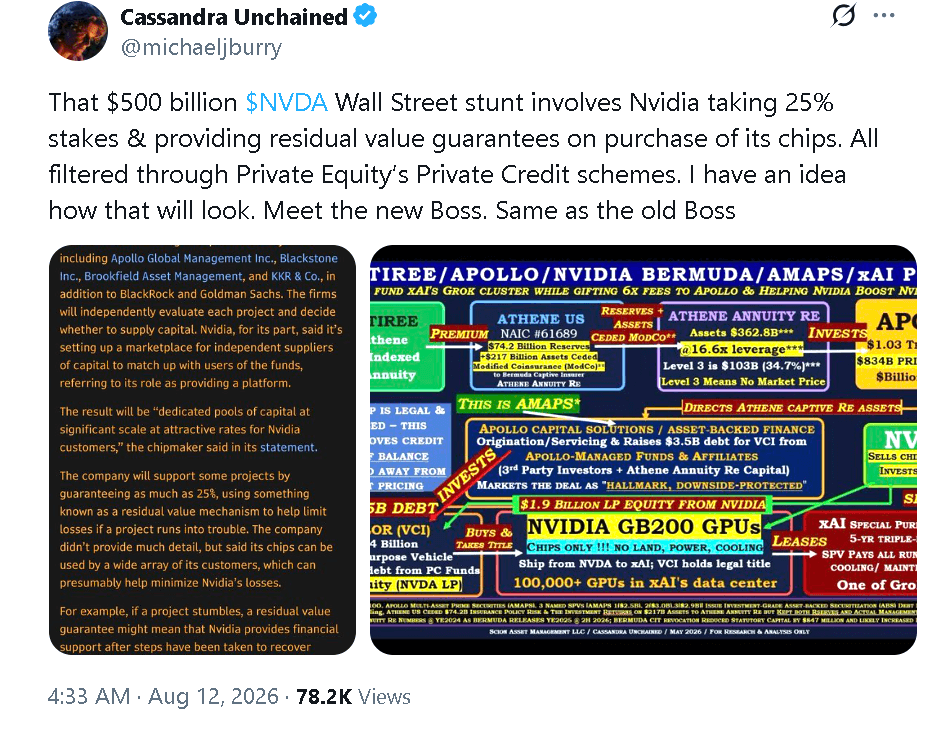
Michael Burry took aim at Nvidia's newly announced $500 billion financing platform, stating that the structure just recreates the same risky debt dynamics that fueled the 2008 financial crisis, this time repackaged for the AI boom.
"That $500 billion NVDA Wall Street stunt involves Nvidia taking 25% stakes & providing residual value guarantees on purchase of its chips. All filtered through Private Equity's Private Credit schemes,” Burry wrote. “I have an idea how that will look. Meet the new Boss. Same as the old Boss.”
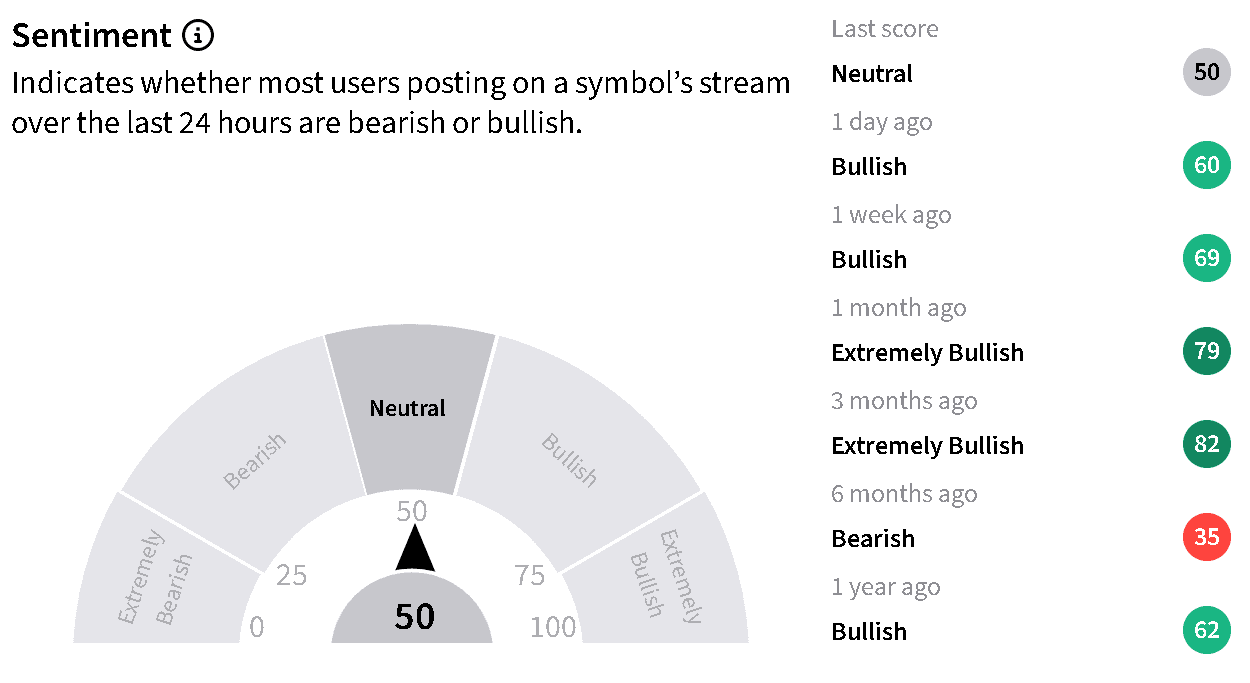
NVDA stock edged 0.8% lower in pre-market trade amid strength in the broader market. On Stocktwits, retail sentiment around the AI bellwether dipped to ‘neutral’ from ‘bullish’ territory over the past day, and chatter dropped to ‘normal’ from ‘high’ levels.
What Is Nvidia’s $500 Billion Deal?
Nvidia announced Monday that it had signed memorandums of understanding with Apollo, BlackRock, Blackstone, Brookfield, Goldman Sachs and KKR to mobilize more than $500 billion in third-party capital for AI infrastructure.
The platform is designed to finance projects including data centers, chip manufacturing facilities and power infrastructure, helping Nvidia customers fund the large upfront costs associated with expanding AI computing capacity.
The deal proposes that Nvidia could provide guarantees covering up to 25% of the residual value of its chips in individual financing transactions. The guarantees would be evaluated on a project-by-project basis and are intended to give lenders additional confidence in the future value of Nvidia's GPUs.
The financial institutions would independently assess each project's creditworthiness, while the capital would come from third-party investors rather than Nvidia's balance sheet.
Why Michael Burry Is Focused On Private Credit
According to Burry, the $500 billion in capital is being funneled through private credit, an increasingly dominant but less regulated corner of finance that's ballooned in recent years as banks pulled back from riskier lending.
Private credit funds, largely run by firms like Apollo, Blackstone, and KKR, now finance deals with less public disclosure and oversight than traditional bank loans or public bond markets.
The structure also comes on the heels of Apollo’s $35 billion Broadcom (AVGO) AI financing transaction in June 2026. The deal was structured through a special-purpose vehicle that purchased chips and leased them to Anthropic, with Broadcom backstopping payments.
That transaction was described at the time as the largest private credit deal of its kind. Nvidia's proposed financing platform, if fully realized, would be more than 14 times larger.
The Bear Case Burry Has Made Before
Burry's concerns build on his broader criticism of how companies account for AI infrastructure. In the past, he has said that hyperscalers could be understating depreciation expenses on AI chips because the hardware may become technologically obsolete faster than the useful lives assigned to it.
Nvidia's product cycle typically introduces new GPU architectures every two to three years, raising questions about how long older chips will retain significant economic value.
Nvidia CEO Jensen Huang has pushed back against that argument, saying GPUs such as the A100 can remain productive for close to a decade
Read also: Why Are Nasdaq, S&P 500 Futures Edging Higher Premarket Ahead Of CPI? SPCX, SMCI, CRWV, NBIS, MU Stocks In Focus
For updates and corrections, email newsroom[at]stocktwits[dot]com.<
