

China’s revenue share is expected to fall substantially in December after reaching 35% in September.
- Revenue of $8.22 billion beat the $8.14 billion consensus, while adjusted EPS of $2.20 topped estimates of $2.18.
- December revenue guidance reached $8.6 billion, but supply constraints will push some shipments into March.
- Lam sees semiconductor equipment spending exceeding $200 billion in 2027, with demand visibility through 2028.
Shares of Lam Research (LRCX) tumbled about 8% to $242 in overnight trading late on Wednesday despite record fiscal first-quarter results, as the chip-equipment maker disclosed supply constraints delaying some shipments and warned that China’s revenue contribution would fall in the December quarter.
LRCX stock fell 1% to $260.81 on Wednesday, with shares on pace to log their third straight week of losses after dipping 1% so far this week.
LRCX Q1 Review
Lam reported fiscal first-quarter revenue of $8.22 billion, beating the $8.14 billion consensus and setting a fifth consecutive quarterly record. Revenue increased 54% from a year ago and 22% sequentially, while adjusted EPS reached a record $2.20, above the $2.18 estimate.
Gross margin improved to 52.4% from 52% in the June quarter. Operating margin climbed to 40.2% from 38.4%, crossing 40% for the first time. Memory systems revenue surged 120% year over year, while NAND revenue grew 40% sequentially. The Customer Support Business Group also delivered strong growth, with revenue rising 40% from a year earlier to nearly $2.5 billion.
Lam generated record free cash flow of $3.24 billion and ended the quarter with $7.5 billion in cash and short-term investments, up from $5.6 billion in June. It repurchased $1 billion of shares and paid $325 million in dividends.
The company has $3 billion remaining under its overall buyback authorization, with an accelerated repurchase program continuing into December. Its long-term goal remains returning 85% of free cash flow to shareholders.
Supply Delays Hold Back Q2 Outlook
Lam forecast December-quarter revenue of $8.6 billion, plus or minus $400 million, and adjusted EPS of $2.33, plus or minus $0.15, versus consensus of $2.32. Gross and operating margins are expected to reach 52.5% and 40.5%, respectively, each plus or minus one percentage point.
However, CFO Doug Bettinger said supply constraints limited the outlook. “I would mention that this revenue guide would have been a bit higher if not for some near-term supply chain constraints that we are actively managing,” he said.
He declined to confirm an analyst’s estimated $300 million to $400 million impact, but said affected December shipments would move into March. CEO Tim Archer said some suppliers face demand growing faster than Lam’s own business. The company is working to expand supplier capacity and would consider investments if needed.
“For those of us who were around during the COVID shortages, this is nothing like that. We learned a lot of lessons during that period,” Archer said. “I think we’ll be caught up very shortly.”
Lam spent $258 million on capital projects and added about 1,900 employees during Q1. Inventory reached $4.6 billion, while inventory turns improved to a nearly seven-year high. The firm sees longer-term gross margins reaching the mid-50s. However, the adjusted tax rate rose to 16.5% from 11% in June and is expected to remain around that level in December and likely beyond.
China Revenue Share Set To Shrink
China accounted for 35% of September revenue, up from 26% in June, but Lam expects the share to fall substantially in December. “I expect that in December we’ll be meaningfully down, driven by the domestic customers in China,” Bettinger said.
Multinational customers in China are expected to remain reasonably strong, although Bettinger did not quantify the overall decline. He also expects mature-node spending outside China to strengthen in 2027, with little meaningful growth this year.
Lam Eyes Over $200B Equipment Market
Lam expects AI demand to sustain semiconductor investment beyond the current supply constraints. “Our preliminary 2027 WFE outlook is for more than $200 billion of spending, with percentage growth led by DRAM, followed by leading-edge foundry logic and NAND,” Archer said.
This compares with spending in the mid-$150 billion range expected for 2026. Lam sees demand through 2028 and 10 new major fabs opening in 2027. It also expects calendar 2026 systems revenue to grow well over 40%, marking a third consecutive year of industry outperformance. Foundry logic and DRAM have contributed 80% of systems revenue growth year-to-date.
AI’s need for faster storage could further increase equipment demand. “Said differently, for each percentage point mix shift of NAND bits to SLC class devices, approximately 2% more installed wafer capacity will be needed to support the same bit demand,” Archer said.
Lam raised its cumulative Aether-related revenue forecast through the decade’s end by $1 billion to $2.5 billion. Advanced packaging is expected to grow about 70% in 2026. “I would be stunned if advanced packaging didn’t grow nicely next year,” Bettinger said.
How Do Retail Traders Feel About LRCX?
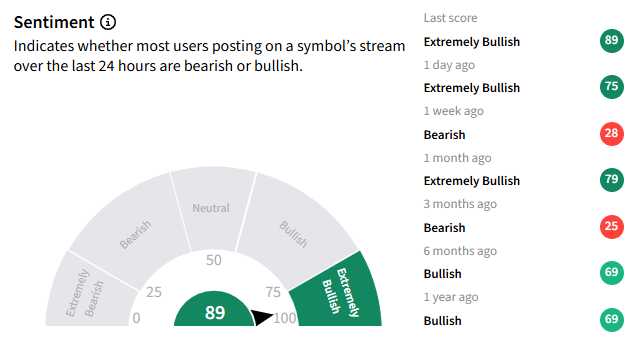
On Stocktwits, retail sentiment for LRCX jumped to ‘extremely bullish’ from ‘bullish’ levels a day ago amid a 758% surge in 24-hour message volumes.
One user noted, “It [Lam] has a great earnings surprise track record. Just one miss over the last 5 years and it was in 2022.
View this Stocktwits post
Another user said, “$LRCX This is a beat and raise quarter. Certainly not weak enough to break down below the range-- easy buy in the AH.”
View this Stocktwits post
LRCX stock has risen 53% year-to-date.
For updates and corrections, email newsroom[at]stocktwits[dot]com.<
