
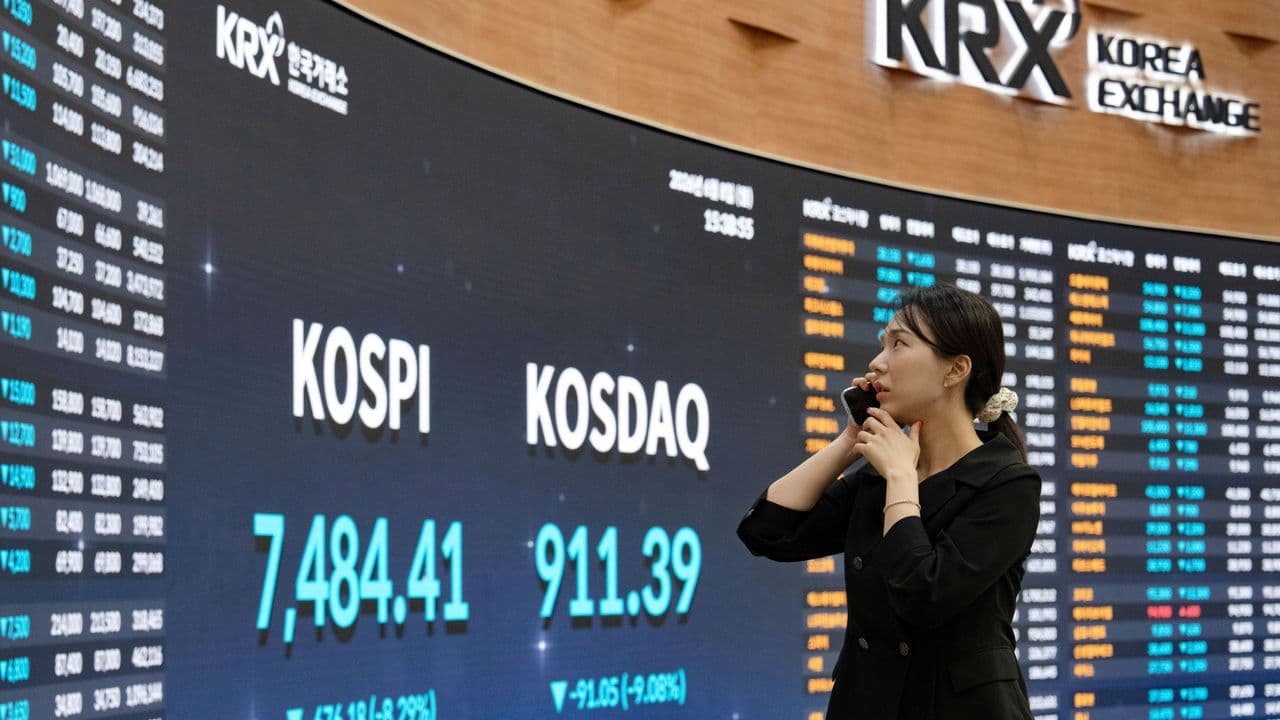
The Korea Exchange (KRX) said on Wednesday last week that it will begin operating an after-market trading session from Sept. 14, from 4 p.m. to 8 p.m.
- The move seeks to increase competitiveness with global markets and expand trading opportunities for investors, the bourse said in a statement.
- The new session will not include exchange-traded funds and exchange-traded notes during the four-hour session, due to concerns about market volatility, the KRX said.
- So far this year, South Korean stocks have dominated the global narrative, ticking higher due to soaring AI stocks.
South Korea's main stock exchange extended its trading hours this week, giving overseas investors greater access to a market that has been swept up in a red-hot, AI-driven rally drawing global attention, even as domestic traders have endured severe financial losses, historic corrections, and some of the most extreme market volatility in the bourse’s history.
The Korea Exchange (KRX) said last Wednesday that it will begin operating an after-market trading session from Sept. 14, allowing investors to buy or sell stocks in real time for four hours after regular trading hours. The after-market trading sessions will run from 4 p.m. to 8 p.m.
The move seeks to increase competitiveness with global markets and expand trading opportunities for investors, the bourse said in a statement. “The longer trading window generally means more flexibility for investors, and that makes the market more efficient,” Young Jae Lee, senior investment manager at Pictet Asset Management in London, reportedly told Bloomberg. “Investors who are more trading-oriented with higher turnover, or hedge fund types, may use it more frequently.”
After-Hours Trading Not Novel In Korea
While most stocks listed on KOSPI and Kosdaq are available for trading after the regular session closes at 3.30 PM, the concept is not entirely new in the Asian country.
Nextrade, an alternative trading system in the country, began pre-market and after-hours sessions in March 2025, which covered about 600 stocks. The move took over nearly a third of activity within a few months of its launch.
However, the new session on major Korean stock markets will not include exchange-traded funds and exchange-traded notes during the four-hour session because of concerns about market volatility, the KRX said.
Meanwhile, the stock exchange has said that it also plans to launch pre-market hours by the end of 2027.
Korean Markets Have Had A Stellar Run In 2026
So far this year, South Korean stocks have dominated the global narrative, ticking higher due to soaring AI stocks. The KOSPI has gained more than 55% in 2026.
AI memory stocks have bolstered Korean stock markets as explosive global demand for AI data centers has created massive shortages and record profits for high-bandwidth memory (HBM), which is essential for AI processors like Nvidia's and is heavily dominated by South Korean firms. SK Hynix Inc. (SKHY) and Samsung Electronics (SSNLF) are major players in the space and have contributed to much of the KOSPI's climb. SK Hynix has soared nearly 154%, while Samsung's Korea-listed stock has gained nearly 95% in 2026. U.S.-listed shares of SKHY have jumped more than 13% since its July launch.
However, volatility has also been extreme. The benchmark KOSPI Index surged early in the year, briefly crossing 9,000 points, before a sharp reversal sent it tumbling toward the 5,500-6,000 range in one of its most severe corrections on record. Retail investors had poured billions into leveraged AI chip funds and blue-chip tech names like Samsung Electronics and SK Hynix. However, when doubts mounted over whether massive global AI spending would translate into real profits, a wave of heavy selling triggered multiple trading halts and circuit breakers. Hundreds of thousands of retail investors faced sudden account liquidations and steep losses, with the pain compounded by escalating geopolitical tensions in the Middle East and rising energy costs weighing further on global equities.
The iShares MSCI South Korea ETF (EWY) has gained about 94% in 2026. Meanwhile, the Direxion Daily South Korea Bull 3X Shares (KORU), a leveraged ETF that aims to deliver 300% of the daily performance of large- and mid-cap South Korean equities, has soared about 154%.
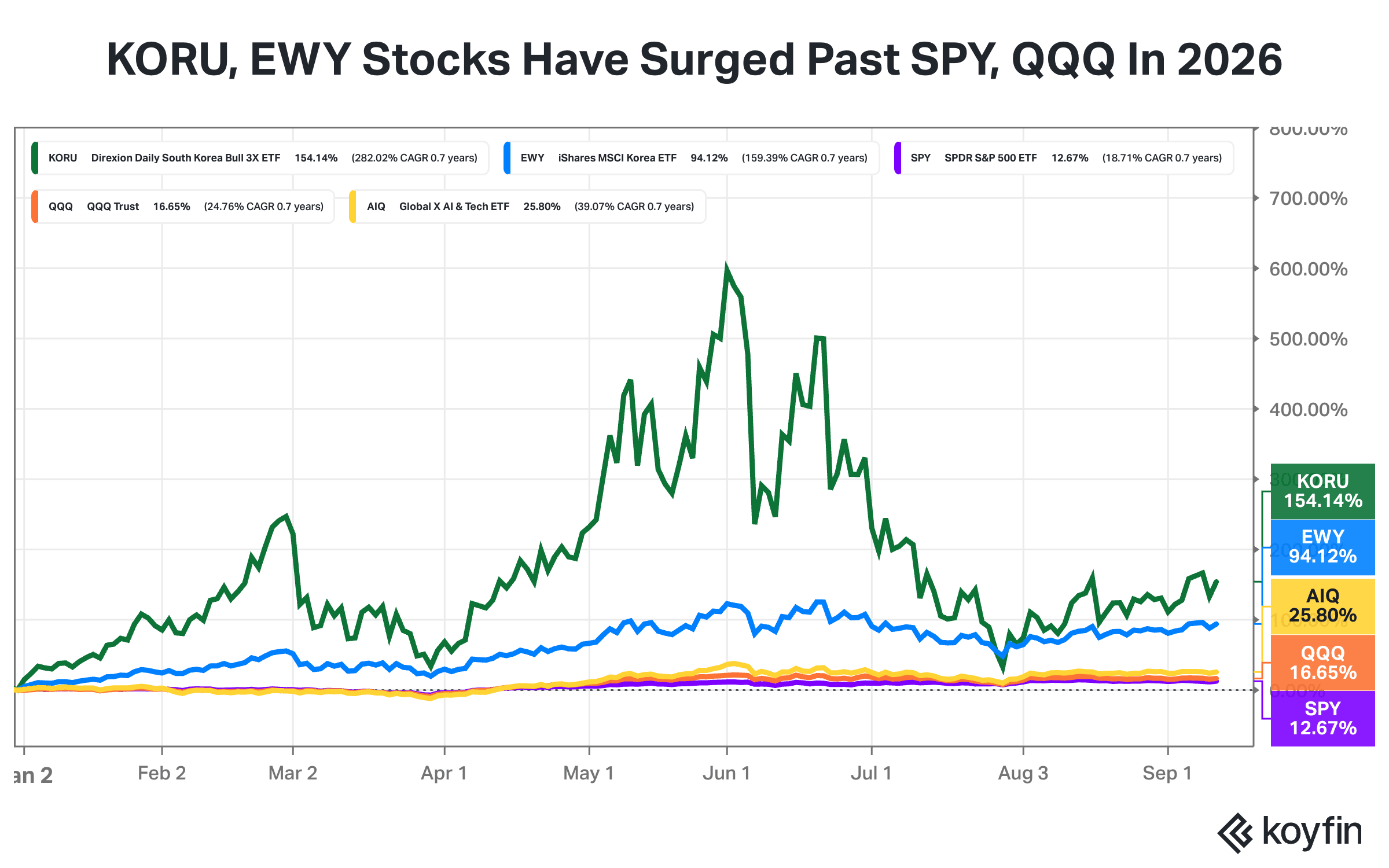
In comparison, the SPDR S&P 500 ETF Trust (SPY) has gained more than 12%, and the Invesco QQQ Trust (QQQ) has gained about 16.6% in the same time. The AI-heavy Global X Artificial Intelligence & Technology ETF (AIQ) has risen nearly 26% in 2026.
On Stocktwits, retail sentiment around KORU stock was ‘bearish’ while it was ‘bullish’ for EWY.
Meanwhile, retail sentiment for SPY and QQQ was ‘extremely bearish,’ and it was ‘bearish’ for AIQ.
For updates and corrections, email newsroom[at]stocktwits[dot]com.<
