
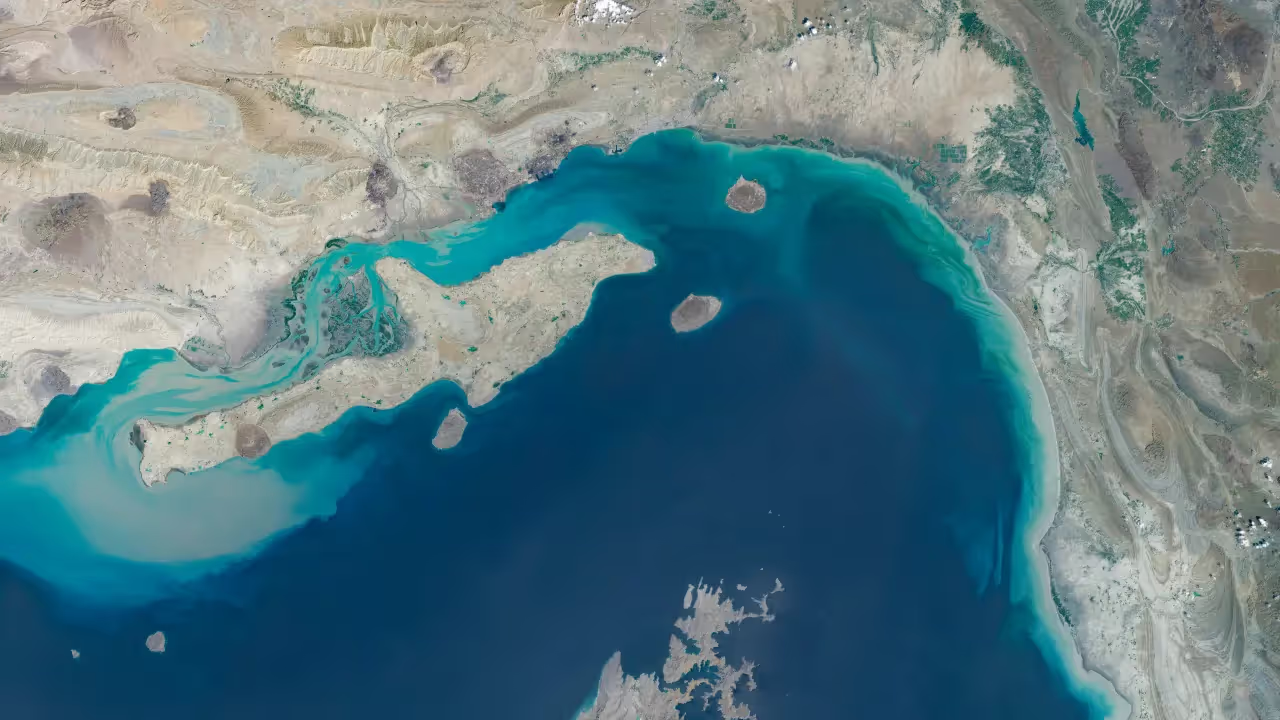
According to a report by Reuters citing Iranian state media, Tehran says Washington must take clear steps before the waterway can reopen.
- Iranian Parliament Speaker Mohammad Bagher Ghalibaf said Tehran's position on the Strait of Hormuz was “completely clear and firm.”
- Iran’s Foreign Ministry spokesperson Esmaeil Baghaei said that Tehran had conveyed its broad response to the U.S. through mediators, but that additional points still needed to be communicated.
- Foreign Minister Abbas Araghchi told foreign ambassadors and diplomats in Tehran on Sunday that Iran hoped the U.S. would choose diplomacy.
Iran will not reopen the Strait of Hormuz until the U.S. meets seven conditions tied to a June agreement, Iranian Parliament Speaker Mohammad Bagher Ghalibaf reportedly said on Sunday.
According to a report by Reuters citing Iranian state media, Tehran says Washington must take clear steps before the waterway can reopen, following a response from the U.S. through Qatari intermediaries last week.
The comments came after Tehran presented a proposal at the United Nations General Assembly that would allow normal maritime passage through the strait to resume within seven days if the conditions are met.
Iran Rejects US Demands As Hormuz Talks Continue
Ghalibaf, who is also Iran's top negotiator, said Tehran's position on the Strait of Hormuz was “completely clear and firm.”
“The Strait of Hormuz will not be opened until our seven conditions, based on the Islamabad Memorandum of Understanding, are met,” he said.
Ghalibaf added that Washington must understand that the era of “dragging out the diplomatic process and dictating one-sided demands is over.”
Iranian Foreign Ministry spokesperson Esmaeil Baghaei said that Tehran had conveyed its broad response to the U.S. through mediators, but that additional points still needed to be communicated.
Baghaei said the U.S. proposals remained broadly consistent with Washington's previous positions, particularly regarding Iran's nuclear program. Tehran, however, has told mediators that its immediate focus is the Strait of Hormuz and restoring security in the waterway.
Before the war, the strait carried roughly one-fifth of global oil and LNG supplies, making its reopening a major factor for global energy markets.
Iran Warns It Is Ready For Military Response
Alongside the diplomatic messaging, Iran's top officials continued to warn Washington against renewed military action.
The report added that Iranian Foreign Minister Abbas Araghchi told foreign ambassadors and diplomats in Tehran on Sunday that Iran hoped the U.S. would choose diplomacy, but warned that Tehran was prepared to respond if Washington again resorted to military force.
“If they again move towards military solutions, we are more prepared than before and will take whatever action is necessary to defend ourselves,” Araghchi said.
The warning follows reports that Iran is preparing a broader response if Washington resumes large-scale military attacks.
Crude Oil Mixed
Crude oil prices were mixed last week, with the U.S. West Texas Intermediate (WTI) futures expiring in November falling 1.41% to $91.26 a barrel after a 3.82% fall the week before.
However, Brent crude futures expiring in December rose 3.47% this week, hovering around $102.72 a barrel after a 0.46% increase the week before.
The United States Oil Fund ETF (USO) declined about 2% on Friday, while the ProShares Ultra Bloomberg Crude Oil ETF (UCO) fell about 0.4%.
During the after-hours session on Friday, the SPDR S&P 500 ETF (SPY), which tracks the S&P 500 index, rose 0.03%; the Invesco QQQ Trust ETF (QQQ) was flat; and the SPDR Dow Jones Industrial Average ETF Trust (DIA) rose 0.12%. Retail sentiment on Stocktwits toward the S&P 500 ETF was in the ‘extremely bullish’ territory at the time of writing.
For updates and corrections, email newsroom[at]stocktwits[dot]com.<
