

Gold prices and gold-backed financial assets are experiencing a major weekly surge driven by expectations of Federal Reserve policy easing, institutional buying by central banks, and positive global ETF inflows.
- U.S. gold equities and exchange-traded funds are pacing toward their strongest weekly performance in over a year, with spot gold climbing back above the $4,200 per ounce threshold.
- Recent U.S. non-farm payrolls data and labor market indications have strengthened market sentiment that the Federal Reserve will defer rate hike plans.
- Central bank additions—led by China's largest monthly purchase since late 2023—and a turnaround in global gold ETF inflows in July are providing strong structural support for the precious metal.
U.S. gold miners and gold-backed exchange-traded funds (ETFs) are on track to record their best weekly performance in over a year.
The rally in bullion-linked assets comes as spot prices surged past $4,250 per ounce. Driven by shifting expectations around Federal Reserve monetary policy, persistent central bank accumulation, and renewed investor appetite through physically backed funds, gold has regained strong upward momentum.
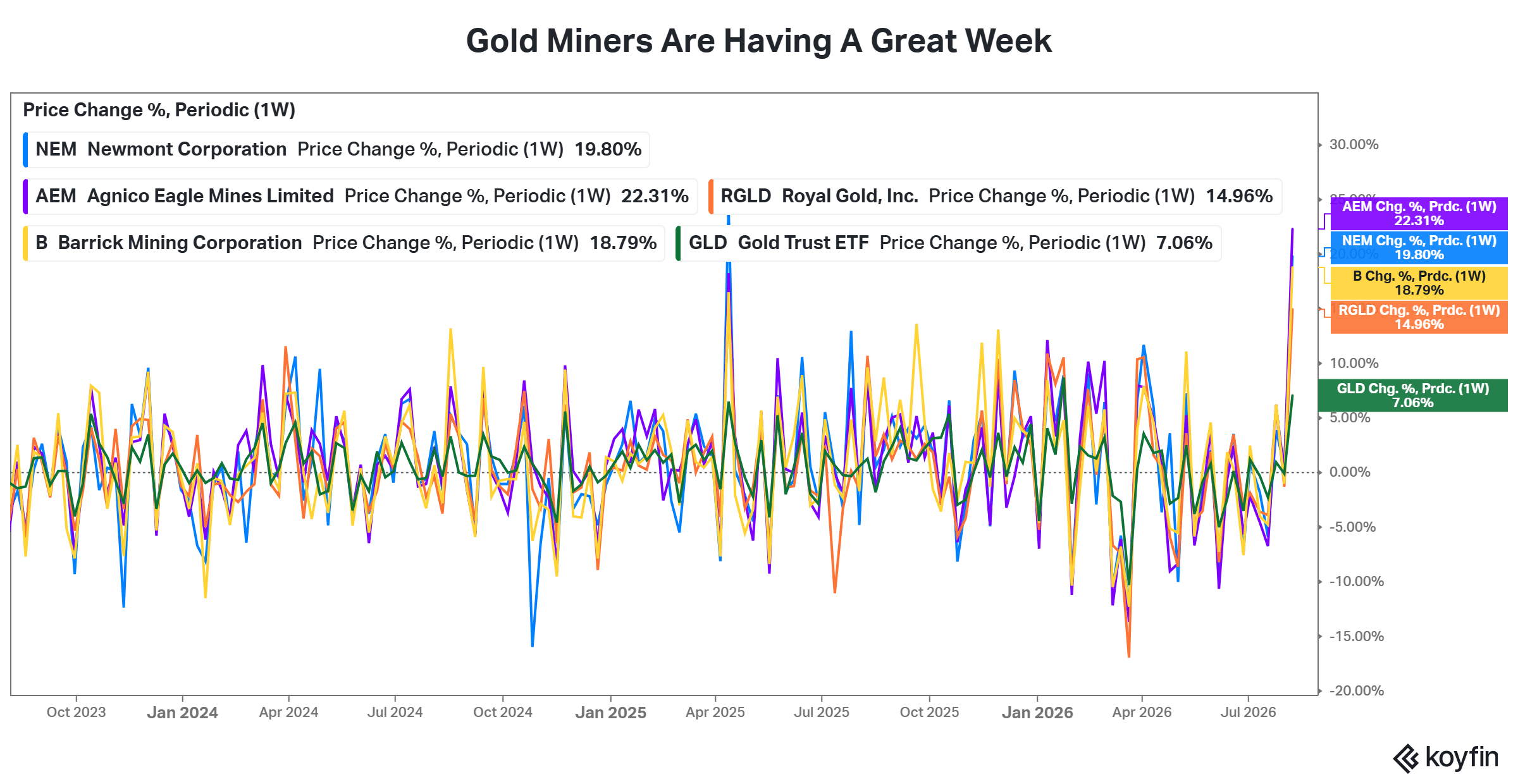
Agnico Eagle Mines (AEM), Newmont Corporation (NEM), and Barrick Mining (B) closed the week ending August 7 at their highest in over a year, while the SPDR Gold Trust ETF (GLD) saw its best week since January this year.
Cooling Labor Data And Fed Policy Drivers
The primary trigger behind gold's momentum stems from macroeconomic signals in the United States. Recent U.S. payrolls data points to a cooling labor market, giving financial markets reason to price in a more dovish stance from the Federal Reserve.
While inflation indicators remain elevated, partly due to energy price volatility linked to Middle East geopolitics and ongoing supply-side pressures, investors are betting that the Fed will refrain from additional rate hikes.
Market observers expect that a gradual moderation in inflation combined with steady policy rates will eventually transition into an easy interest rate scenario, creating a favorable climate for precious metals while putting downward pressure on the U.S. dollar.
Following the release of the non-farm payrolls report, which saw a surprise dip, the dollar has come under pressure as more traders anticipate the Fed to hold rates in its September meeting. July’s nonfarm payrolls report showed a drop of 23,000 jobs, while economists polled by Dow Jones had forecast a gain of 83,000.
According to the CME FedWatch tool, bets for a rate hike in September fell from 55% to 41.9%.

Analysts at UBS note that while near-term trading risk and volatility remain as markets digest economic releases, the medium- to long-term outlook points to gold potentially approaching $5,000 per ounce in 2027.
Global Gold ETF Outflows Reverse In July
In addition to macroeconomic policy expectations, private investment interest is returning to paper gold markets. According to the World Gold Council (WGC), global physically backed gold ETFs snapped a two-month streak of net outflows in July, recording net additions of 23.5 metric tons valued at around $2.97 billion.
The turnaround was primarily driven by European-listed funds, which added 17.3 tonnes (worth $2 billion) as investors seized on price dips near $4,000 per ounce as strategic entry points. UK and Swiss funds led the European demand, adding a combined $1.5 billion during the month.
While North American products experienced only modest inflows of 0.3 tonnes (worth $71 million), Asian-listed funds continued their steady trajectory, accumulating 4.8 tonnes ($616 million). Driven by market volatility in domestic equities and declining local yields, Asian funds remain the largest regional contributor to global year-to-date ETF inflows, which stand at $11 billion (39 metric tons).
PBoC Leads Central Bank Gold Purchases
Beyond retail and institutional fund flows, official sector purchasing continues to provide a structural floor for bullion prices. Data from the People’s Bank of China (PBoC) revealed that the Chinese central bank expanded its official gold reserves by 20 metric tons in July—marking its largest single-month net addition since October 2023 and extending its buying spree to 21 consecutive months.
According to World Gold Council analyst Krishan Gopaul, the July additions brought China's year-to-date official net purchases to 60 tonnes, raising total declared reserves to 2,366 tonnes. Other official institutions also increased holdings, including the Czech National Bank, which added 1.7 tonnes in July to bring its year-to-date total to 12 tonnes.
For updates and corrections, email newsroom[at]stocktwits[dot]com. <
