

The S&P 500 index gained about 0.3%, while the Nasdaq Composite edged up by 0.08%.
- Vice President J.D. Vance said during an address to reporters on Monday that the U.S. wants a regional ceasefire and that a process is now in place to prevent escalation in the region.
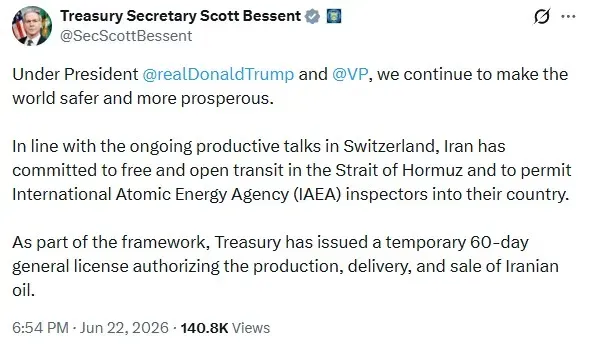
- Treasury Secretary Scott Bessent cited Iran's commitment to keeping the Strait of Hormuz open to shipping and permitting IAEA inspections as key factors behind the sales authorization.
- Vance termed Iran’s invitation for IAEA inspectors a major milestone for the American people.
U.S. equities gained in Monday’s opening trade after Vice President J.D. Vance hailed “great progress” in peace talks with Iran over the weekend.
The Dow Jones Industrial Average (DJIA) rose more than 320 points in the opening session before paring some of the gains. The S&P 500 index gained about 0.3%, while the Nasdaq Composite edged up by 0.08%.
Vance said during an address to reporters on Monday that the U.S. wants a regional ceasefire and added that a process is now in place to prevent escalation in the region.
Meanwhile, Treasury Secretary Scott Bessent announced that the Department of the Treasury has issued a 60-day authorization for Iranian oil sales.
“In line with the ongoing productive talks in Switzerland, Iran has committed to free and open transit in the Strait of Hormuz and to permit International Atomic Energy Agency (IAEA) inspectors into their country. As part of the framework, Treasury has issued a temporary 60-day general license authorizing the production, delivery, and sale of Iranian oil,” he said in a post on X.
Vance Says Iran Agreed To Allow IAEA Inspections
Vance also added that Iran has agreed to allow inspections by officials from the International Atomic Energy Agency (IAEA).
He called it a major milestone for the American people and said that it is the first step in ensuring that Iran is either permanently denuclearized or that it permanently ends its nuclear weapons program.
“Yes, there was a little bit of threatening, there was a little bit of whining, but at the end of the day, the talks continued, and we made great progress,” Vance added.
Crude Oil Prices Decline
Crude oil prices declined on Monday following Vance’s announcement. U.S. West Texas Intermediate (WTI) crude futures expiring in July were down 2.93%, hovering around $73.63 a barrel, the lowest levels in more than three months.
Brent crude futures expiring in August fell 3.3% to hover around $77.41 a barrel.
Crude oil prices have now fallen nearly 24% over the past month.
The United States Oil Fund ETF (USO) fell nearly 3%, while the ProShares Ultra Bloomberg Crude Oil ETF (UCO) declined about 4%.
At the time of writing, the SPDR S&P 500 ETF (SPY), which tracks the S&P 500 index, gained 0.23%; the Invesco QQQ Trust ETF (QQQ) rose 0.36%; and the SPDR Dow Jones Industrial Average ETF Trust (DIA) gained 0.46%. Retail sentiment on Stocktwits regarding the S&P 500 ETF was in the ‘bullish’ territory.
For updates and corrections, email newsroom[at]stocktwits[dot]com.<
