
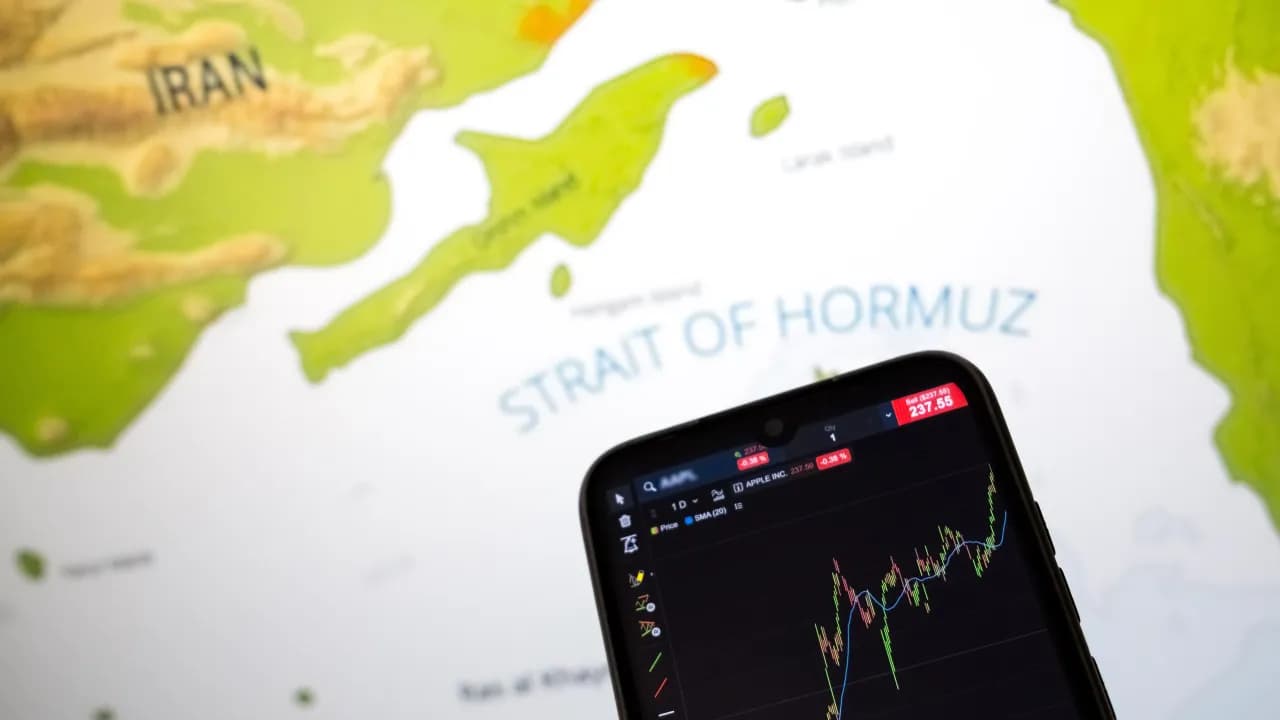
WTI crude jumped about 19% to around $108 per barrel, while Brent rose more than 16%, pushing oil back above $100 for the first time since 2022.
- U.S. stock futures tumbled to start the week as oil surged above $100 per barrel amid disruptions to shipping through the Strait of Hormuz.
- Production disruptions across Kuwait, Iraq and the UAE have weighed on sentiment.
- The Kobeissi Letter said that sustained oil prices at current levels could reduce U.S. GDP growth by about 0.5%, or roughly $160 billion in lost economic output.
U.S. stock futures fell sharply late Sunday as crude oil prices surged above $100 per barrel amid escalating conflict in the Middle East and disruptions to shipping through the Strait of Hormuz, fueling fears of a renewed inflation shock and slower economic growth.
As of 10.40 p.m. ET, Nasdaq 100 futures were down 2.5%, while S&P 500 futures were down by 2.2%. Dow futures were down 2.1%.
On Stocktwits, retail sentiment toward the SPDR S&P 500 ETF Trust (SPY) and Invesco QQQ Trust (QQQ) was ‘bearish’ amid ‘high’ message volume, while sentiment toward the SPDR Dow Jones Industrial Average ETF Trust (DIA) was ‘neutral’ amid ‘high’ message volume.
Here's how benchmark stock indexes changed over the past week:
| Index | Feb 27 Close | Mar 6 Close | Change |
| Dow Jones Industrial Average | 48,977.92 | 47,501.55 | −3.01% |
| S&P 500 | 6,878.88 | 6,740.02 | −2.02% |
| Nasdaq Composite | 22,668.21 | 22,387.68 | −1.24% |
What’s Driving US Stock Markets?
Markets reacted to a dramatic surge in oil prices and escalating geopolitical tensions after major Middle East producers curtailed output, with shipping through the critical Strait of Hormuz effectively halted.
West Texas Intermediate crude jumped about 19% to around $108 per barrel Sunday evening, while Brent crude surged more than 16% to roughly $107. The move pushed oil back above the $100 threshold for the first time since 2022, when markets were reacting to Russia’s invasion of Ukraine.
Oil prices spiked after producers across the Gulf region began cutting output amid security concerns and logistical disruptions tied to the conflict. Kuwait announced precautionary reductions in oil production and refinery output due to “Iranian threats against safe passage of ships through the Strait of Hormuz,” though it did not disclose the scale of the cuts.
Production in Iraq, the second-largest OPEC producer, has reportedly plunged roughly 70% to about 1.3 million barrels per day from around 4.3 million barrels per day previously. Meanwhile, the UAE said it is carefully managing offshore production levels as storage facilities fill up due to halted exports.
The Strait of Hormuz normally handles about one-fifth of global oil consumption, but tanker traffic through the narrow shipping corridor has effectively stopped amid fears of attacks. Storage facilities across the region are filling up as oil barrels accumulate with limited export routes available.
The geopolitical crisis showed little sign of easing over the weekend. Iran named Mojtaba Khamenei, the son of Ayatollah Ali Khamenei, as its new supreme leader following the killing of the elder Khamenei during the early days of the conflict. Meanwhile, Israeli forces struck fuel depots in Tehran and threatened further attacks on the country’s energy infrastructure.
President Donald Trump warned the U.S. could expand its military targeting in the region, saying attacks would continue “until they surrender or, more likely, completely collapse.” Trump also said on Sunday that higher oil prices in the short term were a “very small price to pay” for eliminating Iran’s nuclear threat.
"The Big Short" investor Michael Burry weighed in on X, saying that Trump may have entered “something that would be incredibly dangerous for the world” if a falling stock market again proves to be his “kryptonite.” Energy Secretary Chris Wright told Fox News that traffic through the Strait of Hormuz should eventually resume once Iran’s ability to threaten tankers is neutralized, though he acknowledged that a return to normal shipping conditions could take several weeks.
The Kobeissi Letter said on X that with U.S. oil prices now up more than $55 per barrel in the past three months, their models indicate U.S. GDP growth would decline by about 0.5% if current levels persist, equivalent to roughly $160 billion less economic output.
Economic data released Friday also added to the uncertainty. U.S. nonfarm payrolls fell by 92,000 last month, one of the largest declines since the pandemic, while the unemployment rate rose to 4.4%.
Trending Stocks To Watch On NYSE, Nasdaq
United States Oil Fund (USO), Indonesia Energy (INDO), Battalion Oil (BATL): Oil stocks surged in overnight trading on Sunday as crude prices jumped above $100 per barrel following supply disruptions and halted tanker traffic through the Strait of Hormuz amid escalating Middle East tensions.
Ondas Holdings (ONDS): The stock trended after the company announced about $6 million in new orders for its Sentrycs counter-drone systems from defense and homeland security customers, bringing total orders in March to $26 million.
Trump Media & Technology Group (DJT): Shares drew attention after Trump posted on Truth Social about the Middle East conflict and rising oil prices amid escalating geopolitical tensions.
How Global Markets Are Performing Today
In broader markets, the yield on the benchmark 10-year U.S. Treasury note was around 4.16% as of Friday. Gold traded near $5,124 per ounce. The U.S. dollar strengthened sharply, rising about 0.8% against the euro to roughly $1.1525 and gaining around 0.4% against the Japanese yen to near 158.48.
Asian markets were mostly lower on Monday. MSCI’s All Country Asia Pacific ex-Japan Index fell about 0.75%. The escalation in the Middle East conflict has weighed more heavily on Asia than on Wall Street so far, with South Korea’s technology-heavy benchmark suffering its biggest weekly selloff on record. Despite the recent decline, the broader Asian share benchmark remains more than 7% higher for the year, compared with a 1.5% decline in the S&P 500 year-to-date. Markets in Australia declined, while Japan also opened lower on Monday.
Among the catalysts for the week ahead are U.S. economic releases, including inflation, employment, and gross domestic product (GDP) data. Investors will also monitor earnings from Hewlett Packard Enterprise after the bell on Monday, followed by results from Kohl’s, Oracle, Dollar General, and Dick’s Sporting Goods later in the week.
For updates and corrections, email newsroom[at]stocktwits[dot]com.<
