
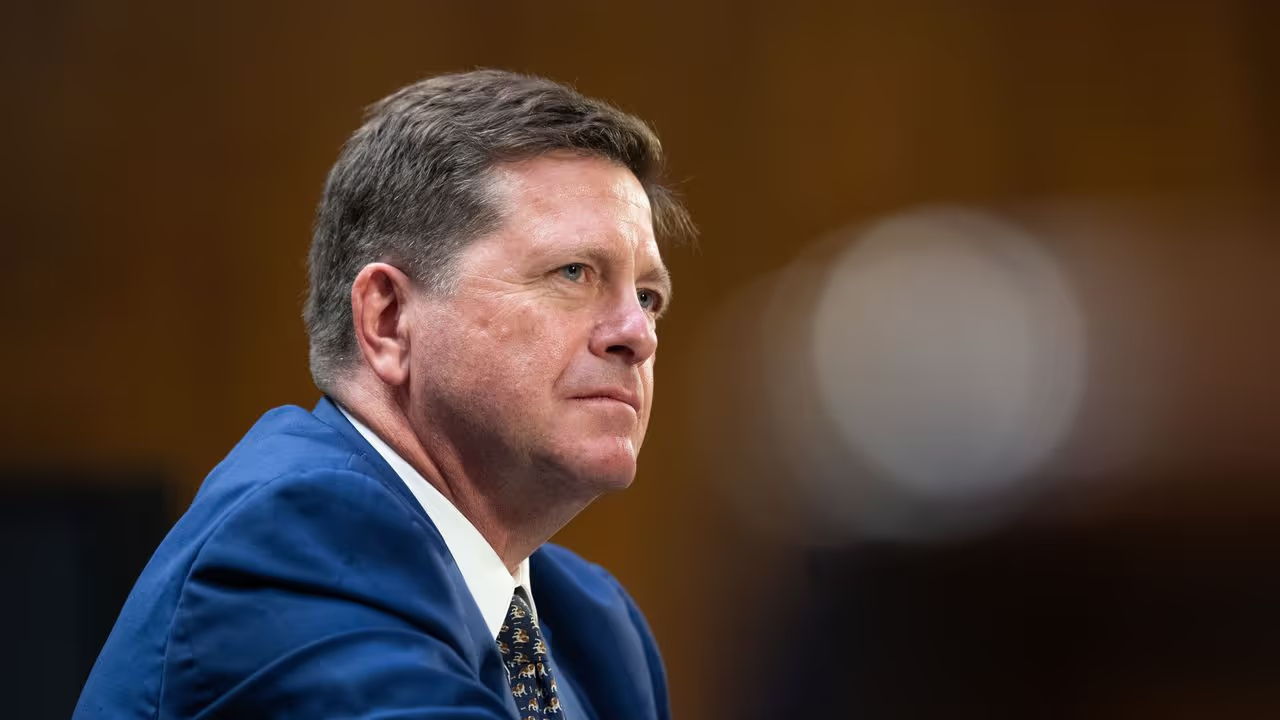
In an interview with CNBC, Jay Clayton said the U.S. faces AI competition from China, Russia, Iran and North Korea, and warned that open-source models can be misused.
- According to Clayton, open-source models, once released into the “digital atmosphere,” can serve good or “nefarious” purposes.
- He added that digital infrastructure is critical infrastructure, and AI “amplifies” cyber risks.
- His comments come after the Super Intelligence Force’s first meeting in Washington, D.C.
White House Super Intelligence Force Chair Jay Clayton said Friday that commercial and state-sponsored espionage are “realities” that AI companies and the government must guard against.
“Both commercial espionage and, I would say, state-sponsored espionage are realities,” he said in an interview with CNBC after the force’s first meeting.
He cited the OpenAI bugging case as evidence of “the lengths that people will go to try and supplant our leadership.” However, he did not say the OpenAI case itself was state-sponsored.
U.S. equities traded mixed after the opening bell. The S&P 500 rose slightly in morning trade, while AI stocks continued to trend lower. The SPDR S&P 500 ETF (SPY) was up 0.02%, and the SPDR Dow Jones Industrial Average ETF (DIA) continued to show strength, rising 0.61%. Meanwhile, the Nasdaq-100 tracking Invesco QQQ Trust (QQQ) extended its slide, down 0.7% at the time of writing.
On Stocktwits, retail sentiment around DIA fell to ‘bearish’ from ‘neutral’ territory over the past day, while sentiment around SPY improved in the opposite direction. QQQ saw retail sentiment continue to trend in the ‘bullish’ zone.
The OpenAI case
The Federal Bureau of Investigation (FBI) earlier this month arrested and charged Abdulrahman Alfozan, a 35-year-old Saudi national and OpenAI employee, with allegedly installing a covert audio-recording device in an executive conference room at the company’s San Francisco offices.
According to the Justice Department, the device was found plugged into a USB port behind a television and was concealed in toilet paper. The criminal complaint alleges that the room was used for discussions involving confidential technical, commercial and strategic information, including proprietary research, product plans and government engagements.
He added that many of the concerns raised about advanced AI center on cybersecurity and digital infrastructure, extend to essential services such as water and electricity, as well as national defense and communications networks.
“Superintelligence amplifies those,” Clayton said, referring to existing cybersecurity threats.
China Isn’t The US’ Only AI Competitor
According to Clayton, the U.S. isn’t just competing with China in the AI race. He pointed to Russia, Iran, and North Korea as having significant technical capabilities in AI. “We need to stay ahead of them,” he said.
Clayton also warned about open-source models released into the “digital atmosphere,” where they serve either good or “nefarious” purposes.
“We have to lead and lead responsibly,” he said, outlining how the Super Intelligence Force’s first meeting established several workstreams focused on AI risks and accountability.
The President’s Council of Advisors on Science and Technology, led by David Sacks, will conduct a risk study drawing on experts including Nobel laureates. The force also established committees to work on reporting and response mechanisms, critical infrastructure protection, and law enforcement and accountability.
Read also: AI Stock Sell-Off Could Catch Bearish Investors Off Guard In ‘Right Tail Risk’, But Wall Street Feels Broader Market Signals Are Holding Up
For updates and corrections, email newsroom[at]stocktwits[dot]com.<
