

Several brokerages, including Barclays, Goldman Sachs, BTIG, and Clear Street, lowered their price targets on COIN stock following the earnings report.
- Analysts cited lower crypto trading volumes and softer third-quarter guidance as the primary reasons for reducing their forecasts.
- Despite the weak quarter, BTIG and Clear Street said Coinbase continues to gain market share and diversify its business beyond spot trading.
- Investors are also watching the progress of the CLARITY Act, which could reshape the regulatory environment for the U.S. crypto industry.
Shares of Coinbase (COIN) dropped in early-morning trade on Friday after a slew of price target cuts from Wall Street following the company's second-quarter earnings report, which missed market expectations.
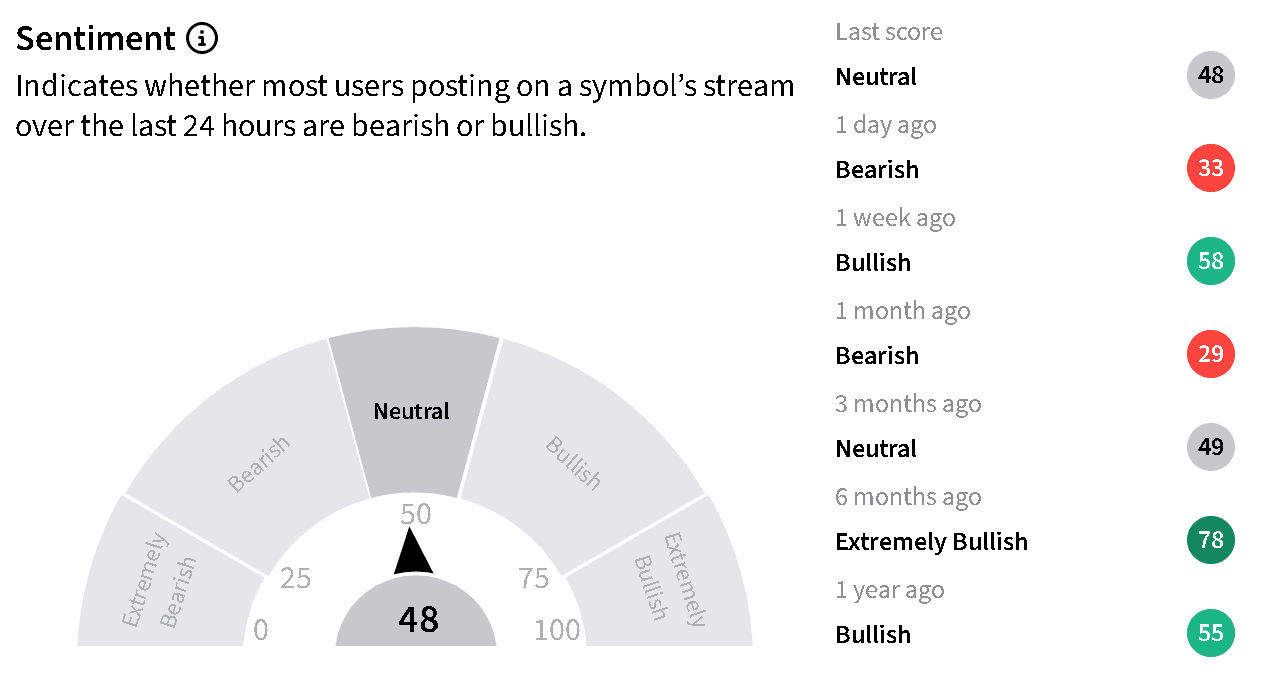
COIN stock fell more than 5% in pre-market trade, on track to slide below the $150 mark. However, retail sentiment on Stocktwits around the company improved to ‘neutral’ from ‘bearish’ territory over the past day. Chatter increased to ‘high’ from ‘normal’ levels, with platform data showing an over 200% jump in message volume.
BTIG lowered its price target on COIN stock to $240 from $260, while Clear Street trimmed its outlook to $204 from $225 and Goldman Sachs cut its price target to $173 from $198. All three kept a ‘Buy’ rating on the shares.
Meanwhile, Barclays slashed its already low price target to $95 from $99, and assigned an ‘Underweight’ rating to the stock.
Wall Street Lowers Price Targets After Weak Quarter
Barclays said the trends that weighed on Coinbase last quarter continued through the second quarter, with both revenue and adjusted EBITDA missing expectations by a wide margin. The firm also said Coinbase's third-quarter outlook suggests consensus estimates will likely need to move lower.
BTIG attributed much of the weakness to a difficult backdrop for cryptocurrency trading. Spot trading volumes fell 25% from the previous quarter, contributing to what the firm described as Coinbase's “weakest quarterly performance in two years.”
Clear Street and Goldman Sachs echoed that view, describing the quarter and near-term outlook as "challenging." Clear Street noted that third-quarter guidance came in below expectations because of continued pressure on trading activity, but said Coinbase's newer businesses continue to gain traction.
Earnings Miss Highlights Slower Trading Activity
Coinbase reported second-quarter revenue of $1.22 billion, missing analysts' expectations of $1.29 billion, according to Koyfin data. It posted a loss of $1.36 per share, compared with Wall Street expectations for a loss of $0.23 per share.
In the company's earnings release, CEO Brian Armstrong doubled down on the narrative of Coinbase's efforts to diversify beyond cryptocurrency trading. “Coinbase is no longer a bet just on the price of Bitcoin,” Armstrong said. “All of financial services are getting updated by crypto, whether that's trading or payments or lending, and Coinbase is the best-positioned company in the world to power this.”
The comments reflect Coinbase's broader strategy of building an “everything exchange” by implementing recurring revenue streams through products such as stablecoins, payments, custody, derivatives, and subscription services — not unlike what Robinhood (HOOD) has also been attempting to do over the past year.
COIN Stock Slides With Bitcoin’s Price
Beyond earnings, investors are also closely watching developments around the CLARITY Act, which could establish a clearer regulatory framework for digital assets in the U.S.
Lawmakers are attempting to advance the legislation before Congress begins its August recess. However, reports indicate supporters are still struggling to secure the 60 Senate votes needed for passage without Democratic backing.
The slide in Coinbase shares comes amid weakness in Bitcoin (BTC), which fell around 1% in the last 24 hours and slipped below the $64,000 mark.
COIN’s stock has fallen nearly 30% this year and is down almost 60% in the last 12 months. Meanwhile, Bitcoin’s price has also fallen around 30% so far this year, but only shown a drop of 45% in the last 12 months.
Read also: Robinhood CEO Says $1T Market Cap Goal Is Possible, But Analysts Remain Cautious Despite Q2 Earnings Beat
