
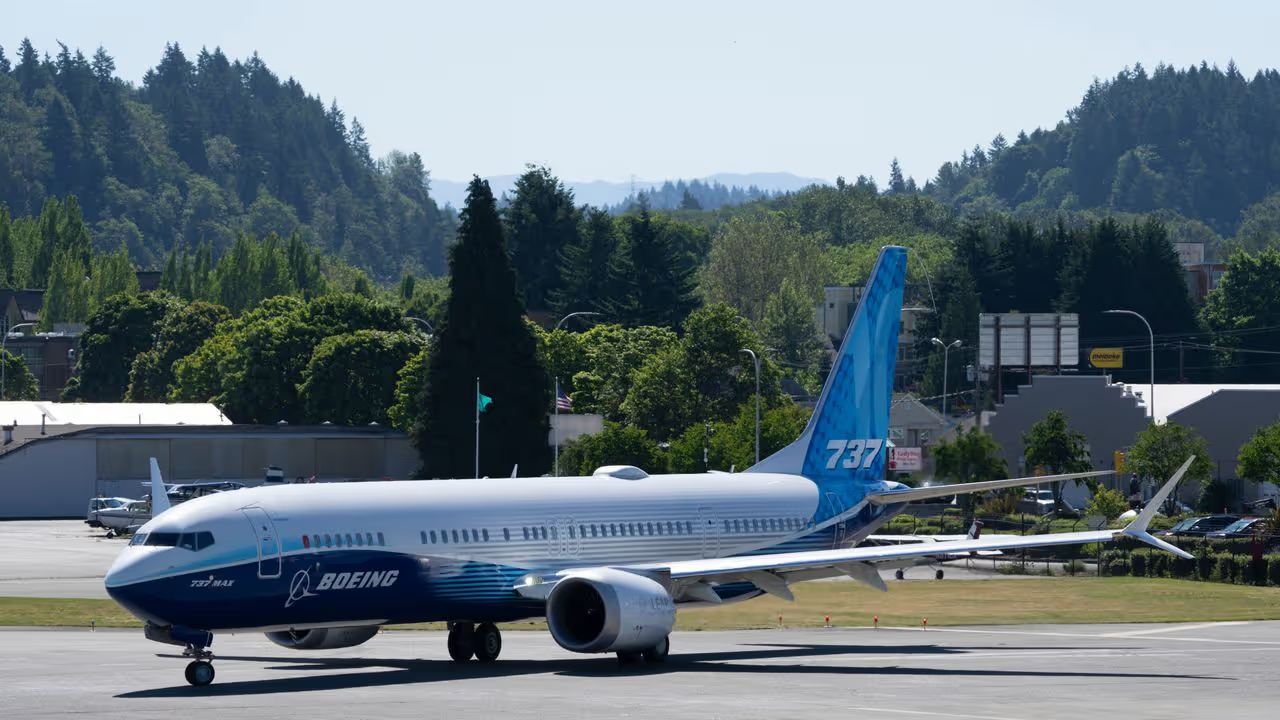
Boeing expects to reach the 737 production target of 47 aircraft per month in 2027, later than planned.
- Boeing CEO Robert Ortberg said the 737 production could need additional time to reach stabilization,
- The FAA approved the delayed 737 Max 10 last week, which has over 1,550 orders.
- Boeing expects free cash flow to increase from $2 billion in 2026 to $10 billion by 2029.
Boeing Co. (BA) stock is heading for a weekly loss as CEO Robert Ortberg outlined a path to $10 billion in free cash flow by 2029, with the company’s 737 production stabilization taking longer than expected. Boeing expects to reach its target production rate of 47 jets monthly in 2027, with cash flow improving over the next three years.
Boeing stock edged up 0.2% overnight Tuesday after a 10% drop in regular trading.
Boeing’s 737 Production Ramp Faces Delays
During the third-quarter (Q3) earnings call, Ortberg said Boeing is working to establish a manufacturing pace of 47 737 aircraft per month and needs additional time to sustain its targeted production rate.
“On 737, we continue to work towards stabilizing production at 47 airplanes per month. Our factory key performance indicators are performing well, particularly in the final assembly, where we've seen a 40% improvement in rework since the start of last year. However, as I mentioned at a conference last month, it is taking us longer than we had expected to demonstrate performance at rate 47. We're making progress, but we still have more work to do, and I'm expecting it will take us into next year to get fully stable at this rate.”
Boeing received U.S. approval last week for the 737 Max 10, its largest model in the 737 Max family, after a six-year wait. The plane has over 1,550 orders, making up more than 30% of Boeing’s total 737 Max orders. The delay followed safety checks after two deadly 737 Max 8 crashes in 2018 and 2019.
Boeing Sets Out Cash Flow Road Map
Ortberg acknowledged that shareholders have struggled to predict how Boeing’s operational improvements would translate into the balance sheet. The company expects to generate roughly $2 billion in free cash flow in 2026, followed by approximately $3 billion in 2027. That 2027 outlook includes additional capital spending to develop the F/A-XX program, the U.S. Navy’s sixth-generation fighter jet contract.
Boeing expects free cash flow to rise to about $6 billion in 2028 before reaching its $10 billion goal in 2029. Ortberg expects the financial recovery to pick up as some existing pressures ease.
The 777X program will remain a drag in the near term. “With respect to program cash flow, we continue to expect 2027 to be a significant use of cash with 2028 improving before turning positive in 2029,” said CFO Jesus Malave of the 777X.
Jefferies called Boeing’s free cash flow targets “disappointing,” noting that each year’s goal had slipped by about a year. In Q3, Boeing reported a loss of $0.34 per share, an improvement from a loss of $7.47 per share a year earlier but worse than analysts’ estimate of a loss of $0.25 per share, according to Fiscal.ai.
BA Stock: Retail View
However, on Stocktwits, retail sentiment for BA improved to ‘extremely bullish’ from ‘bullish’. The stock recorded a 900% surge in message volume over the past 24 hours.
A user said, “Just turbulence. We'll be back to smooth flying soon.”
BA stock has cratered 22% year-to-date.
For updates and corrections, email newsroom[at]stocktwits[dot]com.<
