Morningstar senior analyst Brian Colello said AMD needs to strengthen its software capabilities to challenge Nvidia’s AI dominance.
- On Intel, the analyst said the chipmaker is still the leader in PC CPUs despite AMD’s recent market-share gains, and could regain ground.
- Morningstar raised its fair value estimate for AMD to $570 a share from $530 but maintained a ‘fairly valued’ rating.
- Meanwhile, Nvidia and Intel retained their ‘undervalued’ ratings.
Morningstar believes that Nvidia (NVDA) and Intel (INTC) shares have more room to run than Advanced Micro Devices (AMD), despite a hike in the firm’s fair value estimate for the stock.
Senior analyst Brian Colello raised his fair value estimate for AMD to $570 a share from $530, while maintaining a ‘fairly valued’ rating. Meanwhile, Nvidia and Intel retained their ‘undervalued’ ratings with price targets of $570 and $85, respectively.
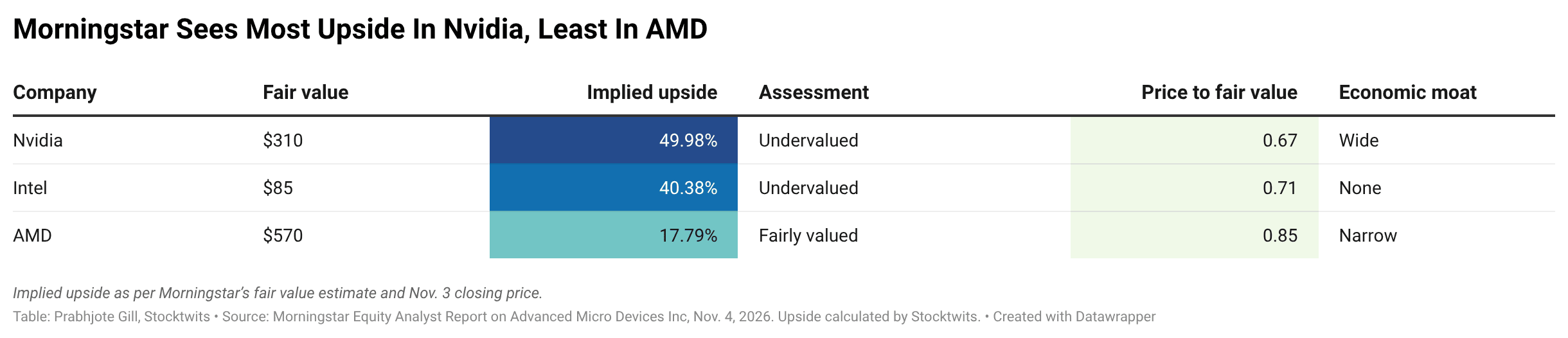
Morningstar’s fair value estimates imply a potential upside of around 50% for Nvidia, 40% for Intel, and 18% for AMD.
In pre-market trading on Thursday, AMD stock fell as much as 2.6%, while NVDA edged 0.3% lower and INTC shares dropped 1.2%. The overall tech sector was weaker, with the Nasdaq-100 tracking Invesco QQQ Trust Series 1 (QQQ) falling around 1.6% in early morning trade.
Nvidia’s Software Lead Remains A Hurdle For AMD
Colello said that the firm sees limits on AMD’s path against Nvidia. “AMD will need to improve its software capabilities to make a dent in Nvidia’s AI dominance, as Nvidia is strong in not only GPUs but also associated AI software tools,” he wrote.
“AI offers a massive opportunity to GPU makers, and while AMD lags industry leader Nvidia, we see plenty of room in the AI market for AMD.”
Brian Colello, Senior Analyst, Morningstar
On Intel, Colello noted that the older chipmaker has not lost its footing in PCs. “Despite AMD’s recent share gains, Intel remains the industry leader in PC CPUs and might recapture most of the market if it can deliver industry-leading manufacturing capabilities once again,” he wrote.
AMD’s Long-Term Forecast Includes Demand Pause
Morningstar’s higher valuation for AMD rests partly on the expected growth of its server CPU business. “We attribute our optimism to the rise of agentic AI, which should require exponentially more server CPUs for agentic orchestration workloads,” Collelo wrote.
Morningstar also raised its expectations for AMD’s server processor business. “We’re more impressed with AMD’s commentary for 2027, as server CPU revenue should grow 100%-plus, above prior expectations of 70%-plus,” the analyst said.
The firm expects AMD’s overall revenue to grow at a compound annual rate of 44% from 2026 to 2030. Its estimates also point to a sharp increase in AI GPU revenue, from $7.4 billion in 2025 to just under $17 billion in 2026, nearly $43 billion in 2027 and $80 billion by 2030.
The forecast does not assume that growth will continue uninterrupted. Morningstar said it had built in a pause in demand, followed by a recovery. “We bake in a pause in demand at some point and assume only 5% growth in 2032, but nearly 10% of revenue growth per year thereafter as AMD cements its place as a prominent AI vendor,” Colello explained.
The firm gave AMD a ‘Very High’ uncertainty rating. “AI is moving at warp speed, and future workloads and improvements are uncertain,” Colello said.
Memory Costs That Hit Apple Also Weigh On AMD’s PC Chips
AMD’s AI opportunity comes with risks in the PC segment, Morningstar said. It cited rising memory costs and concerns about PC demand in 2027.
It pointed to Apple CEO John Ternus’ comments during the company’s fourth-quarter (Q4) earnings call on Monday. “What we’re seeing with memory pricing right now is unprecedented,” he said.
Morningstar said it sees similar pressure building in the PC market. “High memory chip prices may stunt PC production and demand for AMD’s PC CPUs in 2027,” the firm wrote.
Colello said his lower forecast for AMD’s client PC business was “consistent with the gloomy comments about the PC market made by rival Intel last week.” He expects the company’s data center business to help offset the slowdown.
However, AMD might be less exposed to the pressure than Intel, according to Morningstar. Colello noted that AMD “has less PC exposure than Intel and believes it has more content in premium PCs that may be less price-sensitive to the high memory costs plaguing demand.”
How Is Retail Feeling About AMD Stock?
On Stocktwits, retail sentiment around AMD continued to trend in ‘extremely bullish’ territory, accompanied by ‘extremely high’ levels of chatter.
Some retail traders on the platform applauded CEO Lisa Su’s confidence in a significant fourth-quarter ramp in Helios rack-scale AI system deployments.
View this Stocktwits post
Others viewed AMD stock’s recent weakness as temporary noise that does not reflect the company’s underlying performance.
View this Stocktwits post
AMD stock has more than doubled this year.
Read also: Dan Ives Says 10% of Planned U.S. Data Centers ‘Will Not Happen’: Calls Democratic Sweep A ‘Seismic Shift’ For The AI Buildout
For updates and corrections, email newsroom[at]stocktwits[dot]com.<