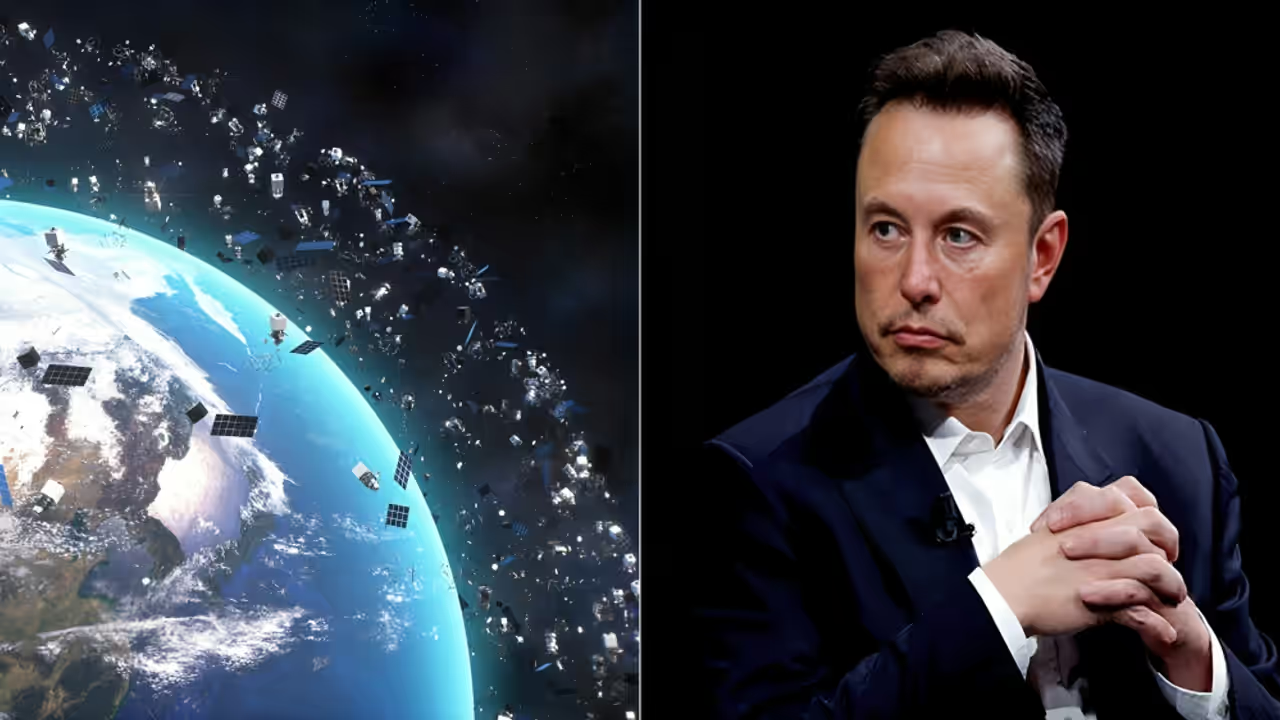
US astronomer has warned an increasing number of Starlink satellites are falling to Earth, raising concerns about space safety and atmospheric pollution. With up to 5 satellites re-entering daily, experts fear long-term effects on upper atmosphere.
Elon Musk's Starlink satellite network, operated by SpaceX, has transformed global internet access by connecting even the most remote corners of the world. However, experts are warning that the rapid expansion of the system is now creating serious space safety and environmental concerns, reports Daily Mail.
A growing number of Starlink satellites are falling back to Earth each day, burning up in the atmosphere. While these fiery reentries have fascinated skywatchers, scientists say the phenomenon could have long-term consequences for the planet’s upper atmosphere and the sustainability of near-Earth space.
Starlink satellites falling daily
According to Jonathan McDowell, an astronomer at the Harvard–Smithsonian Center for Astrophysics in the United States, one to two Starlink satellites currently re-enter Earth’s atmosphere every day. This number could rise to five satellites per day in the coming years as more constellations are launched.
Related Articles

McDowell’s data shows that the rapid turnover is linked to Starlink’s operational cycle, where satellites typically remain in orbit for five to seven years before being decommissioned. Older or faulty units are deliberately deorbited or fall naturally due to technical failures or solar activity.
“With all constellations deployed, we expect about 30,000 low-Earth orbit satellites from Starlink, Amazon Kuiper, and others,” McDowell told EarthSky. “That translates to five re-entries a day. It’s unclear if other systems, like the Chinese constellations, will orbit lower or contribute to a potential chain-reaction Kessler syndrome.”
A fiery show in the night sky
Across the world, skywatchers have reported bright fireballs streaking across the night sky, often mistaken for meteors. These glowing trails are caused by satellites burning up as they re-enter the atmosphere. Videos from the United States, Europe, and Japan have captured the spectacle, sparking both awe and concern.
As the satellites descend, friction with the atmosphere causes them to heat up and disintegrate, creating stunning light displays. While these reentries are designed to be safe with debris completely vaporising before reaching the ground, experts say the frequency of such events is a sign of the massive satellite turnover underway.
“This is the first time in history that we’re seeing this many satellites entering and leaving orbit in such short lifespans,” McDowell noted. “It’s a reminder of how crowded low-Earth orbit has become.”
Potential environmental impact
Scientists are increasingly concerned about the environmental effects of burning satellites. When Starlink satellites disintegrate, they release fine metal particles, particularly aluminium oxide, into the upper layers of the atmosphere.
These particles may interfere with ozone chemistry, reflecting sunlight and potentially altering the balance of the mesosphere, a region of the atmosphere critical to temperature regulation and weather dynamics.
“With tens of thousands more satellites expected to enter orbit, we simply don’t know how the buildup of metal residues could affect our atmosphere,” said McDowell. “Even if individual reentries seem harmless, the cumulative effect might be significant.”
Some researchers have called for stricter regulations and international studies to better understand how satellite reentries contribute to atmospheric pollution.
Space sustainability under pressure
The Starlink program currently operates more than 6,000 active satellites, making it the largest satellite constellation ever built. SpaceX plans to launch tens of thousands more in the coming years to expand global coverage.
However, experts warn that without better coordination, the increasing number of satellites could worsen the space debris problem, a phenomenon known as orbital congestion.
The Kessler Syndrome, a theoretical scenario where collisions between satellites generate a self-sustaining chain reaction of debris, is now seen as a growing risk. "We're not there yet," McDowell said, “but every uncontrolled reentry brings us a little closer.”
Space sustainability has become a central topic of discussion among astronomers and policymakers. Many argue that companies should share real-time tracking data and adopt standardised deorbiting procedures to reduce risks for other spacecraft and astronauts aboard the International Space Station.
SpaceX's response and safety measures
SpaceX maintains that all Starlink satellites are designed to safely disintegrate during reentry, leaving no debris that reaches the surface. The company also states that its new-generation satellites have improved propulsion and shielding systems to ensure safer deorbiting.
However, critics say more transparency is needed. They have urged private space firms to publish detailed environmental assessments and share long-term sustainability plans with international regulators.
Astronomers believe that maintaining a sustainable future for space requires global collaboration. With projects from SpaceX, Amazon’s Project Kuiper, and Chinese networks all expanding rapidly, experts insist that the world must act collectively to establish rules for responsible satellite management.
"Space is no longer a frontier, it's an essential part of human infrastructure," McDowell said. “We have to ensure that our progress doesn’t come at the cost of the planet’s safety or the future of exploration.”