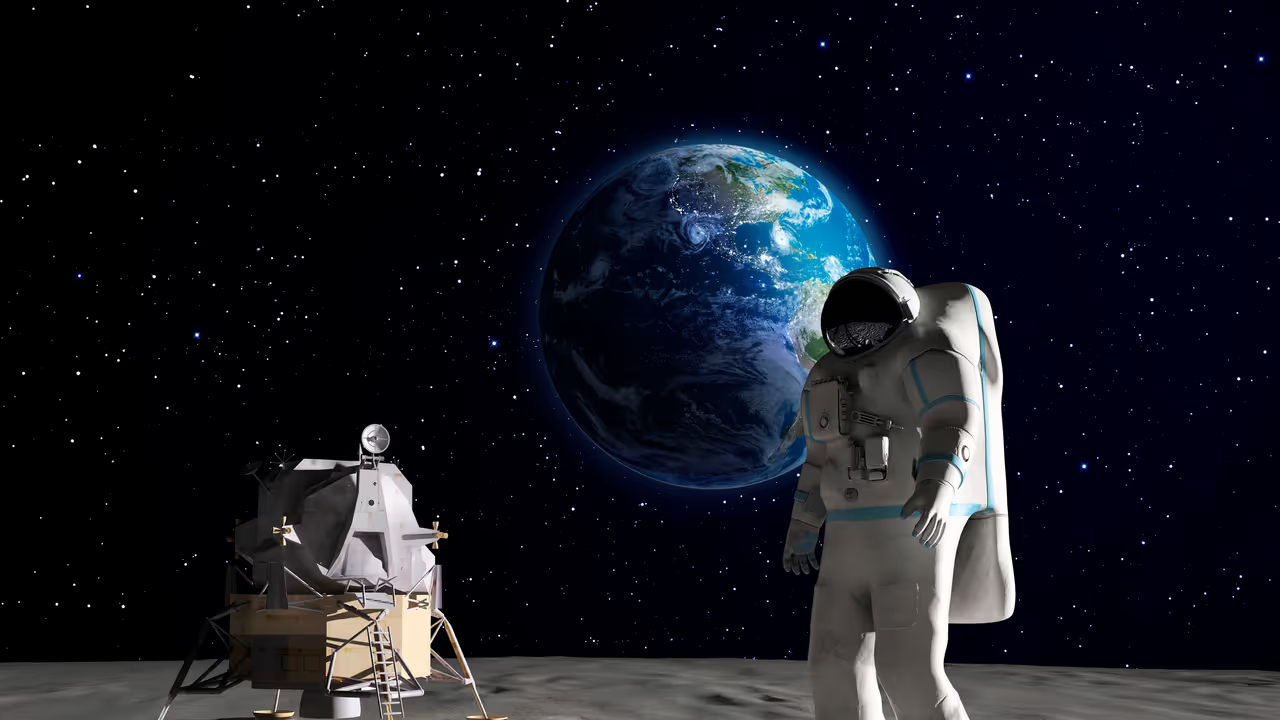
Scientists say faint hydrogen signals from the early Universe, detectable only from the far side of the Moon, could reveal whether dark matter is warm or cold. This breakthrough may finally uncover the mass of dark matter particles.
For decades, scientists have been chasing one of the greatest mysteries in physics: what is dark matter made of? This invisible substance makes up around 80% of the Universe’s matter, yet we can’t see it, touch it, or detect it directly. Now, new research suggests that the answer may lie on the far side of the Moon.
An international team led by Hyunbae Park of the University of Tsukuba, working with Naoki Yoshida at the Kavli Institute for the Physics and Mathematics of the Universe, has shown through advanced simulations that faint radio signals from the cosmic Dark Ages—the period before the first stars lit up—could hold the key to dark matter’s true nature. Their findings were published in Nature Astronomy .
Why Dark Matter Matters
Dark matter doesn’t glow or absorb light, but its gravitational pull shapes galaxies and the cosmic web of the Universe. One of the biggest unknowns is the mass of dark matter particles.
Related Articles

If dark matter is made of lighter particles (warm dark matter), it would prevent smaller cosmic structures from forming.
If the particles are heavier (cold dark matter), they would allow tiny clumps of gas and stars to develop. Pinning down which version is correct is crucial not just for astrophysics, but also for particle physics, where scientists are still hunting for a dark matter particle candidate.
A Signal from the Cosmic Dark Ages
The researchers focused on a time more than 13 billion years ago, in the Universe’s first 100 million years, before stars or galaxies existed. During this era, hydrogen gas cooled and clumped together under the influence of dark matter, leaving behind faint “fingerprints” in the form of 21-centimeter radio waves.
Their simulations revealed that the strength and shape of this hydrogen signal would change depending on whether dark matter is warm or cold. If we can detect this whisper from the early Universe, we may finally learn the mass of dark matter particles.
Why the Moon Is the Perfect Observatory
Here’s the catch: these signals are extremely faint, less than a thousandth of a degree in brightness. On Earth, they’re drowned out by human radio noise and the ionosphere.
That’s why scientists are looking to the far side of the Moon—a natural shield from Earth’s interference. Future lunar observatories could provide the “quiet zone” needed to tune into these cosmic messages.
Projects like Japan’s Tsukuyomi mission, which aims to place radio antennas on the Moon, could make this vision a reality within the next few decades.
A New Cosmic Frontier
While building observatories on the Moon is still a huge technical challenge, international interest in lunar science is growing rapidly. This study provides a roadmap for how these efforts could do more than explore the Moon—they could answer one of the most profound questions in all of science.
As Professor Yoshida notes, measuring faint signals from the Dark Ages could finally reveal the hidden mass of dark matter particles. And with that, the Moon may not just be humanity’s next frontier—it could also become the place where we solve one of the Universe’s oldest puzzles.