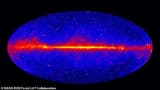
A University of York study suggests dark matter may subtly tint light red or blue as it passes through space, leaving a hidden glow that could reveal its presence and transform how astronomers hunt for the universe’s missing mass.
For decades, scientists believed that dark matter, which makes up nearly 85% of the universe’s mass, was completely invisible — detectable only through its gravitational effects. But a new study from the University of York suggests that dark matter may not be as dark as we thought.
According to the researchers, this mysterious substance could subtly tint light red or blue as it passes through, leaving behind a faint “color fingerprint.” If proven, this discovery could revolutionize how we search for the universe’s hidden matter — and redefine what we know about the cosmos.
Shedding Light on the Dark
Until now, dark matter has been known only for the invisible gravitational pull that holds galaxies together. Because it doesn’t emit, absorb, or reflect light, it has eluded every telescope and detector ever built.
Related Articles

But the new York model challenges that long-held belief. It proposes that light might interact indirectly with dark matter through a “chain reaction” of intermediary particles. Depending on the nature of these interactions, light could shift slightly toward the red or blue end of the spectrum — a phenomenon scientists could detect with next-generation telescopes.
The “Six Handshake Rule” of Particles
The idea is inspired by the “six degrees of separation” concept — that any two people can be connected by a short chain of acquaintances. Similarly, the researchers suggest that light and dark matter could be linked through a series of intermediary particles.
For instance, dark matter particles — particularly WIMPs (Weakly Interacting Massive Particles) — might influence photons indirectly through connections involving the Higgs boson or top quark.
Even though dark matter doesn’t directly “touch” light, it might still change its path or color ever so slightly through these hidden interactions.
Detecting the Universe’s Hidden Glow
Dr. Mikhail Bashkanov, from the University of York’s School of Physics, Engineering and Technology, described the discovery as a bold new way to look at one of physics’ deepest mysteries.
“It’s an unusual question to ask because most scientists would say dark matter is, well, dark,” he said. “But we’ve shown that even the darkest kind imaginable could still have a detectable color signature.”
He added,
“Under the right conditions, that faint color shift could be measurable. With advanced telescopes, we might soon be able to see traces of dark matter — and that’s a thrilling thought.”
A New Roadmap for Cosmic Exploration
The team’s findings, published in Physics Letters, outline how these color distortions could be tested using upcoming astronomical instruments. By observing light from distant galaxies and checking for these subtle tints, researchers could confirm whether dark matter truly leaves behind a “hidden glow.”
Such evidence could allow scientists to rule out some dark matter models and focus their efforts on those that best match observational data — potentially saving years of experimental work and billions in research costs.
Dr. Bashkanov believes this discovery could reshape how humanity hunts for dark matter:
“Right now, we have dozens of large-scale experiments chasing different particles — from axions to dark photons. Our study shows we might already have clues in the light coming from the sky. We just need to know how to look.”
The Beginning of a Brighter Search
If confirmed, these findings could bring us one step closer to understanding the invisible fabric of the universe. Instead of being completely unseen, dark matter may be painting the cosmos with faint, hidden colors — a subtle glow that could finally expose what 20th-century physics could only imagine.