
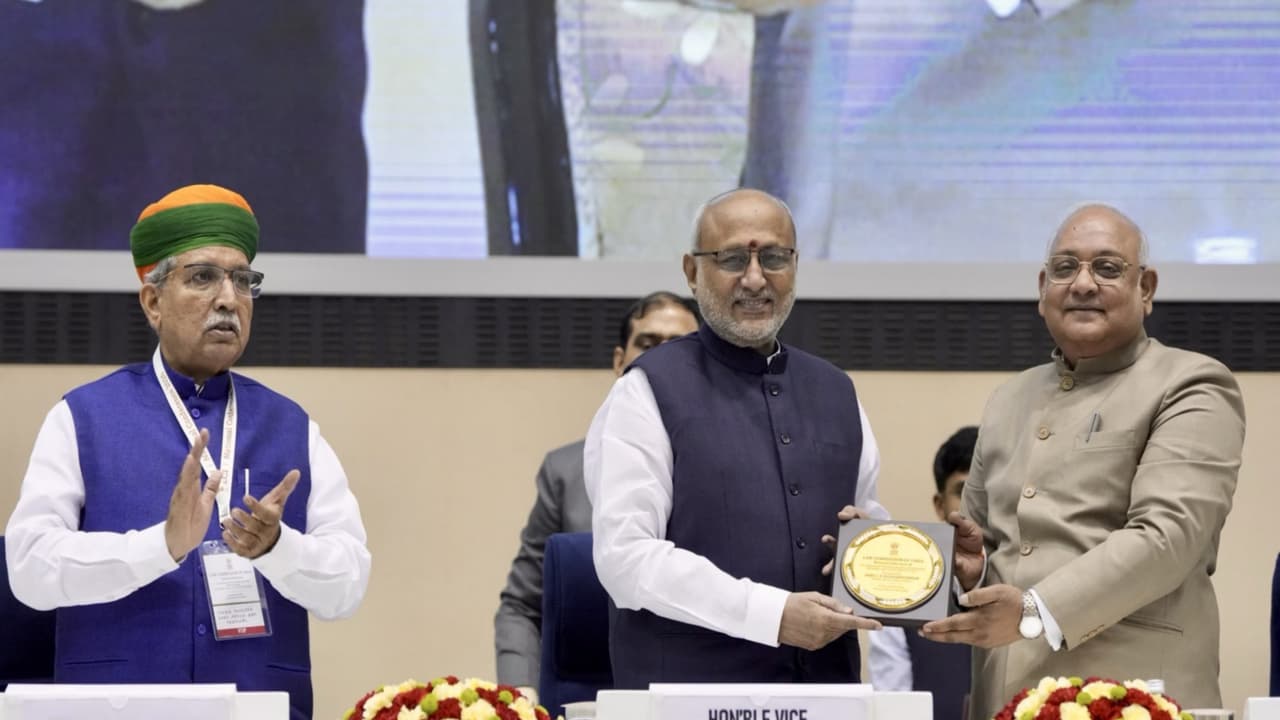
Vice President CP Radhakrishnan called legal reforms essential for India's progress, urging states to identify and repeal outdated laws. He said the replacement of colonial-era criminal laws could serve as a model for state law commissions.
Vice President CP Radhakrishnan on Thursday said legal reforms were essential for India’s progress and called on state law commissions to identify outdated laws and recommend amendments or repeal wherever necessary. Addressing the National Conference on “Co-operative Federalism and Law Reforms: National and State Perspectives” organised by the Law Commission of India at Vigyan Bhawan, Radhakrishnan said the replacement of three colonial-era criminal laws was a major step towards reforming the country’s legal system. He said the experience of these reforms could serve as a model for state law commissions to help state governments review outdated laws, promote liberty and improve governance.
VP Calls for Cooperative Federalism in Law Reform
The Vice President said cooperative federalism did not mean uniformity in every aspect of governance. Instead, it required cooperation between the Centre and states while allowing states the flexibility to address their specific needs. He called for better coordination between the Law Commission of India, state law commissions and state law departments. Sharing best practices, consulting other states and reviewing outdated laws could help remove inconsistencies and make legislation more effective, he said.
Radhakrishnan also referred to the Sengol installed in Parliament and the teachings of Tamil philosopher Thiruvalluvar on good governance. He expressed hope that the conference would produce concrete recommendations, adding that the ultimate purpose of law was to ensure justice and dignity for citizens.
Justice as a Shared Responsibility
Justice (Retd.) Dinesh Maheshwari, Chairperson of the Law Commission of India, called for greater cooperation between the Centre and states in framing and reforming laws, saying that justice was a shared responsibility. He said citizens facing outdated laws, delayed cases or complicated procedures were concerned about whether the law worked effectively, rather than whether the problem arose from a Union or state law. “The Constitution distributes legislative powers, but the pursuit of justice is a shared responsibility,” he said.
Proposed Federal Law Reform Protocol
Justice Maheshwari said the Centre and states should use existing mechanisms for consultation and cooperation to make law reforms more effective. He cited the GST Council as an example of the two working together while retaining their respective constitutional roles. He proposed that the conference consider a voluntary federal law reform protocol to help states and the Centre share research, discuss legal challenges and learn from one another’s experiences. The proposed framework could include consultations before drafting laws, assessments of their practical impact and reviews after implementation.
Evidence-Based Reform
He said law reform should be based on evidence, consultation and evaluation. Studies should consider not only court judgments and legal principles but also the experiences of litigants, lawyers, officials, businesses and vulnerable communities. He also suggested that states be encouraged to test new approaches and share successful practices. “The division of legislative powers must not become a division of knowledge,” he said, stressing that national priorities and local experiences should inform the lawmaking process.
National Priorities and State Experiences
Union Minister of State (Independent Charge) for Law and Justice Arjun Ram Meghwal also addressed the conference, highlighting the importance of cooperative and competitive federalism in improving governance. He stressed the need to combine national priorities with state-level experiences and referred to the importance of the rule of law and constitutional principles.
Sharing Knowledge for Citizen-Centric Reforms
Law Commission member Anju Rathi Rana said states needed to share their legal experiences and learn from one another. She said a problem faced in one state might already have been addressed in another, making the exchange of knowledge important for effective law reform.
Rana stressed that reforms should focus on the difficulties citizens face in their daily lives and make laws and public services simpler and more responsive. “The task is not to make every state alike. It is to ensure that no state has to be alone,” she said.
She also called for a system to share research and preserve institutional knowledge so that experiences from individual states could help improve laws across the country. (ANI)
(Except for the headline, this story has not been edited by Asianet Newsable English staff and is published from a syndicated feed.)