
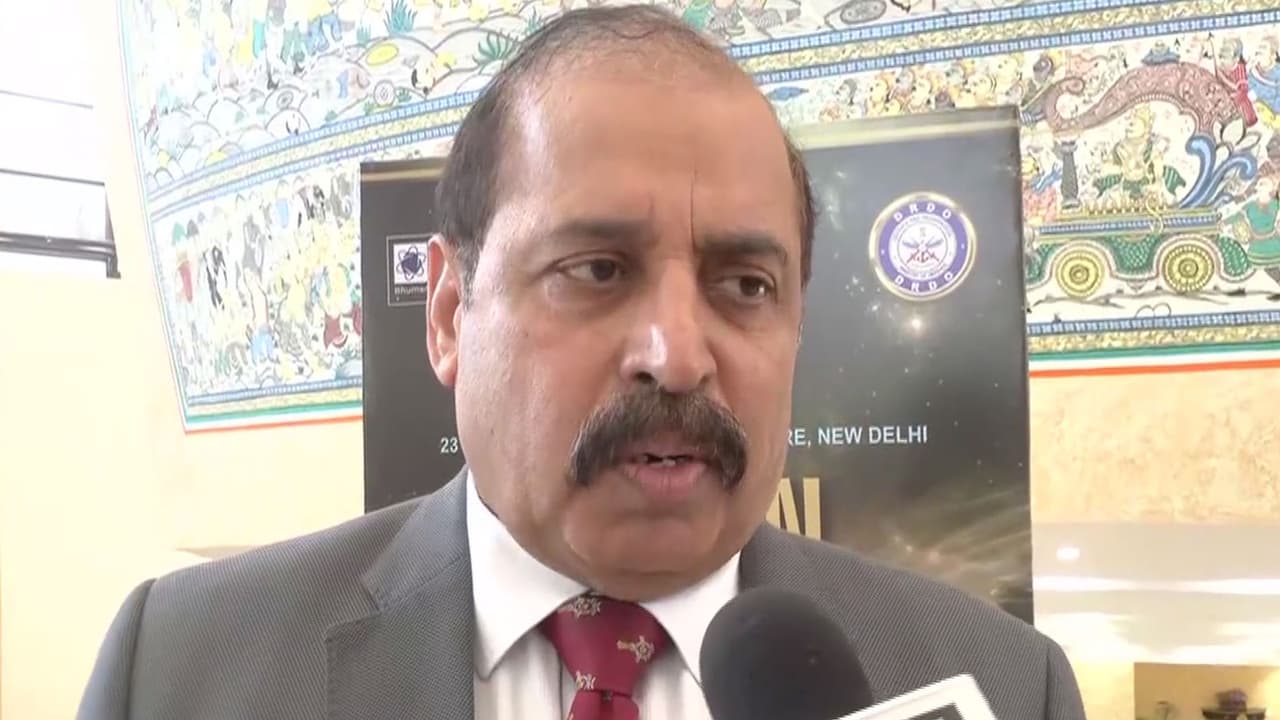
Ex-IAF Chief RKS Bhadauria outlines India's military future, driven by theaterisation, tech, and AI. He highlighted the need for indigenous systems, space-based assets, and lessons from modern conflicts like the use of drones in Ukraine.
Future Military Shaped by Integration and Tech
India's future military transformation will be shaped by theater-based integration, rapid technology adoption, and artificial intelligence-driven systems, former Indian Air Force Chief Air Chief Marshal RKS Bhadauria said on Thursday at the Def Space Symposium in Delhi.
Speaking at the Def Space Symposium in Delhi, he said ongoing defence reforms, including the push towards "theaterisation", will reshape how the armed forces operate by bringing all services under integrated command structures. According to him, future warfare will depend heavily on stronger digital networks, indigenous technology development, and faster decision-making systems. Bhadauria said integration across services, backed by advanced command and control systems, will be central to future operations.
Theatrisation and Command Structures
Retd. Air Chief Marshal RKS Bhadauria told ANI, "... Focus and work on theatrisation are continuing... It is very important to consider the kind of networks we will set up in the future and the integrated capability building. The C2 (Command and Control) structures that will come up are also key. "
He added that the future warfare systems will depend heavily on space-based assets and real-time intelligence, which will improve coordination between services and enable faster operational responses.
Emphasis on Indigenous Systems
Further, as per the former Air Chief, India's ability to build indigenous systems will be critical for long-term defence strength.
Former Air Chief added, "The growth in space will directly contribute to a higher level of capability towards the reform structures that will come in. Having such indigenous capacity is essential. We should be able to have persistent ISR (Intelligence, Surveillance, and Reconnaissance), complete situational awareness. Our command and control should be fully integrated and responsive, and decision-making should be very fast..."
Lessons from Modern Warfare
Retd ACM Bhadauria also highlighted the rapid rise of unmanned systems and data-driven warfare, noting that ongoing global conflicts, including the war in Ukraine, offer important lessons.
"The Drone force is a low-cost capability that has emerged and is hugely disruptive in nature. It is evolving rapidly. If we look at what is happening in Ukraine, we can see more evolution taking place, and it's being deployed fast... They make a change today and field it tomorrow, often on the battlefield. There are many lessons to be learned from that...." the Retd. ACM told ANI.
The Rise of AI and Autonomous Systems
He added modern warfare is increasingly shaped by data ecosystems, artificial intelligence, and autonomous systems, which are gradually changing the speed and nature of military decision-making.
The former Air Chief said, "In terms of data, the world is moving towards AI, data, autonomous operations... When you have a digital footprint in the manufacturing process, where capabilities are digitized, and data is available in various forms... it provides a larger capability to make those systems AI-enabled or ML-enabled in the future. This will make systems more capable and faster. Once AI and ASI (Artificial Superintelligence) come in, we may even see autonomous systems with kill capabilities in the next 10 years... With the way the world is evolving, we will have to design systems that are capable of such capabilities in the future..." (ANI)
(Except for the headline, this story has not been edited by Asianet Newsable English staff and is published from a syndicated feed.)