
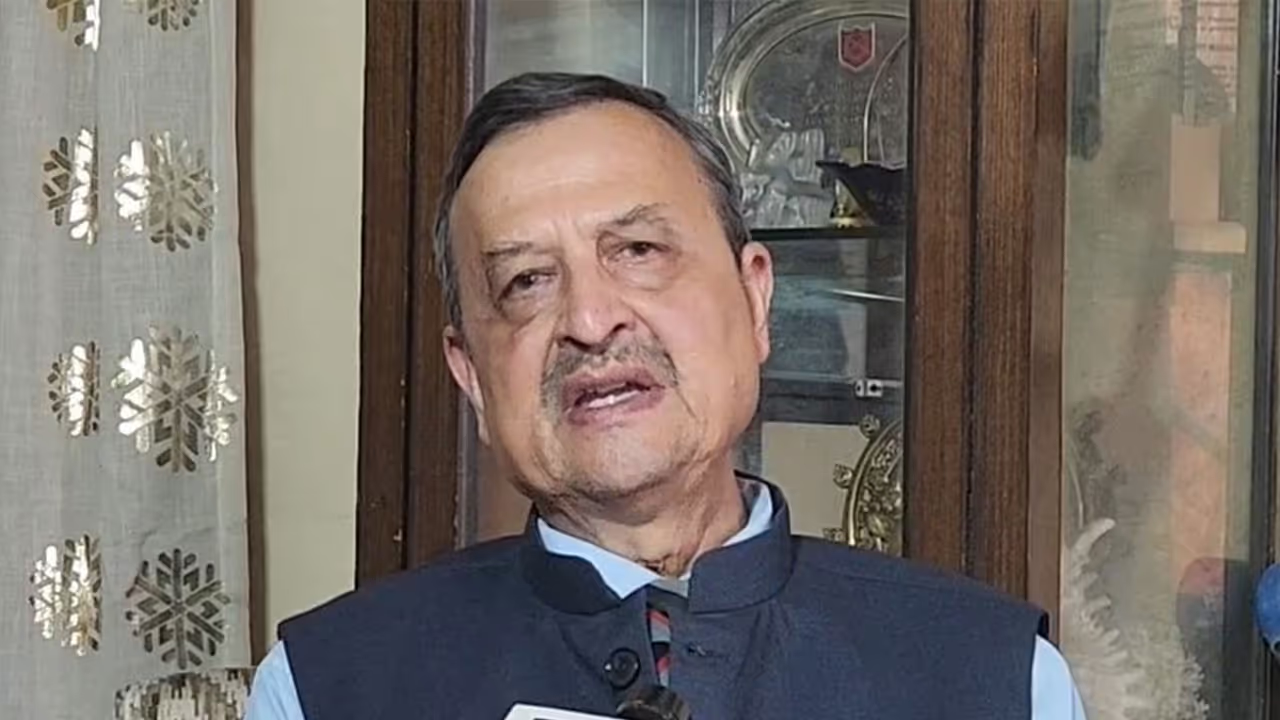
Russia has proposed supplying advanced engines to modernise the IAF's Su-30MKI fleet. According to defence expert (Retd) Brig Hemant Mahajan, this will significantly boost the fighter's thrust, endurance, and combat range, giving India an advantage.
Russia's proposal to supply advanced engines to modernise the Indian Air Force’s (IAF) Su-30MKI fleet will significantly boost the fighter jet's thrust, high-altitude endurance, and combat range, offering India a decisive operational advantage over regional adversaries, according to defence expert (Retd) Brigadier Hemant Mahajan.
A Critical Upgrade for IAF's Backbone
Speaking to ANI on the sidelines of bilateral defence discussions emerging alongside the BRICS Summit in New Delhi, Retd Brig Mahajan emphasised the critical nature of upgrading the Su-30MKI, which forms the primary strike backbone of India's air power. Underlining the fleet's overwhelming prominence in India's overall defence architecture, Mahajan noted, "As far as the Sukhoi fleet is concerned, the Indian Air Force has got about four types of aircraft which form its fighter aircraft fleet... But our most modern aircraft are the Sukhoi series, and 50% of the Indian Air Force consists of Sukhoi aircraft."
Details of the Russian Proposal
Reacting to bilateral defence proposals emerging on the sidelines of the BRICS Summit in New Delhi, (Retd) Brig Mahajan noted that upgrading the Sukhoi fleet is critical, as it forms the primary strike backbone of the IAF. "Russia's President is in India to attend the BRICS Summit. As a beginning to this summit at a bilateral level, he has offered several proposals regarding defence cooperation. One of the most important defence cooperation proposals that he has offered is the upgradation of the Sukhoi aircraft of the Indian Air Force with an engine of Russian origin which is more powerful, which will give you more thrust, and which will give it more energy," (Retd) Brig Mahajan told ANI.
Stressing why enhancing the Su-30MKI platform is crucial to maintaining air superiority through its projected service life until 2035, Mahajan said that by integrating Russia's proposed high-thrust engines, the IAF can significantly boost the fleet's combat range, speed, and endurance while saving approximately 7 per cent in costs compared to equivalent Western aviation upgrades. "The Indian Air Force has got about four types of aircraft which form its fighter aircraft fleet: we have the Jaguars, then we have the Mirages, then we have the MiG series of aircraft. While they are modern, their life is expected to last until 2035. Fighter aircraft, as a matter of policy, are regularly upgraded in terms of avionics, better weapons like missiles, etc., and of course, more powerful engines. So when you talk of this engine, this is basically going to make it more powerful, thereby giving it more range, faster speed, and more endurance. And it is about 7 per cent cheaper as compared to Western aircraft," he said.
Potential Risks and Considerations
While acknowledging that long-term national security requires indigenous engine production, especially for upcoming fifth-generation fighter projects involving HAL and Tata, Mahajan noted that interim foreign partnerships remain indispensable until domestic programs mature. However, he cautioned defence planners to account for potential supply chain disruptions and cost escalations linked to ongoing geopolitical conflicts. "Will Russia ensure that costs do not escalate? Will it ensure there are no supply disruptions, keeping in mind that the Russia-Ukraine war is still going on? These are the grey areas... In the past, there have been cases where the S-400, which was to be delivered to us two years ago, has still not been delivered," he said.
Strategic and Technical Viability
Evaluating the strategic and technical viability of Russia's engine offer, Mahajan emphasised that key factors like technology transfer, cost-efficiency, and airframe compatibility favour the deal. "When you look at the deal, you should consider a few factors: Number one is, will Russia transfer the technology completely? The answer is yes; presently, they have said they will transfer the technology also. How does the cost compare? It is comparatively cheaper than similar types of Western aircraft. The third issue is, will there be any design problems? No, this engine can be fitted on the Sukhoi without any changes, thereby ensuring that the same design of earlier days will be applicable here."
Enhanced Operational Capabilities Across Terrains
Outlining the operational advantages across India’s diverse frontiers, Mahajan noted that the high-thrust engine upgrade will significantly bolster combat effectiveness, "The Sukhoi is an all-terrain aircraft. It operates at high altitudes. With a more powerful engine, it will be able to operate at high altitudes over longer distances; it will be able to operate in the mountainous terrain of the Indo-China border; it will also be able to operate in the maritime environment along India’s Eastern and Western seaboards; and it will also be able to operate in the deserts of Rajasthan. All in all, this engine will give the Sukhoi aircraft much better reach, endurance, speed, and manoeuvrability compared to the earlier version. It is said that with this engine, as a fourth-generation type of aircraft, it will be one of the best aircraft. It will be ahead of both China and Pakistan," he said.
Balancing Self-Reliance and Foreign Partnerships
Addressing India’s long-term defence manufacturing goals, Mahajan acknowledged that while self-reliance remains critical, foreign partnerships are essential during the transition period. "Obviously, we should develop engines ourselves and not buy them from any country, whether Russia, America, or Israel. However, as a country, we have not been able to manufacture such aircraft engines. So, until our program becomes a success, we have to depend on countries like Russia. But we must ensure that for the fifth-generation aircraft which we are developing with Tata, HAL, and many other companies, even the engine is of Indian manufacture, because, for critical technologies, you cannot depend on any other country." (ANI)
(Except for the headline, this story has not been edited by Asianet Newsable English staff and is published from a syndicated feed.)