
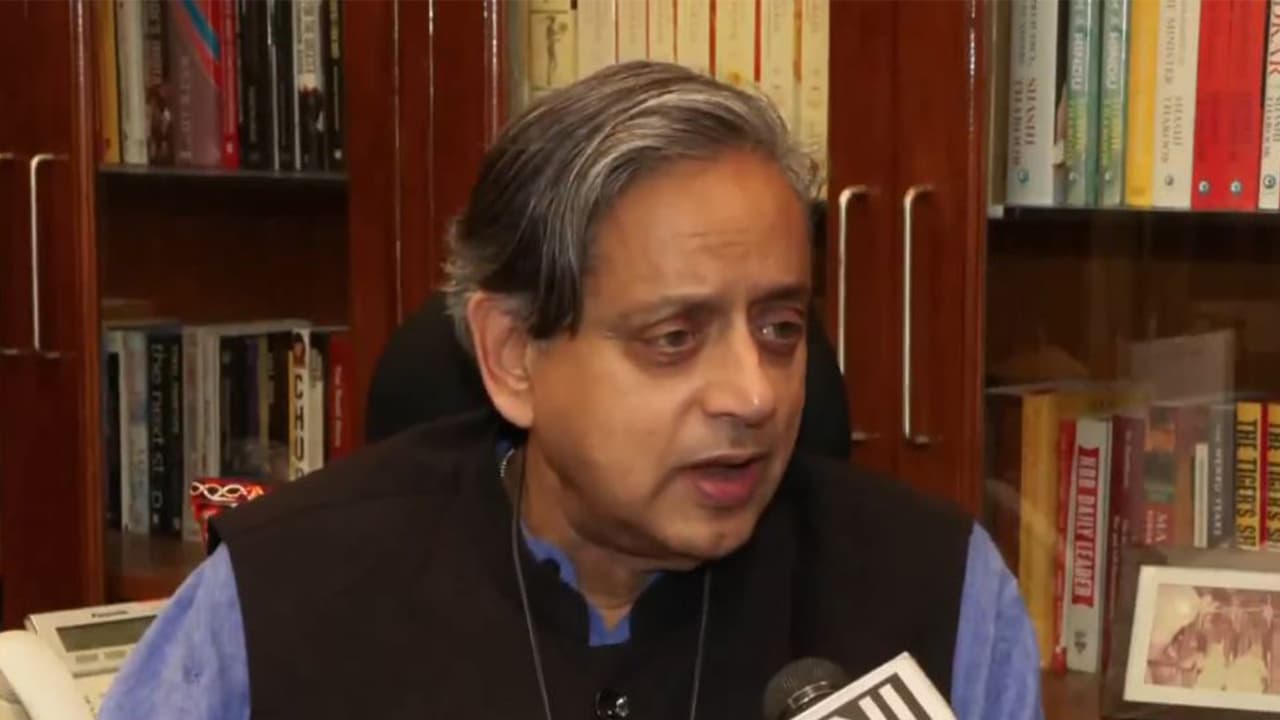
Shashi Tharoor welcomed the unveiling of C Rajagopalachari's statue at Rashtrapati Bhavan, praising his liberal values. The BJP's Shehzad Poonawalla lauded Tharoor's stance but criticized other opposition parties over the issue.
Congress MP Shashi Tharoor on Tuesday welcomed the unveiling of a statue of C Rajagopalachari at Rashtrapati Bhavan. He expressed pleasure at honouring Rajaji, the only Indian Governor-General, and reiterated admiration for his liberal economics, free enterprise, social justice and constitutional freedoms without communal bigotry.
I’m truly pleased to see Rajaji honoured by a statue at Rashtrapati Bhavan. He was its first Indian occupant as the only Indian Governor-General of India, before we became a Republic and he yielded his seat to the new President. I have long admired his convictions and was a… https://t.co/exNBJ0IFIN — Shashi Tharoor (@ShashiTharoor) February 23, 2026
Tharoor's Admiration for Rajaji's Principles
In a post on X, Tharoor wrote, "I'm truly pleased to see Rajaji honoured by a statue at Rashtrapati Bhavan. He was the first Indian occupant as the only Indian Governor-General of India, before we became a Republic, and he yielded his seat to the new President. I have long admired his convictions and was a strong supporter of his Swatantra Party in my student days. His set of values and principles, liberal economics and support for free enterprise, combined with social justice, strong anchoring in Indian civilisation and religious faith but without a shred of communal bigotry, and a staunch faith in the rights& freedoms guaranteed by the Constitution, including keeping the government out of our kitchens, bedrooms and libraries, remain mine to this day. It is sad that there are so few left to follow him today."
BJP Welcomes Tharoor's Stand, Slams Opposition
The Congress MP's endorsement drew a response from BJP national spokesperson Shehzad Poonawalla, who welcomed Tharoor's remarks but criticised sections of the opposition for allegedly prioritising colonial-era figures over Indian icons.
Congress and INDI split over Lutyens Lutyens’ bust has been replaced with Rajaji’s Bust One more step to rid ourselves of colonial baggage but CONGRESS, ILTIJI MUFTI, UDDHAV SENA OPPOSE IT Now, Shashi Tharoor has welcomed the move Sad that some in Congress put Lutyens… pic.twitter.com/FfNFQF8k7O — Shehzad Jai Hind (Modi Ka Parivar) (@Shehzad_Ind) February 24, 2026
In a post on X, a BJP spokesperson wrote, "Congress and INDI split over Lutyens' bust has been replaced with Rajaji's Bust. One more step to rid ourselves of colonial baggage, but CONGRESS, ILTIJI MUFTI, UDDHAV SENA OPPOSE IT Now, Shashi Tharoor has welcomed the move Sad that some in Congress put Lutyens above Rajaji Videshi above Swadeshi Colonial above Bharatiya."
Opposition's Concerns Over Erasing History
Earlier, UBT Sena MP was critical in her view of the replacement of the bust of architecht Edward Lutyens, "The future generation of India would only know of Bimal Hasmukh Patel architectural legacy because am certain whatever is left of Lutyens design history will be broken down, redesigned or repurposed under the narrative of ridding ourselves of our colonial history. Many countries preserve the heritage and legacy of their nation's lived history for generations to remember - the good, the bad and the ugly included to learn from but in new India we are hell bent on replacing it with shiny new glass domes or convention centres- with no soul or cultural context."
PM Modi Calls Unveiling a 'Moment of Pride'
On Monday, Prime Minister Narendra Modi said that the unveiling of the bust of Chakravarti Rajagopalachari, popularly known as Rajaji, at the historic central courtyard of Rashtrapati Bhavan is a moment of pride for the people of India.
In his message, the Prime Minister said the bust was unveiled by President Droupadi Murmu and described the occasion, along with the celebration of 'Rajaji Utsav', as a tribute to one of India's important nation-builders. "The unveiling of the bust of Chakravarti Rajagopalachari Ji, widely known as Rajaji, at the historic central courtyard of Rashtrapati Bhavan by the Honourable President is a moment of pride for the people of India. This occasion and the celebration of 'Rajaji Utsav' honour the memory of one of India's important nation-builders. The celebrations, including a book and panel exhibition, film screening and other cultural performances that are part of the 'Rajaji Utsav' are a great tribute to a towering leader...Today, Rashtrapati Bhavan stands not as a seat of power, but as a visible embodiment of democratic self-confidence rooted in Indian civilisation. Initiatives such as the 'Rajaji Utsav' and the unveiling of a bust of Shri Rajagopalachari Ji reinforce this direction. They honour leaders who shaped the nation and remind us that freedom is sustained by celebrating their memory", he said.
"Initiatives such as the 'Rajaji Utsav' and the unveiling of a bust of Shri Rajagopalachari Ji reinforce this direction. They honour leaders who shaped the nation and remind us that freedom is sustained by celebrating their memory," he added.
This comes after Prime Minister Narendra Modi on Sunday announced that the "Rajaji Festival" will be celebrated in Rashtrapati Bhavan on Monday with the unveiling of the statue of Chakravarti Rajagopalachari, the first Indian Governor-General of independent India. During the 131st 'Mann Ki Baat' episode, PM Modi said that the nation is leaving the symbols of slavery behind and beginning to relate to the Indian culture. "During the Azadi Ka Amrit Mahotsav, I spoke of the 'Panch-Pran' from the Red Fort. One of them is freedom from the mentality of slavery. Today, the country is leaving behind the symbols of slavery and has begun to value symbols related to Indian culture," he said.
Who was C Rajagopalachari?
C Rajaopalachari was born on December 10, 1878, in Madras Presidency. He was a lawyer and intellectual among many other things. He is regarded as an early political comrade of Mahatma Gandhi, who left his legal practice to join the Indian National Congress and later participated in various protests against the British Crown. Most popularly, Rajagopalachari agitated against the Rowlatt Act, non-cooperation, and the Civil Disobedience movement. He was elected to the Constituent Assembly from Madras on a Congress ticket. He was part of the sub-committee on minorities and was conferred with the Bharat Ratna in 1954. (ANI)
(Except for the headline, this story has not been edited by Asianet Newsable English staff and is published from a syndicated feed.)