Samrat Choudhary has been named Bihar’s new CM, ending Nitish Kumar’s long tenure. Once a strong critic of Nitish, Choudhary had taken a public vow to remove him from power. With over 30 years in politics and strong OBC support, he now leads BJP's first govt in Bihar. His journey reflects Bihar's changing alliances and complex political landscape.
A big political shift in Bihar Bihar has witnessed a major political change with Samrat Choudhary being named the new Chief Minister. The development marks the end of Nitish Kumar's long hold over the post, which lasted for nearly two decades. Nitish Kumar, who had been one of the most powerful leaders in Bihar since 2005, stepped down after being elected to the Rajya Sabha. His resignation has opened the way for a new leadership under the Bharatiya Janata Party (BJP). For the first time, the BJP will directly lead the Bihar government, marking a historic shift in the state’s politics.
How Samrat Choudhary was chosen
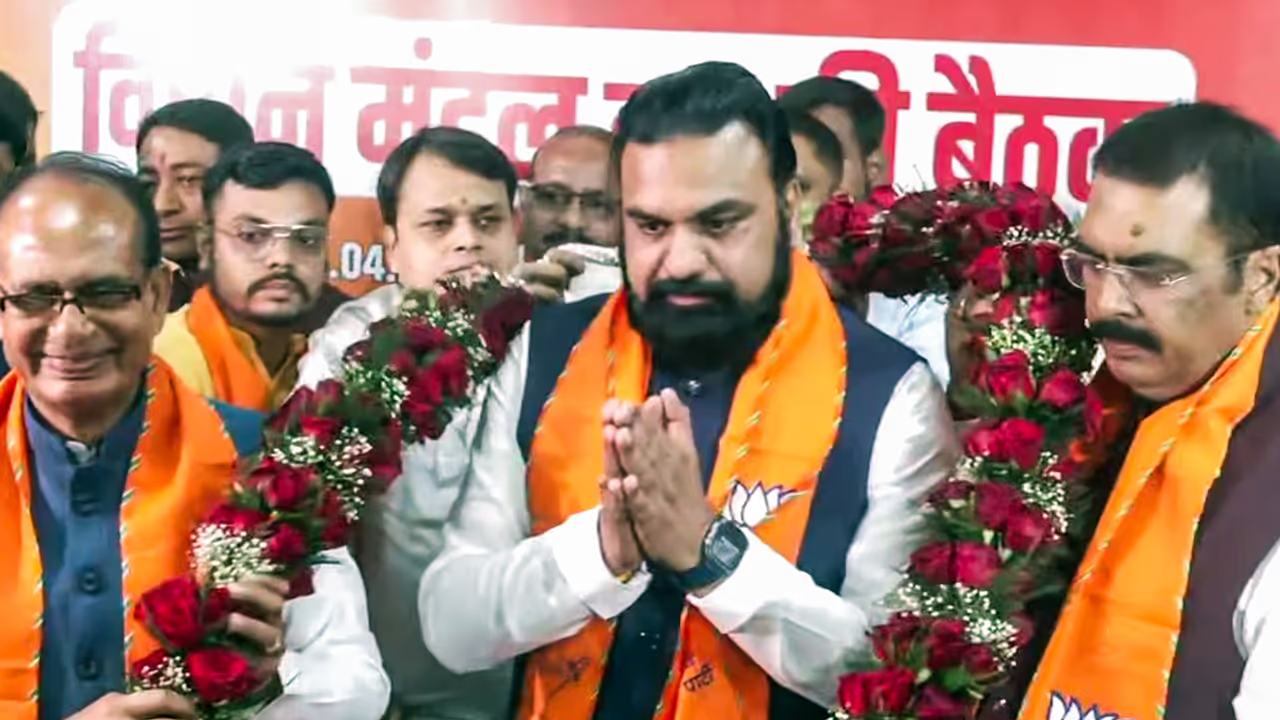
Samrat Choudhary, 57, is currently a Deputy Chief Minister and BJP MLA from Tarapur. His name was finalised after a key BJP legislature party meeting held in Patna. Senior leaders including Vijay Sinha, Mangal Pandey, Dilip Jaiswal and Renu Devi proposed his name. Union Minister Shivraj Singh Chouhan, who attended as the central observer, confirmed that Choudhary was elected unanimously. The swearing-in ceremony is expected to take place at Lok Bhavan in Patna on Wednesday.
Related Articles

From critic to successor
One of the most interesting parts of Choudhary’s journey is his past rivalry with Nitish Kumar. Nearly three years ago, when Nitish Kumar was leading a Mahagathbandhan government with RJD, Congress and Left parties, Choudhary made a strong public vow. During a debate in the state assembly, Nitish asked him why he always wore a traditional muretha (turban). Choudhary replied that it was his 'sankalp' to remove Nitish Kumar from the Chief Minister’s post. He said he would only remove the turban after Nitish was no longer in power. This vow became a symbol of BJP’s aggressive stand against the ruling alliance at that time.
The turban vow and its unexpected turn
However, Bihar politics is known for sudden changes. In January 2024, Nitish Kumar left the Mahagathbandhan and returned to the NDA. This move technically fulfilled Choudhary's vow, as Nitish was no longer leading the earlier alliance. Soon after, in July 2024, Choudhary travelled to Ayodhya. There, he took a dip in the Sarayu river, shaved his head and offered his muretha at the Ram Janmabhoomi temple.
He described it as completing his vow and dedicating it to Lord Ram. The move came around 22 months after he had made the promise.
On his decision, Choudhary told ANI, "True that I had pledged to wear the turban until I made Nitish Kumar resign as the Chief Minister. But now that he has switched back to the National Democratic Alliance (NDA) after resigning as the Chief Minister of the INDI Alliance, it is time for me to dedicate this turban to the feet of Lord Ram. The day Nitish Kumar ji resigned as the Chief Minister of the INDI-Alliance and joined back the NDA, I announced that I would dedicate my turban to Lord Ram."
Opposition criticism
The Rashtriya Janata Dal (RJD) criticised Choudhary’s actions. Party spokesperson Shakti Singh Yadav said, as quoted by India Today, that a vow should be honoured fully. He quoted a traditional line, saying that one should keep their promise even at great personal cost. The criticism suggested that Choudhary had ended his vow too early. Despite this, the BJP continued to back him strongly.
A seasoned political journey
Samrat Choudhary has over three decades of experience in politics. He began his career in the 1990s and has been part of several key political phases in Bihar. He first joined the Rashtriya Janata Dal (RJD) and became an MLA from Parbatta in 2000. He also served as a minister in the Rabri Devi government. Later, in 2014, he moved to the Janata Dal (United) and served in the government led by Jitan Ram Manjhi. In 2017, he joined the BJP. This move played a major role in shaping his future. Within the party, he rose quickly and became the Bihar unit president in 2023.
Strong social and political base
Choudhary belongs to the Kushwaha (Koeri) community, which is a key part of Bihar's OBC population. Along with the Kurmi community linked to Nitish Kumar, this group forms an important voting base in the state. His strong connection with these communities makes him a valuable leader for the BJP, especially with elections approaching. He is seen as both a strategist and a leader who can connect with people on the ground.
Experience in governance
As Deputy Chief Minister since 2024, Choudhary has handled important departments such as finance, urban development and panchayati raj. These roles have given him practical experience in managing the state’s administration. His supporters believe this makes him well prepared for the top job.
Family background in politics
Choudhary comes from a political family. His father, Shakuni Chaudhary, was a six-time MLA from Tarapur. His mother, Parvati Devi, was also a legislator. This background helped him enter politics at a young age and build strong connections over the years.
A message after elevation
After being chosen as the Chief Minister, Samrat Choudhary thanked the BJP leadership for trusting him. He said the role was a “sacred opportunity” to serve the people of Bihar. He also praised Nitish Kumar’s governance model and said it would guide the new government. Choudhary promised to work with dedication and honesty to meet the expectations of the people.
This leadership change signals a new phase in Bihar politics. With BJP now directly leading the government, the focus will be on governance, development and political stability. Choudhary’s appointment also shows the party’s strategy to strengthen its base among OBC and backward communities. At the same time, Bihar’s history of shifting alliances means that political developments will continue to be closely watched.
(With ANI inputs)