
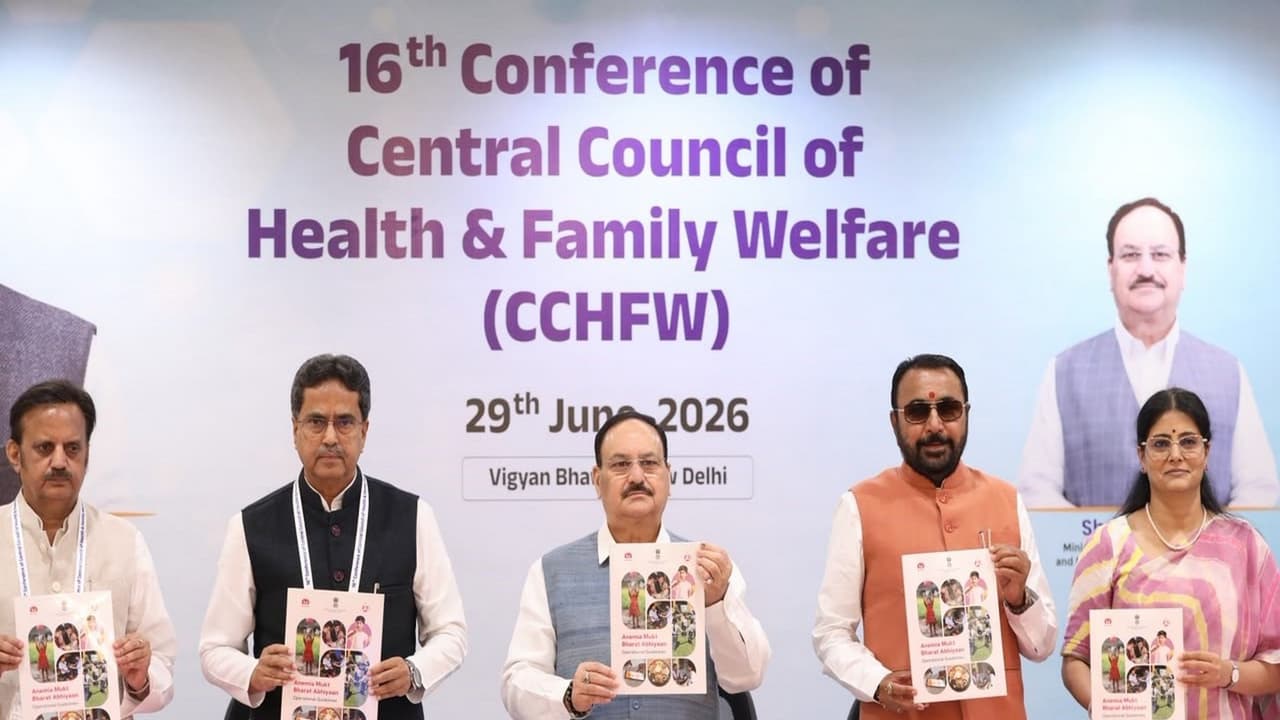
The 16th CCHFW conference, chaired by Union Health Minister JP Nadda, focused on bolstering India's public health system. Key initiatives were launched, including guidelines for ambulance services and new programs for maternal and child health.
The 16th Conference of the Central Council of Health and Family Welfare (CCHFW) was held on Monday under the chairmanship of Union Minister of Health and Family Welfare Jagat Prakash Nadda, focusing on strengthening India's public health system and enhancing Centre-State collaboration.
According to an official statement from the Health Ministry, the Conference served as an important platform to review the progress of key national health programmes, deliberate on emerging public health priorities and further strengthen coordination between the Centre and States to improve healthcare delivery across the country.
Vision for a 'Viksit Bharat'
Addressing the Conference, Union Minister Nadda said that under the leadership of Prime Minister Narendra Modi, India has set a vision of becoming a "Viksit Bharat" by 2047, when the nation completes 100 years of Independence. He emphasised that a developed India cannot be achieved without a healthy population, calling health one of the most critical pillars of national development.
The Union Health Minister highlighted that the last twelve years have witnessed transformational changes in India's healthcare sector. He noted that the National Health Policy, 2017, marked a paradigm shift in the country's healthcare approach by shifting the focus from predominantly curative care to a holistic, inclusive and comprehensive healthcare system encompassing preventive, promotive, curative, palliative and rehabilitative care.
Nadda said that to deliver quality healthcare to nearly 1.5 billion people, the Government had focused on strengthening the foundation of the healthcare system. He informed that nearly 1.85 lakh Ayushman Arogya Mandirs have been established across the country, serving as the first point of contact for citizens while creating a robust linkage between primary, secondary and tertiary healthcare. He also stated that tertiary healthcare infrastructure has been significantly strengthened with the establishment of 23 new AIIMS and more than 157 medical colleges, with a focus on aspirational and underserved districts.
Major Healthcare Initiatives Launched
On the occasion, the Union Health Minister launched several landmark policy documents and programme initiatives aimed at strengthening healthcare delivery across the country.
Operational Guidelines on National Ambulance Services
Among the key initiatives launched was the Operational Guidelines on National Ambulance Services (NAS), 2026, a comprehensive framework that establishes uniform national standards for emergency medical transport services across all States and Union Territories. The Guidelines seek to enhance the quality, accessibility and efficiency of pre-hospital emergency care by standardising ambulance infrastructure, staffing, equipment, response protocols, digital integration and quality assurance mechanisms.
SUMAN Roadmap 2030
Nadda also released the SUMAN Roadmap 2030, a comprehensive strategic framework designed to strengthen maternal and newborn healthcare services across the country. The roadmap outlines targeted interventions to improve service quality, ensure respectful maternity care, reduce preventable maternal and neonatal deaths, and accelerate India's progress towards achieving the Sustainable Development Goals related to maternal and child health.
Samagra Shishu Bal Swasthya Karyakram (SSBSK)
The Conference also witnessed the launch of the Samagra Shishu Bal Swasthya Karyakram (SSBSK), a unified programme that integrates Home-Based Newborn Care (HBNC) and Home-Based Care for Young Child (HBYC) into a seamless continuum of care. The programme aims to strengthen community-based healthcare for children from birth to five years of age through regular home visits, early identification of illnesses, counselling on nutrition and child development, and timely referrals whenever required.
Anaemia Mukt Bharat Abhiyaan
Another major initiative launched during the Conference was the Anaemia Mukt Bharat Abhiyaan, marking the next phase of India's efforts to eliminate anaemia as a public health concern. Building upon the achievements of the Anaemia Mukt Bharat programme, the revamped initiative expands its scope through saturation-based screening, digital beneficiary tracking, case-based management, strengthened nutrition interventions and a stronger emphasis on dietary diversification and behaviour change communication across all beneficiary groups.
The Conference concluded with a renewed resolve by the Centre and States to work together in achieving the vision of a healthier India through stronger public health systems, enhanced service delivery and people-centric healthcare reforms. (ANI)
(Except for the headline, this story has not been edited by Asianetnews Editorial staff and is published from a syndicated feed.)