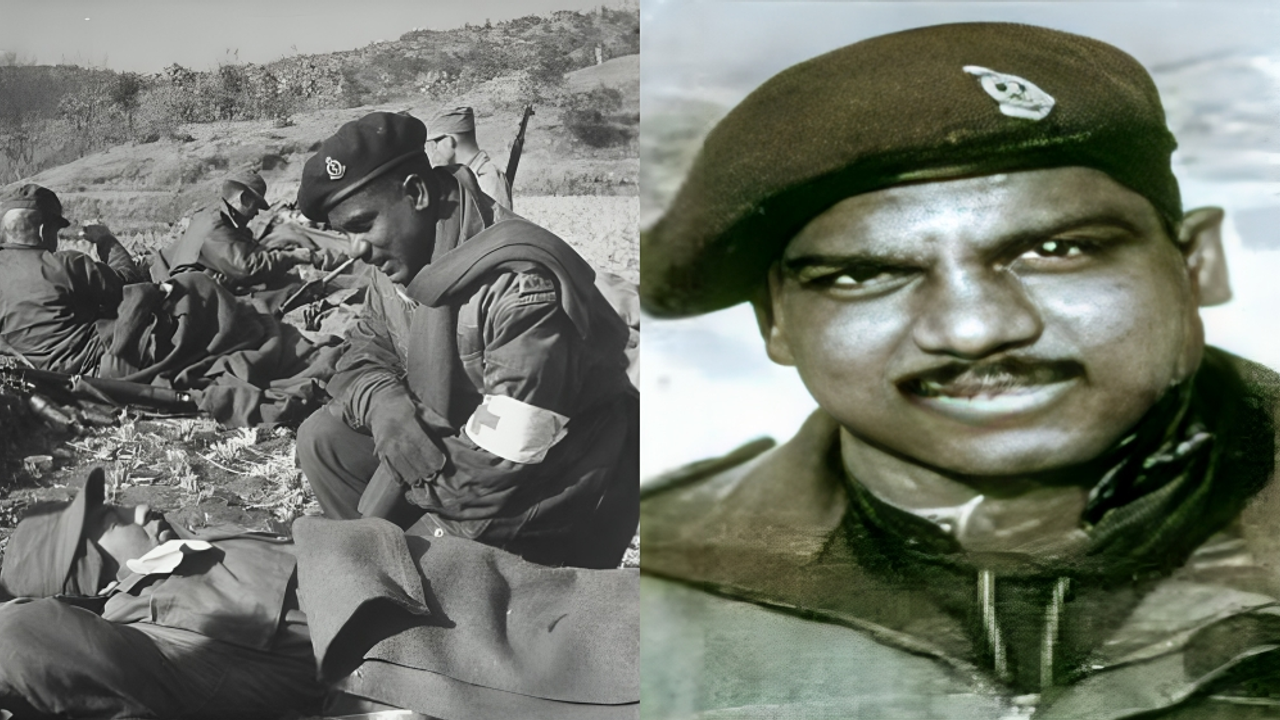
Lt Col Dr Arcot Rangaraj, India’s first paratrooper doctor, served heroically in Korea and helped wipe out smallpox in Afghanistan. His untold story is one of courage, medical brilliance, and global service.
Lieutenant Colonel Dr Arcot G Rangaraj made history in 1941 when he became one of India’s first paratroopers, alongside Havildar Major Mathura Singh. Born in 1917, he studied medicine at Madras Medical College before joining the Indian Medical Service. He trained as a paratrooper at Delhi’s Willingdon Air Landing School (now Safdarjung Airport), combining medical service with military bravery.
A hero in World War II and Kashmir
During World War II, Dr Rangaraj served on the Manipur front, treating Indian soldiers during Japan’s Burma campaign, as per The Better India feature. After Independence, he headed the 60th Parachute Field Ambulance unit, which operated in Kashmir from 1948-49. There, his team ran the ‘Cariappa Hospital’ under tough weather and supply shortages, serving soldiers near the frontlines.
Related Articles

India's answer to Korea's medical crisis
When the Korean War broke out in 1950, newly independent India offered help. Dr Rangaraj’s unit, the 60th Parachute Field Ambulance, was sent on a medical mission under the UN flag. They arrived in Busan in November 1950 and immediately supported the 27th British Commonwealth Brigade in intense war zones.
Despite minimal resources and extreme conditions, Dr Rangaraj and his team treated over 2,00,000 patients and performed 2,300 surgeries during their 39-month deployment. Their efficiency earned praise from US commanders and the nickname “Angels in Maroon Berets” from locals.
A risky jump into enemy territory
In March 1951, Dr Rangaraj was one of 12 Indian officers who volunteered to parachute with 3,400 American troops into enemy territory. The mission aimed to disrupt Chinese and North Korean supply lines. The planned support never came. Stranded in freezing conditions with little more than tea and biscuits, Dr Rangaraj and his men still managed to carry out emergency surgeries and save lives.
Honours from South Korea
For his bravery and service, Dr Rangaraj received the Chungmu Distinguished Military Service Award, South Korea’s third-highest military honour. Three members of his unit received the same. In India, he was awarded the Maha Vir Chakra, the second-highest gallantry award.
The unit earned six Vir Chakras and honours from the UN and US as well.
In July 2020, the South Korean government named him their “Hero of the Month”. His photos were displayed in Korean schools as part of history lessons on the war.
From war doctor to disease warrior
After retiring from the Army in 1966, Dr Rangaraj didn’t stop serving. He earned a diploma in Public Health and worked with the World Health Organization (WHO). He became the senior WHO adviser on smallpox eradication in Afghanistan in 1969, teaming up with Dr Abdul Mohammad Darmanger. Together, they built Afghanistan’s first national health programme, a key reason for the region’s successful smallpox eradication.
He later supported eradication efforts in Bangladesh and the Arabian Peninsula. His optimism and leadership inspired his teams even during the hardest times.
A lifetime of service
Dr Rangaraj passed away in 2009 at the age of 92. From battlefield surgeries to public health victories, his life remains a shining example of service, both to India and to the world. His story, rarely told in mainstream histories, deserves to be remembered.