
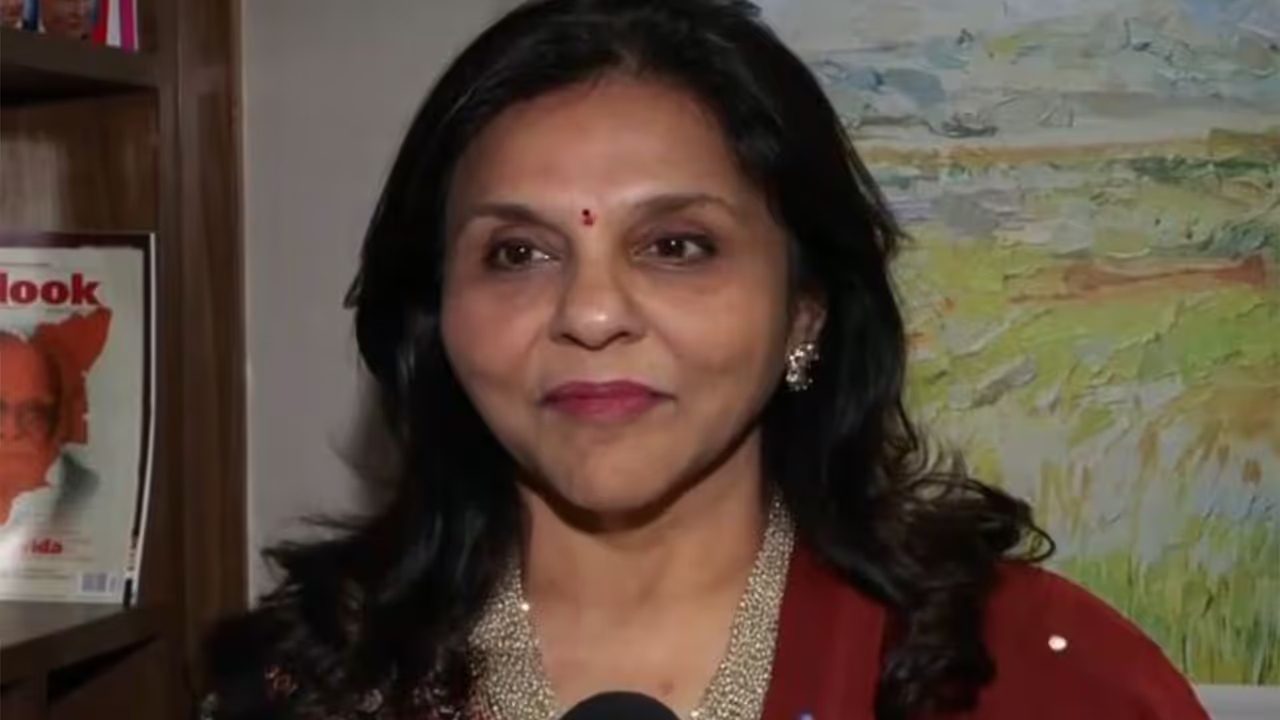
India and Russia are poised to deepen their healthcare partnership, says Apollo's Sangita Reddy, citing Russia's demand for Indian pharma, expanding medical tourism, and transformative AI-driven innovations in healthcare like robotics and predictive analysis.
Deepening India-Russia Healthcare Partnership
India and Russia are poised to deepen their healthcare partnership, said Apollo Hospitals' Joint Managing Director Sangita Reddy, highlighting Russia's growing demand for Indian pharmaceuticals, expanding medical tourism, and transformative AI-driven innovations. In an exclusive interview with ANI on India-Russia ties in the healthcare sector, Joint Managing Director of Apollo Hospitals, Sangita Reddy, said, "I think it's always been well known that Russia is one of the largest markets for the Indian pharmaceutical sector, and therefore the agreement echoed the need that Russia has towards buying Indian pharmaceuticals."
On opportunities for both countries in healthcare, she said, "There is also an opportunity for Russians because there is a shortage of healthcare in Russia. In Moscow and its major cities, they have very advanced healthcare, but for the whole population, India offers affordable healthcare of high quality, and therefore, that is also being explored, and the Russians will be coming to India for surgery."
Artificial Intelligence Redefining the Healthcare System
On artificial intelligence redefining the Healthcare system, she said, "This is a large, comprehensive and complex subject. You can look at AI in what it can move from operationalising efficiencies, whether it's in supply chain or predictive analytics or staffing, or reduction of manpower. But, the area that Apollo is very interested in and working at a tremendous pace is the use of AI in medical areas."
AI in Predictive Analysis and Risk Scoring
"So first we have a framework which looks at the ethics, the applicability, the ease of use of and the explainability of that AI. Then we divide it into the first risk scoring and predictive analysis. So our cardiovascular risk score, which was built almost six years ago in partnership with Microsoft, has been validated by many global universities, and as of now, we have over 2 million API calls on this. Its efficacy, its accuracy and prediction have also been proven to be extremely high by third-party analysis," she added.
Early Warning Systems and Consumer Connectivity
Explaining the role of AI in early picking of warning symptoms, Reddy said, "So the propensity to a certain degree, the prediction of, you know, and the picking up of early warning symptoms, like in our intensive care. So we monitor ICUs within our environment, as well as outside. In small nursing homes, we bring them into a central command station, which is manned by doctors and nurses."
"And on top of that, we have an AI which is called an EWS early warning system, which picks up any changes in the ECG and the heart rate and the combined signals which are coming from the patient to say, this patient could probably go into a deterioration in the next four hours. So it picks up these simple signals earlier. And I think that is one of the biggest advancements. But AI is also playing a tremendous role across consumer connectivity," she added.
AI-Powered Robotic Surgery
Moreover, she further explained the use of the Robotic system for different types of surgeries with the help of AI. "One of the exciting things is combining it with existing advanced technologies, like today, we are at the Apollo Spectra on Pusa Road, where we have just launched two robots. So if you combine the AI image 3D reconstruction and then plan the surgery, and then feed this into the robotic system, the precision that you have by using robotics enables a much better surgery. And of course, robotics minimises blood loss, minimises damage to tissues, and therefore enables a faster recovery," she added. (ANI)
(Except for the headline, this story has not been edited by Asianet Newsable English staff and is published from a syndicated feed.)