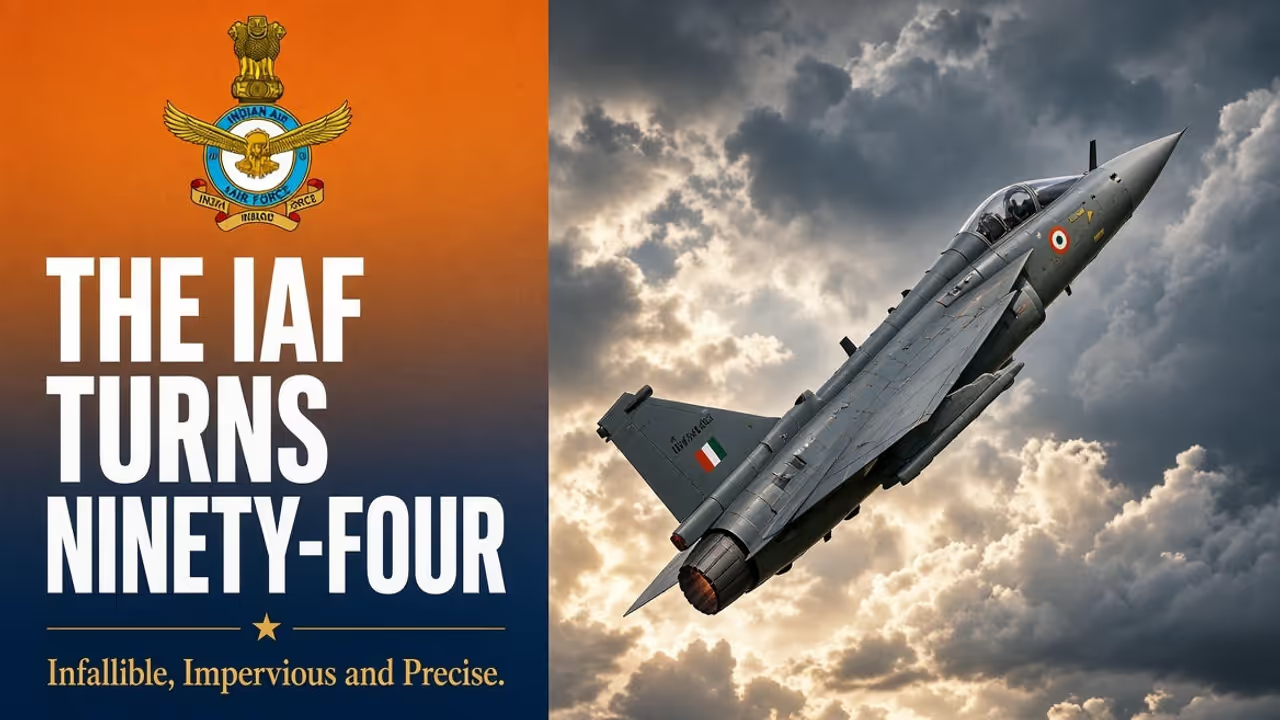
IAF commemorated its 94th Air Force Day at Hindon Base on 8 October 2026. Air Chief Marshal A. P. Singh unveiled the new motto, "Infallible, Impervious and Precise," hailing the force's combat speed during Operation Sindoor. The event showcased frontline assets alongside joint international drills under Exercise Tarang Shakti 2026.
On the morning of 8 October 2026, Air Chief Marshal A. P. Singh arrived at Hindon Air Force Station in Ghaziabad not in a modern staff car but in a vintage vehicle from the 1960s. Three helicopters swept overhead in the Dhwaj formation, flags riding the wind. Beside him stood Army chief General Dhiraj Seth and Navy chief Admiral Krishna Swaminathan, with former air chiefs, veterans and families. The parade had returned to Hindon after three years, polished by a full rehearsal on 6 October.
This year's words are simple and stern: "Indian Air Force – Infallible, Impervious and Precise." Infallible is the promise that a mission will be finished, the way a night watchman is expected to stay awake till dawn. Impervious is the shield that does not let a blow through, the way a sound roof keeps a monsoon out. Precise is the arrow that finds the mark and nothing else. The Air Chief told the parade that these are not slogans. They are what the force showed when the world watched how fast it moved into combat during Operation Sindoor. Last year's line, "Saksham, Sashakt, Atmanirbhar" — capable, powerful and self-reliant — had honoured aircraft built at home, among them the Tejas, the coming Advanced Medium Combat Aircraft and the Light Combat Helicopter.
On the tarmac sat Rafale, Su-30MKI, Jaguar and Tejas fighters, the Prachand attack helicopter and the Dhruv. For the first time at such a gathering, the Akash air-defence missile and the BrahMos stood in the static line. Mi-17 helicopters were to bear the National Flag, the IAF flag and the Operation Sindoor flag. The flypast brought those fighters, the heavy C-17 and Apache helicopters. Presidential awards followed the review.
Related Articles

Numbers explain why the day feels larger than a parade. The Global Air Powers Ranking 2026 places the IAF sixth among all flying arms, a list that also counts US Navy, Army and Marine aviation. The top five are the United States Air Force (242.9 points, 5,004 aircraft), the US Navy (142.4, 2,504), the Russian Air Force (114.2, 3,677), US Army aviation (112.6, 4,333) and US Marine Corps aviation (85.3, 1,211). Count only independent air forces, and India stands third, behind the United States Air Force and Russia, and ahead of China.
The IAF scores 69.4 on the TrueValue Rating, with 1,716 active aircraft. China's air arm, seventh overall, scores 63.8 with a much larger inventory of about 3,733 aircraft. The rating is less a headcount than a report card. It asks what kinds of aircraft a force owns, and whether the mix can fight, lift, watch and refuel. A bigger hangar does not automatically mean a stronger sky. That report card, though, was not written in a single year. It was earned by a service that once had almost nothing to fly.
On 8 October 1932, under British rule, the young force existed only to assist the Royal Air Force. It began with four Westland Wapiti biplanes, cloth and wood against a sky it did not yet own. No. 1 Squadron took shape in 1933. When India became a republic in 1950, the word "Royal" was dropped. The tests came quickly: Jammu and Kashmir in 1947–48, the wars of 1965 and 1971, the heights of Kargil, and Operation Sindoor. The Air Chief called it a journey from those four biplanes to a force linked across domains. Readiness of the kind counted today grew out of that bare-bones survival.
The same morning, far to the west, Jodhpur opened its sky. The Suryakiran team, nine Hawk Mk-132 jets, and the Sarang team, five Dhruv helicopters, drew tricolour smoke and tight shapes above the base. Defence Minister Rajnath Singh was expected, with NCC cadets in the crowd. The show sat inside Tarang Shakti 2026, running from 26 September to 12 October, where Indian crews train with air forces from the United States, France, Australia, the UAE, Germany, Sri Lanka and Bangladesh. This year a US F-35 stealth fighter flew in an Indian exercise for the first time.
Later this month the celebration moves to Kashi. A public display over the Ganga at Varanasi is set for 24–26 October, the main show on the 25th near Namo Ghat. In Delhi and at stations across the country, veterans will be honoured in halls that remember names more than machines.
Between sorties the work is quieter. A technician checks a bolt before dawn. A pilot trusts that check with his life. A family waits. The force guards airspace, fights for control of the sky, carries troops and supplies, watches from above, and reaches people after floods and earthquakes. Ninety-four years on, the aircraft are only as steady as the hands that keep them so.
(Girish Linganna is an award-winning science communicator and a Defence, Aerospace & Geopolitical Analyst. He is the Managing Director of ADD Engineering Components India Pvt. Ltd., a subsidiary of ADD Engineering GmbH, Germany.)